

Court’s decision
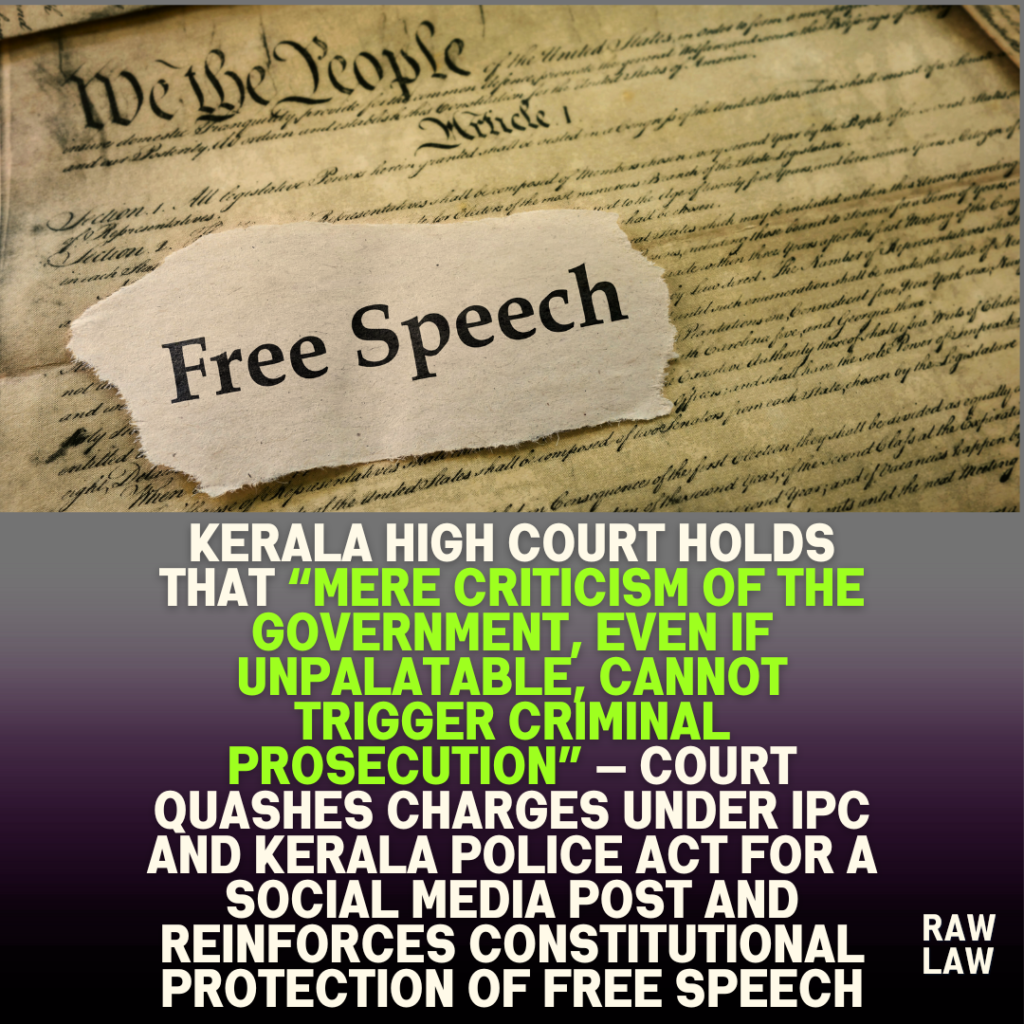
The Kerala High Court delivered a decisive ruling reaffirming constitutional free-speech protections, holding that a citizen cannot be prosecuted merely for expressing criticism of the Government through a social media post. The Court observed: “fear of setback to Government’s initiatives, due to expression of opinion or dissent by a citizen, cannot result in Article 19(2) being brought into play.”
The Court examined each invoked provision—Section 505(1)(b) IPC and Sections 118(b), 118(c) and 120(o) of the Kerala Police Act—and held that none of the statutory ingredients were satisfied. It found the prosecution to be an abuse of process, noting that the Petitioner’s Facebook comment did not cause fear, alarm, nuisance, false alarm, or any damage to essential services. Accordingly, the High Court allowed the petition and quashed the final report and all further proceedings, concluding that criminal law cannot be weaponised to silence dissent.
Facts
The Petitioner was booked in a police-initiated case arising from a Facebook post made on 11 August 2019. The comment criticised the Government’s call for contributions to the Chief Minister’s Distress Relief Fund, suggesting that direct assistance to those affected would be more transparent. The police registered a suo motu case alleging that the post was capable of misleading the public and undermining relief efforts. The prosecution invoked Section 505(1)(b) IPC and Sections 118(b), 118(c) and 120(o) of the Kerala Police Act. The matter later proceeded as a calendar case before the Magistrate.
The Petitioner approached the High Court seeking quashing, asserting that the post amounted to legitimate political criticism protected by Article 19(1)(a) of the Constitution. The Petitioner contended that the allegations, even if accepted at face value, disclosed no offence, and that continuing prosecution would violate constitutional freedoms and constitute abuse of criminal process.
Issues
The High Court considered several key issues:
- Whether a Facebook post containing criticism of governmental relief initiatives meets the threshold for restricting free speech under Article 19(2).
- Whether the ingredients of Section 505(1)(b) IPC—intent to cause fear or alarm capable of inducing an offence—were satisfied.
- Whether the post constituted spreading rumours, false alarm, damage to essential services, or nuisance under the Kerala Police Act.
- Whether continuation of proceedings would amount to abuse of process in light of constitutional protections.
Petitioner’s arguments
The Petitioner argued that the right to criticise elected Governments is integral to democracy and cannot be curtailed merely because criticism causes discomfort. The content of the post did not relate to national security, sovereignty, public order, or any ground under Article 19(2), and therefore criminalising such speech would violate constitutional guarantees. The Petitioner contended that the post neither caused fear nor instigated the public to commit any offence, and thus Section 505(1)(b) IPC was inapplicable. He further asserted that Sections 118(b), 118(c) and 120(o) of the Kerala Police Act require intentional spread of false alarms or repeated nuisance, none of which were present.
The Petitioner placed reliance on the Kerala High Court’s earlier decision in Gowri Sankari v. State of Kerala, arguing that criminal prosecution cannot be used to silence citizen criticism. He emphasised that a single Facebook post, expressing an opinion about Government policy, does not amount to any penal conduct and that invocation of the Kerala Police Act in such circumstances would be unconstitutional and disproportionate.
Respondent’s arguments
The Respondent contended that the State had undertaken urgent relief initiatives at the relevant time and that public criticism could undermine trust in administrative measures. It was argued that the post was capable of discouraging contributions to Government relief funds, thereby affecting essential services of public welfare. The Respondent submitted that the call for funds constituted an essential public service for disaster victims and therefore fell within the protective ambit of the Kerala Police Act.
The Public Prosecutor argued that prevailing circumstances must be considered and that statements which may appear harmless in isolation could, in context, derail collective public efforts. The prosecution also maintained that the comment had the potential to mislead sections of the public and warranted criminal investigation to prevent misinformation affecting relief operations.
Analysis of the law
The Court analysed free-speech jurisprudence, drawing upon the Supreme Court’s landmark ruling in Shreya Singhal v. Union of India to emphasise that restrictions under Article 19(2) apply only when speech amounts to incitement or creates a real propensity for disorder. The Court held that casual criticism of Government policy, even if harsh or exaggerated, enjoys constitutional protection. It noted that criminal law cannot be used to stifle political dissent or regulate narrative management by the State.
The Court examined the statutory ingredients of Section 505(1)(b) IPC and found no evidence of intent to cause fear or alarm. It held that the offence requires a real likelihood of inducing the public to commit an offence against the State or public tranquility, which was wholly absent. Turning to Sections 118(b) and 118(c) of the Kerala Police Act, the Court adopted a strict interpretation since they are penal provisions, concluding that “essential services” under these sections refer only to services mandated under Section 82—such as police, fire brigade, and emergency responders—not voluntary disaster relief donations.
Precedent analysis
The Court relied heavily on Shreya Singhal, which established that mere annoyance or unpalatable criticism cannot justify criminal prosecution unless it reaches the level of incitement. It also referred to its own decision in Gowri Sankari, reinforcing that political dissent is constitutionally protected and cannot be penalised under overbroad state laws. These precedents significantly guided the Court’s conclusion that criminal action in the present case lacked legal foundation.
While the Respondent attempted to rely on the Essential Services Maintenance Act, the Court clarified that the statutory definition could not be imported into the Kerala Police Act. Penal statutes must be applied strictly and cannot be expanded through interpretation to criminalise otherwise lawful speech.
Court’s reasoning
The Court’s reasoning centred on safeguarding democratic freedoms. It held that the Petitioner’s comment, though critical, did not threaten public order or national security. Criminal law cannot be triggered solely because views expressed are unfavourable to the Government. The Court stated that the comment did not induce panic, did not mislead essential services, and did not constitute repeated nuisance. Each offence failed on its statutory ingredients.
The Court concluded that continuing prosecution would chill free expression and create a precedent allowing criminal law to be misused against dissent. Therefore, it quashed the final report and all proceedings pending before the Magistrate. The judgment stands as a reaffirmation that constitutional democracy thrives on free criticism, debate, and dissent.
Conclusion
The Kerala High Court allowed the Petition, holding that prosecution for a single Facebook post lacked legal and constitutional basis. The Court held that none of the offences under IPC or the Kerala Police Act were made out and that the Petitioner’s right to free speech was impermissibly curtailed. The ruling reinforces that criminal law cannot be invoked to silence citizens who critique Government decisions, and that dissent remains an essential facet of democratic life.
Implications
This judgment has wide-ranging implications for free-speech jurisprudence. It restricts the use of penal provisions to suppress online dissent, especially under broadly worded state statutes. It provides clarity that essential services under the Kerala Police Act cannot be expanded to include voluntary fundraising efforts. It also highlights the judiciary’s role in preventing misuse of criminal process to stifle criticism. The ruling will likely influence similar cases involving social-media-based allegations of misinformation or political criticism.


