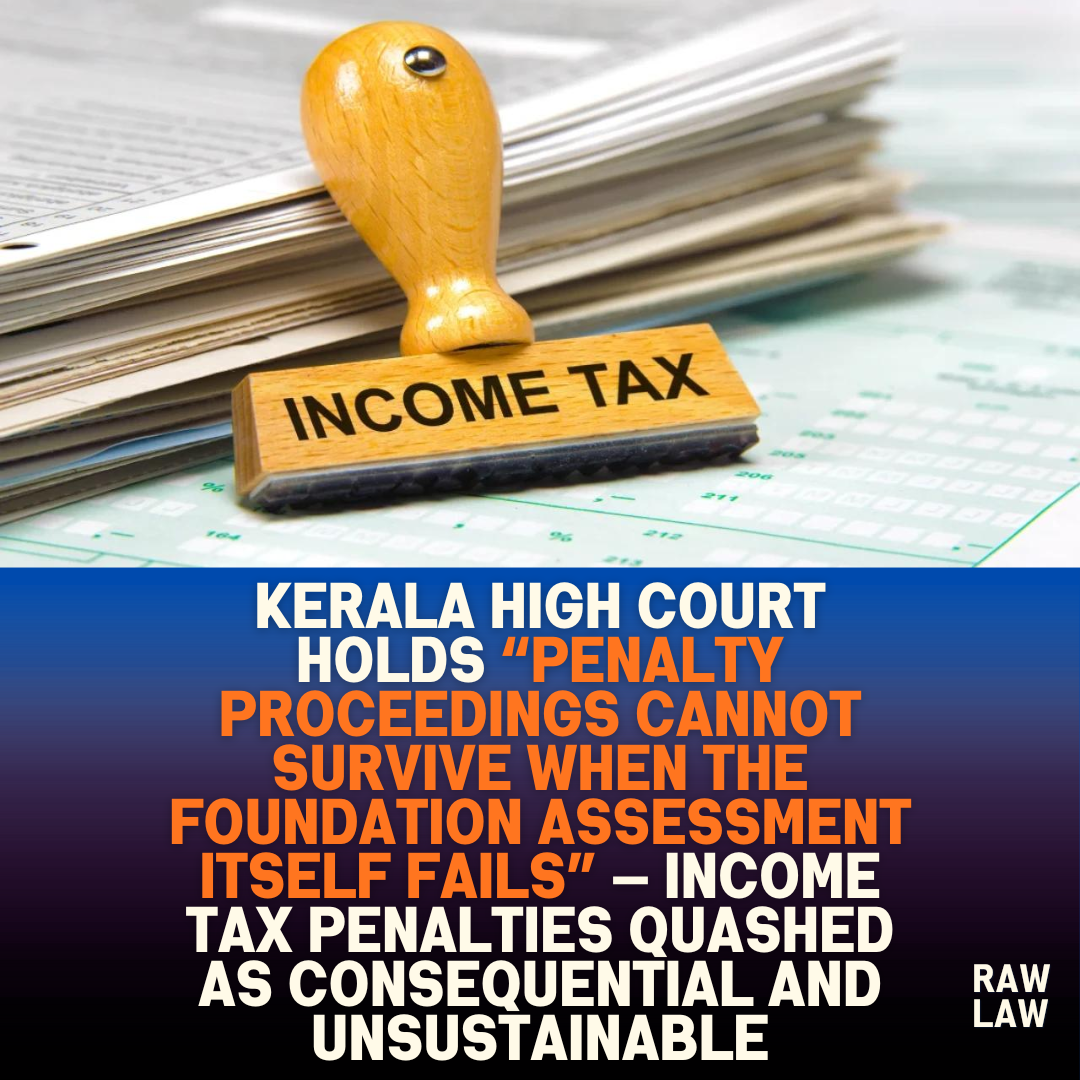
Kerala High Court holds “penalty proceedings cannot survive when the foundation assessment itself fails” — income tax penalties quashed as consequential and unsustainable

Court’s decision
The Kerala High Court allowed the appeals and set aside the penalty orders passed under the Income Tax Act, holding that penalty proceedings cannot independently survive when the very basis of the assessment has been annulled. The Court reiterated the settled principle that penalty is a consequential proceeding and must necessarily fall once the substantive additions giving rise to the penalty are set aside.
The Court found that the appellate authorities had already deleted the additions made by the Assessing Officer on which penalty proceedings were founded. In such circumstances, continuation of penalty proceedings was held to be legally impermissible. The Court rejected the Revenue’s contention that penalty proceedings are independent and can continue irrespective of the fate of the assessment.
Accordingly, the Court quashed the impugned penalty orders and allowed the appeals in favour of the assessees.
Facts
The assessees were subjected to assessment proceedings under the Income Tax Act resulting in additions to their declared income. Based on these additions, the Assessing Officer initiated penalty proceedings alleging concealment of income and furnishing of inaccurate particulars.
The assessees challenged the additions before the appellate authorities. The appellate forums, upon examining the merits, deleted the additions holding that the assessment was unsustainable. Despite this, the penalty proceedings initiated on the basis of the deleted additions were continued and culminated in penalty orders against the assessees.
Aggrieved by the levy of penalties despite deletion of the substantive additions, the assessees approached the High Court challenging the penalty orders as illegal and without jurisdiction.
Issues
Whether penalty proceedings can be sustained when the additions forming the basis of penalty are deleted.
Whether penalty under the Income Tax Act is independent of the assessment proceedings.
Whether continuation of penalty proceedings after annulment of assessment violates settled principles of tax jurisprudence.
Whether the penalty orders were legally sustainable in the facts of the case.
Petitioner’s Arguments
The assessees contended that penalty proceedings are purely consequential in nature and cannot survive in the absence of a valid assessment. It was argued that once the appellate authorities deleted the additions, there remained no foundation for alleging concealment or furnishing of inaccurate particulars.
The assessees submitted that the Revenue’s argument of penalty being independent of assessment was misconceived and contrary to settled law. It was contended that penalty presupposes existence of taxable income and a finding of concealment, both of which were absent after deletion of additions.
The assessees relied on binding Supreme Court and High Court precedents holding that penalty cannot be levied where the assessment itself fails.
Respondent’s Arguments
The Revenue contended that penalty proceedings are distinct from assessment proceedings and that deletion of additions does not automatically nullify penalty proceedings. It was argued that penalty can still be sustained if concealment or furnishing of inaccurate particulars is independently established.
The Department submitted that the Assessing Officer had recorded satisfaction regarding concealment at the time of initiating penalty and that such satisfaction was sufficient to sustain the penalty orders.
The Revenue therefore sought to uphold the penalty orders as valid and lawful.
Analysis of the law
The High Court analysed the scheme of penalty provisions under the Income Tax Act and reiterated that penalty is not an automatic consequence of addition but is dependent on existence of concealment or furnishing of inaccurate particulars of income.
The Court held that when the addition itself is deleted on merits, the very substratum of the penalty proceedings disappears. In such a scenario, there remains no income in respect of which concealment can be alleged.
The Court further held that while penalty proceedings are separate in form, they are dependent in substance on the assessment. Independence of penalty does not extend to survival of penalty in absence of a valid assessment.
Precedent Analysis
The Court relied on authoritative Supreme Court decisions holding that penalty cannot survive where the quantum addition does not survive. Precedents clarifying that penalty proceedings are consequential and dependent on assessment were applied.
Judgments distinguishing cases where penalty was sustained despite partial relief on quantum were also examined, and the Court held that such cases were fact-specific and inapplicable where additions were entirely deleted.
These precedents decisively supported the assessees’ challenge.
Court’s Reasoning
The Court found that the appellate authorities had categorically deleted the additions forming the sole basis for penalty. It held that in absence of any surviving addition, there was no scope to examine concealment or inaccurate particulars.
The Court rejected the Revenue’s argument that penalty proceedings can continue independently, holding that such an approach would lead to absurdity and violate principles of fairness.
Accordingly, the Court concluded that the penalty orders were without jurisdiction and liable to be set aside.
Conclusion
The High Court allowed the appeals and quashed the penalty orders. It held that penalty proceedings cannot be sustained once the assessment additions are deleted.
Implications
This judgment reinforces the principle that penalty proceedings are consequential and cannot outlive the assessment. It provides strong protection to taxpayers against unwarranted penalties following successful challenges to assessments.
The ruling brings clarity and certainty to penalty jurisprudence under the Income Tax Act.