
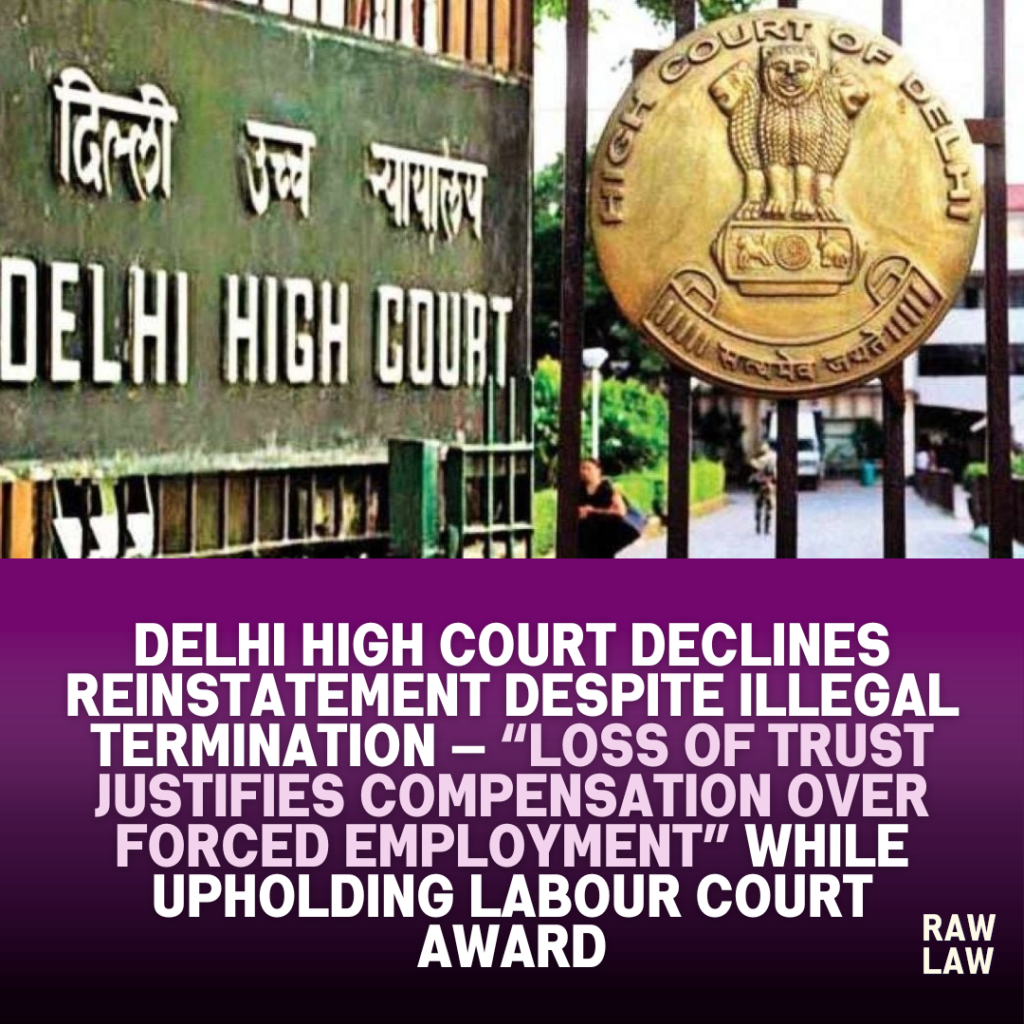

Court’s decision
The Delhi High Court dismissed a workman’s writ petition challenging a Labour Court award which, despite holding his termination to be illegal, denied reinstatement and instead granted lump-sum compensation of ₹1,00,000. The Court held that reinstatement is not an automatic consequence of illegal termination and that where long-standing disputes, police complaints, and erosion of mutual trust exist between employer and employee, compensation is a more appropriate remedy than forcing continuation of a fractured employment relationship .
Facts
The case concerned a gardener employed in a private school in West Delhi. The workman claimed that he had been continuously employed since 1998, initially at a meagre salary which was incrementally increased over the years. He alleged that although a bank account was opened in his name, salary continued to be paid in cash and statutory benefits such as Employees’ State Insurance were denied. He further asserted that provident fund contributions were deposited without disclosure or access to records.
According to the workman, he was first terminated in 2012, which compelled him to issue a legal notice. Following this, he was reinstated and his salary was enhanced. However, in September–October 2013, he was allegedly denied entry into the school premises, abused, threatened, and ultimately terminated without any misconduct. Police complaints and legal notices followed, but he was not taken back into service. He therefore raised an industrial dispute seeking reinstatement with full back wages.
The management denied continuous service since 1998, alleged misconduct and habitual late coming, and claimed that the workman had abandoned his job in September 2013. It also asserted that the claim was not maintainable due to alleged non-cooperation during conciliation proceedings .
Issues
The key issue before the High Court was whether, after holding the termination to be illegal, the Labour Court was justified in refusing reinstatement and awarding monetary compensation instead. The Court was also required to consider whether reinstatement with back wages is the normal rule in cases of illegal termination, and if so, whether the present case fell within recognised exceptions to that rule.
Petitioner’s arguments
The workman argued that once the Labour Court concluded that the termination was illegal, reinstatement with continuity of service and back wages ought to have followed as a matter of course. It was contended that the school was a continuing establishment and not a closed unit, and therefore reinstatement was feasible. Emphasising his relatively young age and the absence of any proven misconduct, the workman relied on Supreme Court jurisprudence which treats reinstatement as the normal relief in cases of wrongful termination. It was further argued that he had specifically pleaded and proved that he was not gainfully employed after termination, and the management had led no evidence to rebut this claim.
Respondent’s arguments
The management supported the Labour Court’s award and submitted that the grant of compensation instead of reinstatement was justified in the peculiar facts of the case. It was argued that the employment relationship had irretrievably broken down due to repeated disputes, police complaints, and adversarial proceedings. The management also pointed out that the compensation awarded had already been offered to the workman, but was refused by him. According to the respondent, no perversity or illegality existed in the Labour Court’s exercise of discretion warranting interference under writ jurisdiction.
Analysis of the law
The High Court revisited settled principles governing relief in cases of illegal termination under labour law. While reinstatement with back wages is often described as the normal rule, it is not an inflexible mandate. Courts retain discretion to mould relief based on facts such as the nature of employment, length of service, conduct of parties, passage of time, and the practicality of restoring the employment relationship. Compensation is increasingly recognised as an equitable alternative where reinstatement would be counterproductive or unjust.
Precedent analysis
The Court examined the Supreme Court’s decision in Deepali Gundu Surwase v. Kranti Junior Adhyapak Mahavidyalaya, which emphasises that reinstatement with back wages is the norm in cases of illegal termination, subject to judicial discretion. The High Court applied this precedent while underscoring its caveat: that relief must be tailored to the realities of the employment relationship. The judgment demonstrates that Deepali Gundu Surwase does not mandate reinstatement in every case, particularly where trust and confidence have been irreversibly damaged.
Court’s reasoning
The Court noted that the Labour Court had rightly held the termination to be illegal, particularly since the management neither cross-examined the workman nor led any evidence in rebuttal. However, the High Court agreed with the Labour Court’s assessment on relief. It observed that, by the workman’s own case, the relationship between the parties had been marked by repeated terminations, police complaints, and legal notices. Such a history indicated that mutual trust and confidence—an essential element of any employment relationship—had eroded long ago.
In these circumstances, compelling reinstatement after more than a decade would neither serve industrial harmony nor the interests of either party. The Court found the compensation of ₹1,00,000 to be a balanced and reasonable remedy, reflecting both the illegality of termination and the impracticality of reinstatement .
Conclusion
The Delhi High Court dismissed the writ petition, holding that the Labour Court had exercised its discretion judiciously in granting compensation instead of reinstatement. Finding no perversity or legal infirmity in the award, the Court declined to interfere under Articles 226 and 227 of the Constitution. All pending applications were disposed of accordingly.
Implications
This judgment reinforces the evolving labour law approach that reinstatement is not an automatic or mechanical consequence of illegal termination. It highlights judicial recognition of workplace realities, particularly the significance of trust and industrial peace. The ruling provides guidance to Labour Courts and practitioners that compensation may be a more appropriate remedy where reinstatement would revive a dysfunctional employment relationship, even in cases where termination is held to be illegal.
Case law references
- Deepali Gundu Surwase v. Kranti Junior Adhyapak Mahavidyalaya
Held that reinstatement with back wages is the normal rule in cases of illegal termination, but subject to judicial discretion based on facts and circumstances.
FAQs
1. Is reinstatement automatic after illegal termination?
No. While it is the normal rule, courts may deny reinstatement and award compensation where circumstances justify such deviation.
2. What factors can justify compensation instead of reinstatement?
Loss of trust, prolonged disputes, passage of time, impracticality of restoring the employment relationship, and overall equities of the case.
3. Can High Courts interfere with Labour Court reliefs?
Only if the award suffers from perversity or legal infirmity. Discretionary reliefs are generally not interfered with lightly.


