

1. Court’s decision
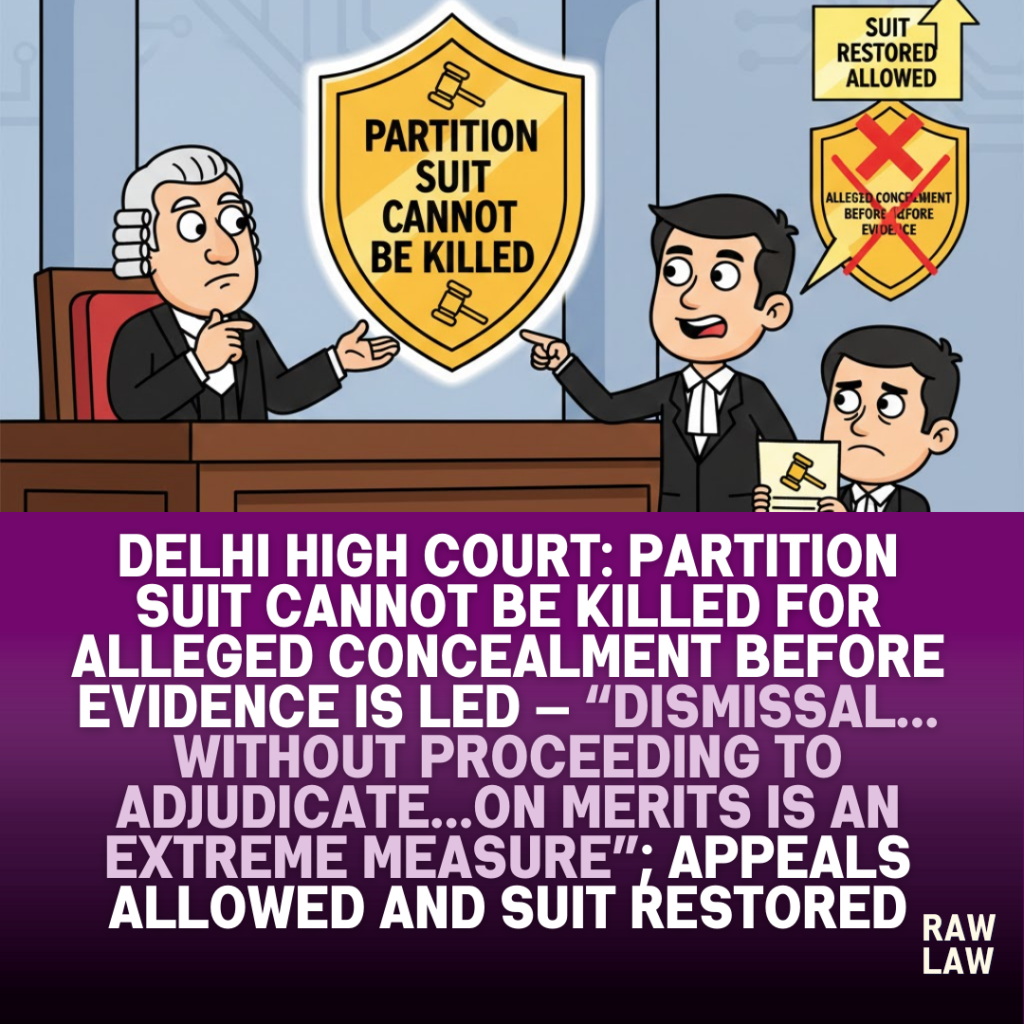
The Delhi High Court set aside a single judge order that had dismissed a family partition suit at the threshold, primarily on allegations of concealment of material facts and violation of an earlier undertaking. The Division Bench held that terminating a civil suit without framing issues or permitting parties to lead evidence is an exceptional step, justified only where the defect strikes at the very root of maintainability or amounts to proven fraud on the court. Since the dispute involved contested questions of title, nature of property, and the effect of alleged agreements and possession transfer, the Court ruled that the suit had been prematurely shut down and must be restored for adjudication on merits.
2. Facts
Two family members instituted a suit seeking partition of an industrial property in Kirti Nagar, New Delhi, claiming it to be joint family property and seeking consequential injunction against alienation or creation of third-party interests. An interim restraint was initially granted but later vacated amid developments suggesting that a portion of the property had been dealt with and that third-party possession may have been handed over. A third party was impleaded, and the first plaintiff at one stage sought withdrawal of the suit but later withdrew that withdrawal request, saying it was filed by mistake. Subsequently, it emerged that four agreements were executed for part of the property and consideration was received.
3. Issues
The main question before the High Court was whether the single judge was justified in dismissing the partition suit outright—without trial—on the ground that the plaintiffs had concealed material facts and the first plaintiff had allegedly violated a prior undertaking not to transfer or part with the property. Closely connected was whether disputed transactions, receipt of money, and alleged delivery of possession could be treated as settled facts at a preliminary stage, and whether such conduct could automatically extinguish the second plaintiff’s independent right to pursue partition. The Court also had to examine whether the dismissal foreclosed substantive civil rights in an impermissible manner.
4. Petitioner’s arguments
The first plaintiff contended that the suit was dismissed prematurely because the court never permitted evidence to be led on ownership, nature of property, shares, or the legal effect of the alleged agreements. He argued that even if agreements and consideration were alleged, their authenticity, enforceability, requirement of registration, and consequence for title could only be decided after a full civil trial. He maintained that allegations of concealment or breach of an undertaking cannot by themselves justify denying a trial in a partition action meant to adjudicate civil rights. He also urged that his withdrawal application and its later retraction should not have been treated as a decisive ground for terminating the suit.
5. Respondent’s arguments
The defendants argued that the plaintiffs abused the court process by suppressing material developments, particularly the execution of four agreements and receipt of substantial consideration, and by not candidly disclosing an earlier undertaking restraining transfer of the relevant portion. They contended that the first plaintiff’s conduct amounted to wilful violation of an undertaking given to a competent court and that such conduct disentitled the plaintiffs from equitable and discretionary relief. They also claimed that both plaintiffs were aware of the relevant developments and that the second plaintiff could not insulate himself by seeking to proceed independently. Relying on fraud-and-suppression jurisprudence, they supported summary dismissal as a justified response to abuse.
6. Analysis of the law
The High Court emphasised that the Code of Civil Procedure, 1908 equips courts to prevent abuse of process and deny relief where fraud is established, but dismissing a civil suit without trial remains an “extreme measure” to be used sparingly. A partition suit is designed to decide substantive rights after pleadings are tested through issues, evidence, and cross-examination. Allegations of concealment and misstatement may justify adverse inferences, costs, or tailored interim directions, but they do not automatically extinguish the right to seek adjudication unless the court finds that no adjudicable rights survive. The court stressed proportionality: case-management tools exist short of terminating proceedings altogether.
7. Precedent analysis
The Bench noted that authorities on fraud upon the court typically involve clear, established findings that a decree or order was procured by deliberate deception, collusion, or suppression of decisive documents. It also explained that cases concerning discretionary writ jurisdiction cannot be mechanically transplanted into civil suits governed by the trial framework of the Code of Civil Procedure. In other words, while concealment can defeat discretionary remedies, a civil trial is ordinarily the forum to determine contested facts and legal consequences. The Court treated the cited precedents as fact-specific and held they did not justify dismissing a partition action midstream where triable issues remained.
8. Court’s reasoning
The High Court acknowledged that the single judge relied on pleadings, admitted material, earlier orders, and conduct to conclude concealment and undertaking breach. But it held that such findings—however serious—could not substitute a trial on core civil questions. The existence of agreements, receipt of consideration, and alleged handing over of possession may be relevant, but the legal consequences—whether title was divested, what rights were created, and how shares in joint family property are impacted—require evidence and adjudication. The Court also held that even assuming wrongdoing by the first plaintiff, it could not “ipso facto” disentitle the second plaintiff from pursuing independent partition rights, because the primary disputed conduct was attributed to the first plaintiff.
9. Conclusion
The Delhi High Court concluded that the single judge’s order had prematurely foreclosed adjudication of substantive civil rights in a partition suit. It ruled that the plaintiffs were entitled to lead evidence and have contested questions determined through the normal civil process. Accordingly, it allowed the connected appeals, set aside the dismissal order, and restored the partition suit to its original position. It directed that the roster bench should freshly examine pending applications—such as for amendment of pleadings and for transposition of the first plaintiff as a defendant—without being influenced by the appellate court’s observations, which were confined to deciding the appeals.
10. Implications
This decision reinforces a key principle in civil procedure: allegations of concealment of material facts and violation of an undertaking, while serious, do not automatically justify terminating a civil suit—especially a partition suit—without trial. For litigants in family property disputes, the ruling underscores that questions of title, nature of property, shares, and the legal effect of agreements and possession transfers are ordinarily triable issues requiring evidence. For trial courts, it is a reminder to calibrate responses to litigation misconduct: impose costs, draw adverse inferences, and issue protective directions where warranted, but reserve the drastic step of dismissal without trial for cases of established fraud that extinguish any real adjudicable controversy.
Case law references
- Supreme Court decision on fraud and suppression in civil proceedings
What it held: A decree or relief obtained by fraud or by suppressing decisive facts cannot be allowed to stand; fraud vitiates judicial acts.
How it was treated here: The High Court distinguished it, noting that the cited case turned on established fraud findings, whereas the present dispute involved contested civil rights and required evidence before concluding that the suit itself should be terminated. - Supreme Court decision on orders procured through collusion and fraud
What it held: Where material indicates collusion and fraud leading to an order, recall and corrective action are justified.
How it was treated here: Distinguished on facts; even where serious allegations exist, a partition suit cannot be dismissed mid-way merely on allegations without a full trial on the substantive issues. - High Court decision in constitutional writ proceedings on suppression of material facts
What it held: Writ relief is discretionary; suppression of material facts can justify refusal of that discretion.
How it was treated here: The Delhi High Court held that principles governing discretionary writ jurisdiction cannot be mechanically extended to dismiss a civil suit governed by the Code of Civil Procedure’s trial framework. - Delhi High Court Division Bench decision on abuse of process through non-disclosure in successive litigation
What it held: Non-disclosure of prior proceedings and adverse orders can amount to abuse of process warranting denial of relief.
How it was treated here: The Court held the factual matrix was different; a partition suit asserting ownership and share requires adjudication, and the proper course is trial-level determination rather than threshold dismissal.
FAQs
1. Can a partition suit be dismissed without trial for concealment of material facts?
A civil court can curb abuse of process, but the Delhi High Court held that dismissing a partition suit without framing issues and without evidence is an extreme measure. Alleged concealment is usually addressed through costs, adverse inferences, or tailored directions, unless proven fraud strikes at the root so that no adjudicable rights survive.
2. Does alleged breach of an undertaking automatically defeat a family property partition claim?
Not automatically. The Court held that while undertaking breach allegations are serious, they cannot replace a full civil trial on title, shares, and the legal effect of transactions. The impact of agreements, possession transfer, and consideration on ownership must ordinarily be decided on evidence.
3. Can one co-plaintiff’s misconduct bar the other co-plaintiff from continuing a partition suit?
The High Court indicated that it cannot be assumed. Where the second plaintiff asserts an independent share and the primary impugned conduct is attributable to the first plaintiff, the second plaintiff cannot be “ipso facto” denied adjudication of his substantive rights without a merits trial.


