

1. Court’s decision
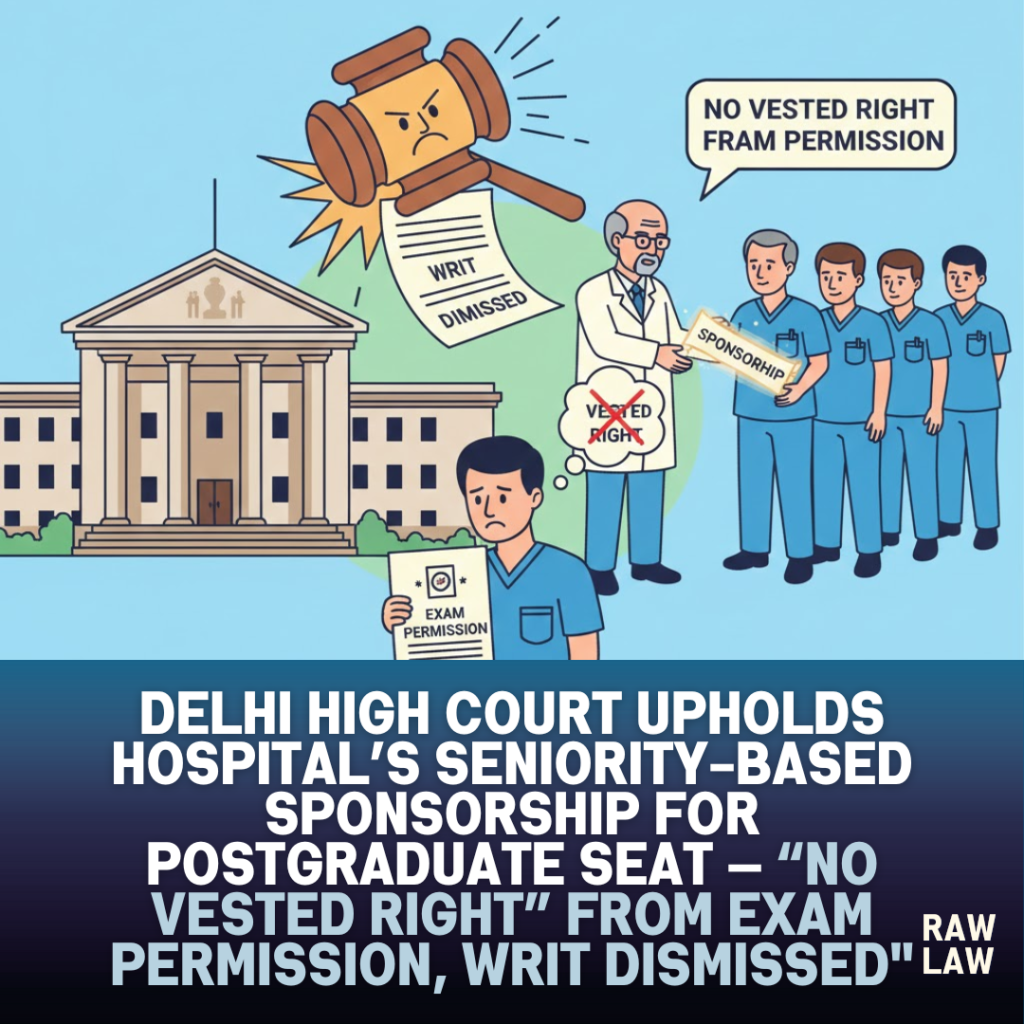
The Delhi High Court dismissed a writ petition challenging an Office Memorandum dated 19 December 2025 that refused a government doctor a no objection certificate and study leave to pursue a postgraduate course in Nuclear Medicine at PGIMER Chandigarh. The Court held that where the applicable standard operating procedure did not prescribe a tie-break criterion and only one sponsorship slot was available, deciding inter se entitlement on seniority was a relevant and permissible factor. The Court ruled the administrative decision was neither arbitrary nor unreasonable, and reiterated that judicial review under Article 226 targets the decision-making process—not re-appreciation of administrative choices.
2. Facts
The petitioner joined as a Medical Officer on 18 September 2020 with the Directorate General of Health Services under the Government of NCT of Delhi, and was transferred to Guru Teg Bahadur Hospital in April 2022. AIIMS New Delhi invited applications for postgraduate courses on 30 September 2025. The petitioner applied on 1 October 2025 for permission to appear in the entrance test under the sponsored category; permission was granted on 30 October 2025. After the result was declared on 15 November 2025, the petitioner was allotted a postgraduate seat in Nuclear Sciences at PGIMER Chandigarh. On 19 December 2025, the hospital rejected the request for study leave and NOC, stating that only three doctors can be sponsored at a time and two were already pursuing postgraduate courses; with both the petitioner and a private respondent qualifying, only one could be sponsored, and sponsorship was given to the senior candidate.
3. Issues
The Court addressed whether, in the absence of an explicit SOP criterion, the hospital could prefer seniority over entrance-exam merit for deciding which of two eligible candidates would receive sponsorship and study leave when only one slot was available under the relevant policy. It also considered whether granting permission to appear for the entrance test created any enforceable right to be sponsored later, and whether the petitioner could demand a transfer to another hospital to bypass the institutional cap on sponsored doctors. A broader issue was the permissible scope of judicial review over such administrative decisions and policy-linked allocations in public health institutions.
4. Petitioner’s arguments
The petitioner argued that the SOP did not mandate seniority as the basis for granting study leave and that sponsorship should have been decided by merit in the postgraduate entrance test, where the petitioner claimed to be higher ranked than the private respondent. It was submitted that once permission to sit for the entrance examination was granted, study leave and an NOC could not later be denied. The petitioner also contended that as an employee of the Government of NCT of Delhi, he could be transferred to another hospital for sponsorship to overcome GTB Hospital’s limit of sponsoring only three doctors at a time. Reliance was placed on a Chief Minister’s letter dated 31 October 2025 to highlight a shortage of Nuclear Medicine specialists, and on Supreme Court decisions including Sudhir N. and Devesh Sharma, and the decision in Dr. Rohit Kumar, to argue against arbitrary decision-making and for protection of candidature.
5. Respondent’s arguments
The Government of NCT of Delhi defended the restriction as a policy choice linked to maintaining adequate staffing for patient care, explaining that the cap on sponsored doctors is determined by sanctioned strength and institutional needs. The private respondent submitted that she would suffer irreparable loss if denied study leave despite being the senior-most among those who qualified, and highlighted that the same seniority-based approach had earlier been applied in 2023 when she qualified but could not be sponsored because she was not the senior-most among successful candidates then. The respondents thus justified seniority as a consistent and rational administrative criterion to resolve inter se disputes when only one sponsorship slot is available and the SOP is silent.
6. Analysis of the law
The Court anchored the dispute in the Office Memorandum dated 2 November 2012, under which the number of officers allowed to join postgraduate courses depends on the sanctioned strength of the organisation/institute. The petitioner did not challenge this cap, and the Court treated it as binding. Where policy fixes a maximum number of sponsored officers and the SOP does not prescribe how to choose between competing eligible candidates, the competent authority must adopt a reasonable, non-arbitrary criterion. The Court treated seniority as a relevant factor for administrative prioritisation, especially in service matters involving equitable opportunity and institutional continuity. It also reiterated classical limits of judicial review: the Court does not act as an appellate authority over administrative decisions, and intervenes only when decisions are illegal, mala fide, procedurally improper, or so unreasonable as to be perverse under Wednesbury principles.
7. Precedent analysis
The judgment relied on established Supreme Court authority restraining courts from substituting their judgment for administrative choices, citing U.P. Financial Corpn. v. Gem Cap (India) (P) Ltd. and Union of India v. K.G. Soni on Wednesbury unreasonableness and proportionality in administrative law. It also cited a very recent Supreme Court decision, Ranjeet Baburao Nimbalkar v. State of Maharashtra (18 December 2025), reiterating that judicial review concerns legality of the decision-making process, not the merits of the administrative decision. Additionally, W.B. Central School Service Commission v. Abdul Halim was cited for the proposition that Article 226 review does not sit in appeal over administrative action. The Court then distinguished the petitioner’s reliance on Sudhir N. as relating to statutory medical admission regulations, and Dr. Rohit Kumar as an Article 142 fact-specific order not meant as precedent, while holding Devesh Sharma did not assist because the policy cap itself was unchallenged.
8. Court’s reasoning
The Court noted that under the OM dated 2 November 2012, only three doctors from GTB Hospital could be sponsored for postgraduate courses at a time, and two were already pursuing such courses, leaving only one available slot. It recorded that the SOP did not specify criteria when two candidates compete for a single slot, and held that the hospital’s reliance on seniority was a relevant and rational basis, making the impugned decision a “possible view” not warranting interference. The Court rejected the argument that entrance-test merit should control, holding that entrance-test merit governs seat allocation and course choice, not resolution of internal sponsorship disputes within the same institution. It also rejected the transfer argument, explaining that the sponsorship cap is tied to the sanctioned strength of the institute, and that officers remain borne on the strength of the same organisation during higher studies, with no substitute provided, and must rejoin the same organisation after completion. Finally, it rejected the claim of any vested right from the permission to sit the exam, holding that at that stage only eligibility is assessed and the authority cannot foresee how many candidates will qualify; permission does not guarantee sponsorship.
9. Conclusion
The Delhi High Court upheld the administrative choice to grant study leave and an NOC to the senior-most eligible candidate when only one sponsored slot remained and the SOP was silent on selection criteria. It found no arbitrariness, irrationality, perversity, or legal error in the impugned Office Memorandum dated 19 December 2025. The writ petition was dismissed, and related applications were also dismissed. The decision reinforces that internal sponsorship decisions in public hospitals, when grounded in sanctioned-strength policy and consistent criteria like seniority, will not be re-opened in writ jurisdiction merely because a rival candidate has higher exam merit.
10. Implications
For government doctors seeking sponsored postgraduate education, this ruling clarifies that permission to appear in an entrance examination does not create an enforceable right to study leave or institutional sponsorship. It also signals that where institutional caps exist on sponsored officers, courts are unlikely to intervene unless the policy itself is challenged as illegal or arbitrary, or the decision-making is tainted by mala fides or perversity. Administratively, hospitals and health departments may treat seniority as a defensible tie-breaker in the absence of express SOP criteria, especially where the institution has previously followed the same approach. For future SOP drafting, the case highlights the value of clearly stated selection criteria to reduce litigation over sponsorship and NOC decisions.
Case law references
1) U.P. Financial Corpn. v. Gem Cap (India) (P) Ltd. (1993) 2 SCC 299
- What it held: Courts should not substitute their judgment for administrative discretion; interference is warranted only when the decision is so unfair or unreasonable that no reasonable person would take it.
- How applied: Used to underscore limited judicial review and to justify non-interference with GTB Hospital’s seniority-based selection.
2) Union of India v. K.G. Soni (2006) 6 SCC 794 (drawing on G. Ganayutham / Wednesbury)
- What it held: Wednesbury review applies; courts examine illegality, procedural impropriety, perversity, and do not choose among reasonable administrative alternatives.
- How applied: Supported the conclusion that seniority-based preference was a reasonable administrative choice.
3) Ranjeet Baburao Nimbalkar v. State of Maharashtra (W.P.(C) 914/2025, decided 18.12.2025)
- What it held: Judicial review targets legality and process; courts exercise restraint absent mala fides, extraneous considerations, or shocking unreasonableness.
- How applied: Reinforced restraint in interfering with policy/administrative decisions on sponsorship and study leave.
4) W.B. Central School Service Commission v. Abdul Halim (2019) 18 SCC 39
- What it held: Article 226 review does not sit in appeal over administrative decisions; it checks only whether process infirmities vitiate the decision.
- How applied: Cited to reject the invitation to re-weigh seniority versus exam merit.
5) Sudhir N. v. State of Kerala (2015) 6 SCC 685
- What it held: Admissions to postgraduate medical courses must follow the statutory/regulatory methodology (merit-based) under medical education regulations.
- How distinguished: Held inapplicable because the present dispute was not about statutory admission criteria, but internal sponsorship/study leave allocation within an institution.
6) Dr. Rohit Kumar v. Secretary, Office of Lt. Governor of Delhi (2021 INSC 336)
- What it held (as noted): The Supreme Court, in peculiar COVID-19 circumstances, used Article 142 and clarified the order was not to be treated as precedent.
- How distinguished: Not treated as precedent and factually different from a sanctioned-strength based sponsorship dispute.
7) Devesh Sharma v. Union of India (2023) 18 SCC 339
- What it held: Policy decisions can be judicially reviewed if contrary to law or arbitrary.
- How applied: The Court held it did not help because the key policy cap (OM dated 02.11.2012) was not challenged.
FAQs
1) Can a Delhi government hospital deny study leave and NOC for postgraduate medical education after allowing a doctor to appear for the entrance exam?
Yes. The Delhi High Court held that permission to appear in the entrance exam does not create a vested right to sponsorship or study leave; sponsorship depends on availability of slots and fulfilment of policy conditions.
2) When two doctors qualify for a sponsored postgraduate seat but only one slot is available, can the hospital choose based on seniority?
Yes. Where the SOP is silent on selection criteria and the institutional cap allows only one sponsorship, seniority was treated as a relevant and rational factor, and the Court refused to interfere.
3) Does entrance-exam merit decide which doctor gets hospital sponsorship for postgraduate studies?
Not necessarily. The Court held that entrance-exam merit decides seat allocation and course choice, but does not automatically resolve inter se sponsorship disputes within the same hospital when policy caps apply.


