

HEADNOTE
Pahalman Budha Magar v. State (NCT of Delhi)
Court: High Court of Delhi
Bench: Hon’ble Mr. Justice Saurabh Banerjee
Date of Judgment: January 21, 2026
Case Number: Bail Application No. 4034/2025
Laws Involved:
Article 21 & Article 22(1), Constitution of India; Sections 20, 25, 29 & 37, NDPS Act, 1985; Sections 47, 103, 104 & 105, Bharatiya Nagarik Suraksha Sanhita, 2023
Keywords: NDPS bail, commercial quantity, grounds of arrest, Article 22(1), illegal arrest
Summary
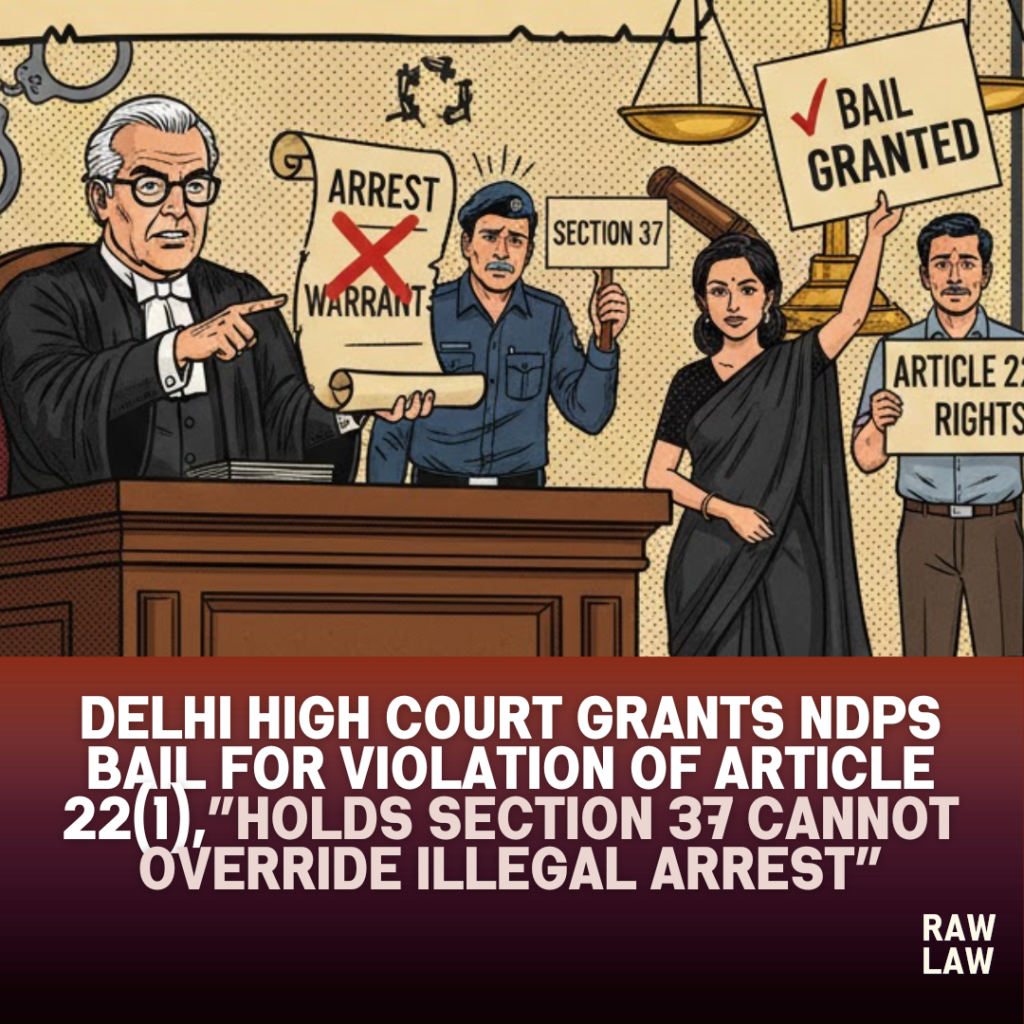
The Delhi High Court granted regular bail to a Nepalese national accused of possessing commercial quantities of charas, holding that the failure to supply written grounds of arrest violated Article 22(1) of the Constitution and vitiated the arrest and subsequent remand. Justice Saurabh Banerjee ruled that the constitutional mandate to communicate grounds of arrest in writing is a substantive safeguard and cannot be eclipsed by the stringent bail restrictions under Section 37 of the NDPS Act. Relying on recent Supreme Court jurisprudence, the Court held that once an arrest is rendered illegal for non-compliance with Article 22(1), continued incarceration cannot be justified solely on the gravity or quantity of the offence. The applicant was released on bail subject to stringent conditions.
Court’s decision
The Delhi High Court allowed the regular bail application of the accused, holding that the non-supply of written grounds of arrest constituted a direct violation of Article 22(1) of the Constitution. The Court ruled that such non-compliance renders the arrest and subsequent remand illegal, entitling the accused to bail irrespective of the statutory bar under Section 37 of the NDPS Act. Justice Saurabh Banerjee underscored that constitutional guarantees occupy a higher pedestal and cannot be overridden by statutory restrictions, even in cases involving commercial quantities of narcotic substances.
Facts
The case arose from FIR No. 266/2023 registered by the Special Cell, Delhi Police, following the seizure of charas allegedly smuggled from Nepal. Initially, 32.230 kilograms of charas were recovered from a co-accused’s vehicle. Based on disclosures, the applicant was apprehended from Safdarjung Enclave, Delhi, and 29.055 kilograms of charas, along with cash and weighing equipment, were recovered from his rented premises. After completion of investigation, a charge sheet was filed and charges were framed under Sections 20(c), 25, and 29 of the NDPS Act. The trial court rejected the applicant’s bail plea, leading to the present application.
Issues
The primary issue before the Court was whether an accused charged with offences involving commercial quantities under the NDPS Act could be granted bail on the ground of violation of Article 22(1) of the Constitution. The Court also examined whether oral intimation of reasons for arrest satisfies constitutional requirements, and whether the rigours of Section 37 of the NDPS Act could override an arrest rendered illegal due to non-supply of written grounds.
Petitioner’s arguments
The petitioner contended that no written grounds of arrest were supplied at the time of arrest or thereafter, in clear violation of Article 22(1) of the Constitution, Section 47 of the BNSS, and Section 52 of the NDPS Act. It was argued that mere oral communication was insufficient and rendered the arrest illegal. The petitioner also highlighted the absence of videography during recovery from his premises and the lack of independent witnesses. Additionally, prolonged incarceration of over two years was cited as a violation of the right to speedy trial under Article 21.
Respondent’s arguments
The State opposed the bail application, invoking the rigours of Section 37 of the NDPS Act and arguing that the recovery from the applicant constituted a commercial quantity. It was contended that the applicant was aware of the reasons for his arrest and had been duly informed of the disclosures made by co-accused persons. The State further argued that the applicant, being a foreign national, posed a serious flight risk and was likely to abscond if released on bail.
Analysis of the law
The Court analysed the constitutional mandate under Article 22(1), emphasising that the right to be informed of the grounds of arrest is a substantive safeguard aimed at enabling effective legal defence. Relying on recent Supreme Court jurisprudence, the Court reiterated that the grounds of arrest must ordinarily be communicated in writing, in a language understood by the arrestee. The failure to do so strikes at the root of personal liberty and renders the arrest unconstitutional, irrespective of the nature of the offence.
Precedent analysis
The Court relied extensively on recent Supreme Court decisions holding that non-supply of written grounds of arrest vitiates arrest and remand. These judgments clarified that Article 22(1) applies uniformly across all statutes, including special laws like the NDPS Act. The Court distinguished earlier decisions where bail was denied, noting that in those cases, grounds of arrest had been duly communicated, unlike in the present matter.
Court’s reasoning
Justice Saurabh Banerjee observed that the arrest memo and seizure documents were conspicuously silent on the reasons for arrest and lacked necessary signatures, raising serious procedural infirmities. The Court held that once the arrest itself is unconstitutional, the statutory embargo under Section 37 of the NDPS Act cannot operate to justify continued detention. The Court further held that constitutional safeguards cannot be eclipsed by considerations of gravity or quantity of contraband.
Conclusion
The Court concluded that the applicant’s arrest and subsequent remand stood vitiated due to non-compliance with Article 22(1) of the Constitution. Consequently, the applicant was entitled to be released on bail notwithstanding the commercial quantity involved. The bail application was accordingly allowed.
Implications
This judgment reinforces the primacy of constitutional safeguards in criminal procedure, even in cases involving stringent special statutes like the NDPS Act. It serves as a clear reminder that investigative agencies must strictly comply with procedural and constitutional requirements, failing which even serious prosecutions may be undermined. The ruling is likely to have a significant impact on NDPS bail jurisprudence, particularly in cases involving alleged procedural violations at the stage of arrest.
Case law references
- Pankaj Bansal v. Union of India – Held that written grounds of arrest are mandatory under Article 22(1). Applied to hold arrest illegal.
- Prabir Purkayastha v. State (NCT of Delhi) – Reaffirmed Article 22(1) as a substantive safeguard. Relied upon.
- Mihir Rajesh Shah v. State of Maharashtra – Clarified consequences of non-supply of written grounds of arrest. Followed.
- State of M.P. v. Kajad – Held refusal of bail is the norm under Section 37 NDPS Act. Distinguished on facts.
FAQs
1. Can bail be granted in NDPS cases involving commercial quantity?
Yes, if constitutional safeguards such as Article 22(1) are violated, bail can be granted despite Section 37.
2. Is oral communication of grounds of arrest sufficient?
No. Courts have held that grounds of arrest must ordinarily be communicated in writing.
3. What is the significance of this ruling?
It reinforces that constitutional rights override statutory bail restrictions in cases of illegal arrest.


