

HEADNOTE
Dr. Saroj Bahl v. Sushma Batra & Ors.
Court: High Court of Delhi
Bench: Justice Purushaindra Kumar Kaurav
Date of Judgment: 12 December 2025
Citation: CS(OS) 653/2023, I.A. 38413/2024
Laws / Sections Involved: Order VII Rule 11 CPC; Section 34 Specific Relief Act, 1963; Section 41(j) Specific Relief Act, 1963; Indian Succession Act, 1925; Court Fees Act, 1870
Keywords: Rejection of plaint, Order 7 Rule 11 CPC, declaratory suit, forged release deed, joint possession, limitation mixed question, non-executant relief
Summary:
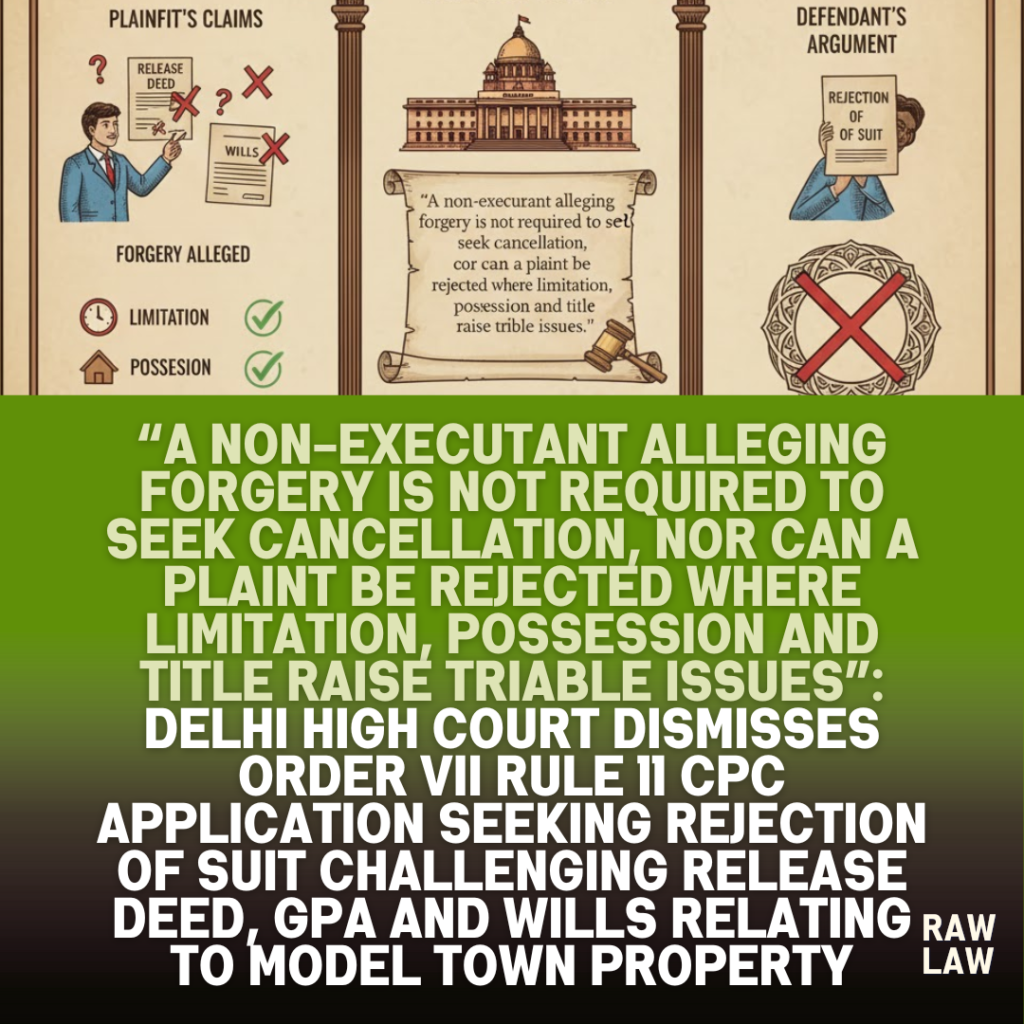
The Delhi High Court dismissed an application under Order VII Rule 11 CPC seeking rejection of a civil suit filed by an overseas co-owner challenging multiple title documents relating to a Model Town property. The Court held that the suit was not barred by the proviso to Section 34 of the Specific Relief Act since the plaintiff had sought consequential relief of injunction and pleaded joint possession. It further ruled that where a plaintiff specifically alleges forgery and denies execution of a release deed, she is not required to seek cancellation or pay ad valorem court fee, as she is a non-executant. Objections based on limitation, Section 41(j) SRA, and non-joinder were held to raise triable issues. Reiterating the narrow scope of Order VII Rule 11, the Court refused to reject the plaint at the threshold.
Court’s decision
The Delhi High Court dismissed the application filed by Defendant No. 2 under Order VII Rule 11 CPC seeking rejection of the plaint. The Court held that none of the grounds urged—bar under Section 34 of the Specific Relief Act, improper court fees, Section 41(j) SRA, limitation, or non-joinder—warranted rejection of the suit at the threshold. It directed that the suit proceed to trial, observing that the issues raised required adjudication on evidence.
Facts
The plaintiff, Dr. Saroj Bahl, residing in the United States, instituted a civil suit through her power of attorney seeking declaration that certain documents relating to property bearing No. K-1/41, Model Town, Delhi, were null and void. These documents included a Release Deed dated 23 October 1982, a General Power of Attorney referred therein, and two Wills dated 3 February 1977 and 16 April 2014.
The plaintiff asserted that she never executed the Release Deed in favour of her deceased mother and that the document was forged and fabricated by the defendants to deprive her of her share in ancestral property. She claimed to be a co-owner in joint possession, stating that her belongings continued to remain in the suit property. On learning of the alleged release deed during earlier litigation in 2014, she instituted the present suit in 2023.
Defendant No. 2 moved an application under Order VII Rule 11 CPC seeking rejection of the plaint on multiple legal grounds.
Issues
The principal issue before the Court was whether the plaint was liable to be rejected under Order VII Rule 11 CPC. This required determination of whether the suit was barred by the proviso to Section 34 of the Specific Relief Act for not seeking possession, whether cancellation of the release deed and payment of ad valorem court fee was mandatory, whether the suit was barred by limitation, whether Section 41(j) of the Specific Relief Act applied, and whether non-joinder of a party rendered the suit defective.
Applicant’s arguments (Defendant No. 2)
The applicant contended that the suit was barred by the proviso to Section 34 of the Specific Relief Act as the plaintiff had sought only declaratory relief without seeking possession. It was argued that since the plaintiff was allegedly a party to the Release Deed dated 23 October 1982, she ought to have sought cancellation of the deed and paid ad valorem court fees.
The defendant further submitted that the suit was barred by limitation as the plaintiff claimed knowledge in 2014–2015 but filed the suit only in 2023. Reliance was also placed on Section 41(j) of the Specific Relief Act to argue that no injunction could be granted as the plaintiff allegedly had no personal interest. Lastly, it was urged that the suit was bad for non-joinder of a necessary party, namely one Mr. Chaman Kumar Mehra.
Plaintiff’s position
The plaintiff maintained that she was not an executant to the release deed and that her purported signatures were forged, making a declaratory suit the correct remedy. She emphasised that consequential relief of permanent and mandatory injunction had been sought, and that she had clearly pleaded joint possession. It was argued that limitation and possession were mixed questions of law and fact requiring trial, and that Order VII Rule 11 could not be invoked to short-circuit adjudication.
Analysis of the law
The High Court reiterated that an application under Order VII Rule 11 CPC must be decided solely on a meaningful reading of the plaint, without reference to the defence. The Court analysed Section 34 of the Specific Relief Act and its proviso, noting that the bar applies only where a plaintiff seeks a simpliciter declaration despite being able to seek further relief.
Relying on Supreme Court precedent, the Court held that where consequential relief such as injunction is sought, the proviso does not apply. It further analysed the distinction between cancellation and declaration, emphasising that cancellation is required only where the plaintiff is an executant to the document.
Precedent analysis
The Court relied on Suhrid Singh v. Randhir Singh to hold that a non-executant who alleges forgery need only seek a declaration that the document is void or not binding, and is not required to seek cancellation or pay ad valorem court fee. It also relied on Akkamma v. Vemavathi to reject the plea based on the proviso to Section 34 of the Specific Relief Act, and on Venkataraja v. Vidyane Doureradjaperumal to explain the object of the proviso.
Court’s reasoning
Justice Purushaindra Kumar Kaurav held that the plaint clearly disclosed a cause of action and raised several triable issues. The plaintiff had pleaded joint possession and sought consequential relief, defeating the argument under Section 34 SRA. Since the plaintiff specifically denied execution of the release deed and alleged forgery, she could not be compelled to seek cancellation.
The Court further held that limitation, applicability of Section 41(j), and alleged non-joinder were all matters requiring evidence. It cautioned that rejection of a plaint has serious consequences and must be exercised sparingly. Nothing in the plaint, even if taken at face value, justified rejection at the threshold.
Conclusion
The Delhi High Court dismissed the application under Order VII Rule 11 CPC as devoid of merit and directed that the suit proceed. It clarified that all defences remained open to be urged at trial, but none justified rejection of the plaint at the preliminary stage.
Implications
This judgment reinforces the strict and narrow scope of Order VII Rule 11 CPC and protects plaintiffs from premature dismissal of civil suits involving disputed title, forgery, and possession. It clarifies that non-executants alleging forged documents are entitled to seek declaratory relief without cancellation, and that limitation and possession issues are ordinarily matters for trial. The ruling strengthens procedural discipline and prevents misuse of rejection applications to stifle genuine civil claims.
CASE LAW REFERENCES
• Suhrid Singh v. Randhir Singh – Non-executant need only seek declaration, not cancellation
• Akkamma v. Vemavathi – Proviso to Section 34 SRA inapplicable where consequential relief is sought
• Venkataraja v. Vidyane Doureradjaperumal – Object of proviso to Section 34 SRA
• TV Ramakrishna Reddy v. M. Mallappa – Declaratory suits and possession requirement
FAQs
Q1. Can a plaint be rejected if limitation is disputed?
No. Limitation involving disputed facts is a triable issue and cannot justify rejection under Order VII Rule 11 CPC.
Q2. Is cancellation mandatory if a plaintiff alleges a document is forged?
No. A non-executant alleging forgery can seek a declaration without seeking cancellation.
Q3. Does pleading joint possession affect maintainability of a declaratory suit?
Yes. Pleading joint possession and seeking consequential relief defeats the bar under Section 34 SRA.


