

HEADNOTE
Sandeep Kumar Sharma v. State (NCT of Delhi) & Anr.
Court: High Court of Delhi
Bench: Justice Ravinder Dudeja
Date of Judgment: 10 December 2025
Citation: W.P.(CRL) 4093/2025
Laws / Sections Involved: Sections 419, 420 IPC; Section 528 Bharatiya Nagarik Suraksha Sanhita, 2023; Section 482 CrPC (principles); Articles 226 & 227 Constitution of India
Keywords: Quashing of FIR, cheating, impersonation, compromise quashing, Section 482 principles, abuse of process, settlement in criminal cases
Summary:
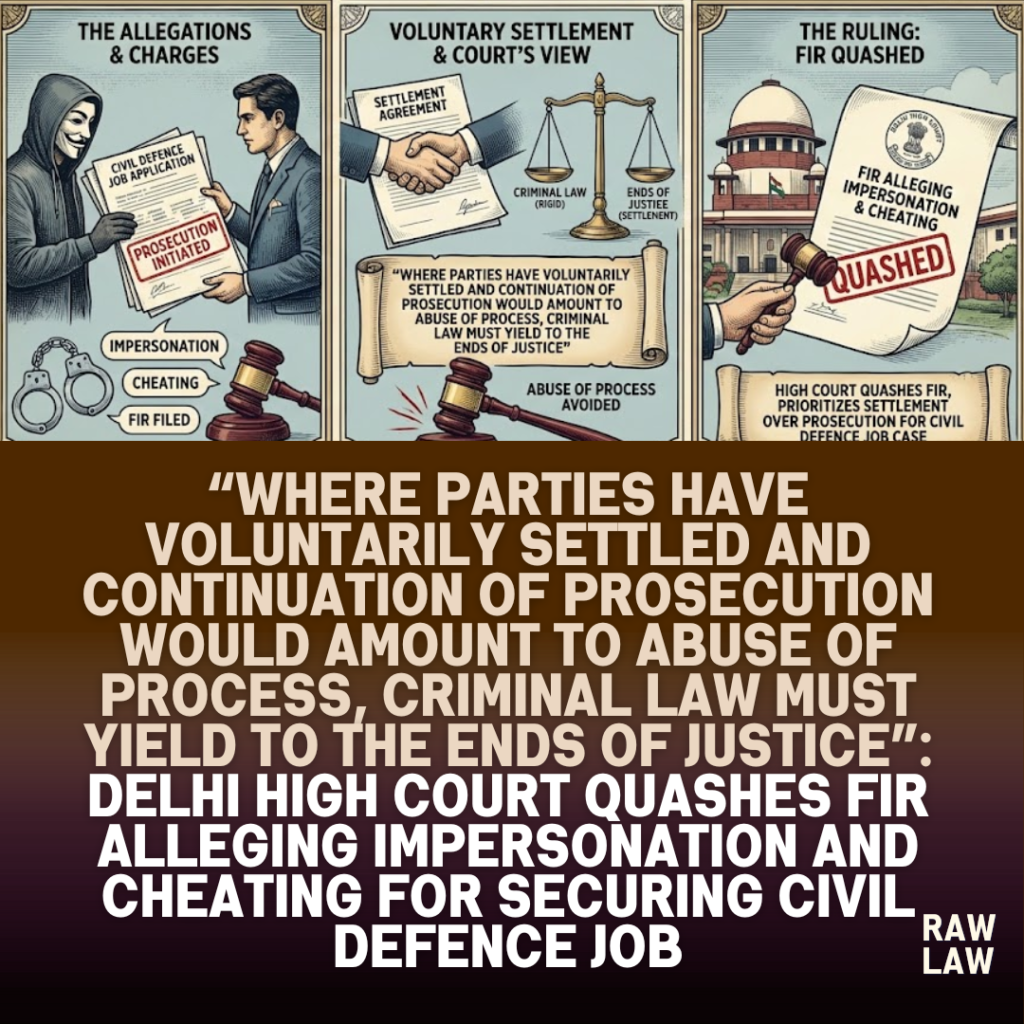
The Delhi High Court quashed an FIR registered for offences of cheating and impersonation after noting that the dispute between the accused and the complainant had been amicably settled without coercion. The FIR stemmed from allegations that the petitioner falsely projected himself as a Sub-Inspector of Delhi Police and induced the complainant to pay money on the pretext of securing a Civil Defence job. Taking note of the Compromise Deed executed between the parties and the complainant’s categorical statement supporting quashing, the Court held that continuation of criminal proceedings would amount to abuse of process. Applying the principles laid down in Gian Singh and B.S. Joshi, the Court exercised its inherent jurisdiction to secure the ends of justice, subject to payment of costs for use of State machinery.
Court’s decision
The Delhi High Court allowed the writ petition and quashed FIR No. 0679/2021 dated 15 June 2021 registered at Police Station Mahendra Park under Sections 419 and 420 IPC, along with all consequential proceedings. The Court held that in view of the amicable settlement between the parties and the complainant’s express no-objection, continuation of the criminal proceedings would serve no useful purpose. The quashing was made subject to the petitioner depositing costs of ₹30,000 with the Delhi High Court Staff Welfare Fund within 30 days.
Facts
The FIR was registered on the complaint of Respondent No. 2, who alleged that the petitioner falsely represented himself as a Sub-Inspector of Delhi Police and induced him to pay ₹30,000 on the assurance of securing employment in Civil Defence. It was alleged that despite repeated assurances, the promise was never fulfilled and communication was discontinued. An inquiry conducted by Barakhamba Vigilance corroborated the allegations, leading to registration of the FIR under Sections 419 and 420 IPC.
During the pendency of proceedings, the parties entered into an amicable settlement and executed a Compromise Deed dated 21 November 2025. Both the petitioner and the complainant appeared before the High Court and affirmed the settlement.
Issues
The principal issue before the Court was whether the FIR and criminal proceedings arising from allegations of cheating and impersonation could be quashed on the basis of a compromise between the accused and the complainant. The Court also examined whether such quashing would be consistent with the principles governing exercise of inherent powers to prevent abuse of process and secure the ends of justice.
Petitioner’s arguments
The petitioner submitted that the dispute was purely personal in nature and had been amicably resolved without any pressure or coercion. It was argued that continuation of the criminal proceedings would only prolong unnecessary litigation despite the complainant having no subsisting grievance. The petitioner relied on settled Supreme Court jurisprudence permitting quashing of criminal proceedings, including non-compoundable offences, where the dispute has been genuinely settled and societal interest is not adversely affected.
Respondents’ position
Respondent No. 2, the complainant, appeared in person and categorically stated that the matter had been settled voluntarily and that he had no objection to quashing of the FIR. The State, represented by the Additional Public Prosecutor, also expressed no objection to quashing in view of the settlement between the parties.
Analysis of the law
The High Court analysed the scope of its inherent powers to quash criminal proceedings on the basis of settlement. Relying on Gian Singh v. State of Punjab and B.S. Joshi v. State of Haryana, the Court reiterated that even non-compoundable offences may be quashed where the dispute is predominantly private, the settlement is genuine, and continuation of proceedings would amount to abuse of process. The Court emphasised that the guiding consideration is whether quashing would secure the ends of justice.
Precedent analysis
The Court relied on Gian Singh v. State of Punjab, which recognises the power of High Courts to quash criminal proceedings when continuation would be unjust despite settlement, and B.S. Joshi v. State of Haryana, which permits quashing of proceedings to prevent abuse of process and secure justice. These precedents formed the legal foundation for allowing the present petition.
Court’s reasoning
Justice Ravinder Dudeja noted that both parties were present before the Court and were duly identified by their counsel and the Investigating Officer. The complainant unequivocally confirmed the settlement and his consent for quashing. The Court found no element of coercion or undue influence. In these circumstances, it held that insisting on continuation of the prosecution would be contrary to the interest of justice, especially when the victim himself sought closure of the dispute. However, considering that State machinery had been set in motion, the Court imposed costs as a condition for quashing.
Conclusion
The High Court allowed the petition and quashed the FIR and all consequential proceedings, subject to deposit of ₹30,000 as costs with the Delhi High Court Staff Welfare Fund. All pending applications were disposed of.
Implications
This judgment reaffirms the liberal and pragmatic approach adopted by High Courts in settlement-based quashing of criminal proceedings involving private disputes. It underscores that criminal law should not be used as a tool for needless continuation of litigation once parties have resolved their differences, while also recognising the need to balance equities by imposing costs where State resources have been utilised.
CASE LAW REFERENCES
• Gian Singh v. State of Punjab – Quashing of criminal proceedings on basis of settlement
• B.S. Joshi v. State of Haryana – Inherent powers to prevent abuse of process
FAQs
Q1. Can FIRs under Sections 419 and 420 IPC be quashed after settlement?
Yes, where the dispute is private in nature and the settlement is genuine, courts may quash proceedings.
Q2. Is complainant consent necessary for quashing?
Yes, the complainant’s voluntary and informed consent is a crucial factor.
Q3. Why did the Court impose costs while quashing the FIR?
Costs were imposed as State machinery had been used and to balance equities.


