

Court’s decision
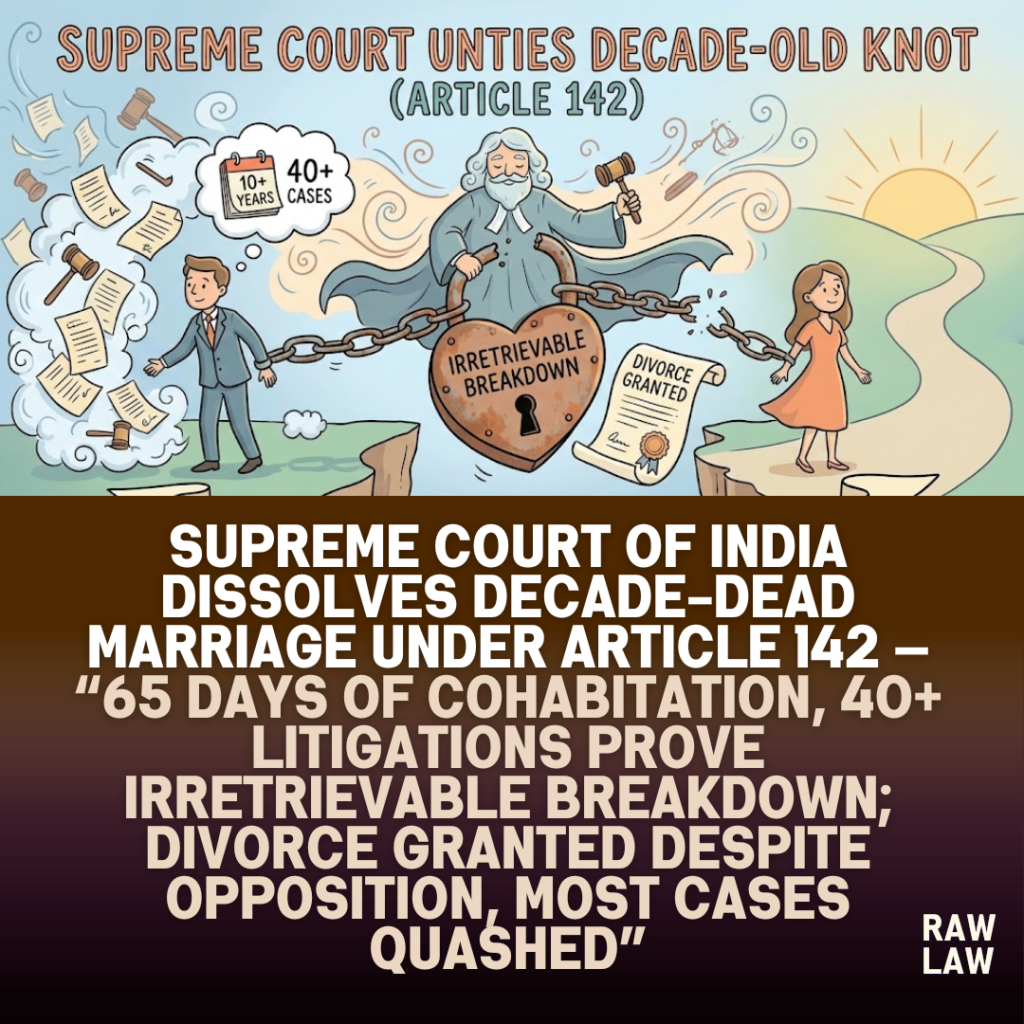
The Supreme Court of India dissolved a marriage solemnised in 2012 by invoking its extraordinary powers under Article 142 of the Constitution, holding that a relationship marked by only 65 days of cohabitation, more than a decade of separation, and over forty civil and criminal cases constituted a clear case of irretrievable breakdown. The Court ruled that continuation of the marital bond would be unjustified and counterproductive — “warring couples cannot be allowed to treat courts as their battlefield”; marriage dissolved, all matrimonial litigations quashed except perjury proceedings.
Court’s decision
A Bench comprising Justice Rajesh Bindal and Justice Manmohan allowed the wife’s application under Article 142 while disposing of a transfer petition. Despite strong opposition from the husband, the Court held that the marriage had broken down beyond repair and that no useful purpose would be served by keeping the parties legally bound. The Court dissolved the marriage, directed that all pending matrimonial disputes across multiple courts stand disposed of, retained only perjury-related proceedings, and imposed costs of ₹10,000 each on both parties.
Facts
The parties married on 28 January 2012 and separated on 2 April 2012, having lived together for only about 65 days. Since then, they have remained apart for more than thirteen years. The marital breakdown led to an extraordinary volume of litigation, including cases under the Hindu Marriage Act, Criminal Procedure Code, Domestic Violence Act, Indian Penal Code, and proceedings under the Bharatiya Nyaya Sanhita, spread across courts in Delhi, Ghaziabad, Lucknow, Allahabad, and the Supreme Court itself.
The immediate proceeding before the Supreme Court arose from a transfer petition filed by the wife seeking transfer of a perjury application under Section 340 CrPC. During pendency, she filed an application under Article 142 seeking dissolution of marriage on the ground of irretrievable breakdown. Mediation efforts ordered by the Court failed to even commence meaningfully.
Issues
The principal issue before the Court was whether it should exercise its powers under Article 142 of the Constitution to dissolve a marriage on the ground of irretrievable breakdown, despite the husband’s categorical opposition, and notwithstanding the fact that irretrievable breakdown is not a statutory ground under the Hindu Marriage Act, 1955.
A connected issue was whether the Court could, in the interest of complete justice, terminate the avalanche of pending matrimonial litigations between the parties and bring finality to their disputes.
Petitioner’s arguments
The wife argued that the marriage was dead in substance and form, having lasted only 65 days in terms of cohabitation and followed by more than a decade of complete separation. She contended that repeated litigation, failed mediation attempts, and extreme bitterness demonstrated that there was no possibility of reconciliation.
Relying on the Constitution Bench judgment in Shilpa Sailesh v. Varun Sreenivasan, she submitted that the Supreme Court has ample power under Article 142 to dissolve a marriage that has irretrievably broken down, even without mutual consent. She also clarified that she was not claiming any alimony and sought closure of all matrimonial disputes.
Respondent’s arguments
The husband, appearing in person, vehemently opposed the plea for divorce. He alleged that the wife had filed multiple false and frivolous cases to harass him and destroy his life. He asserted that many of her complaints had been dismissed and that several perjury applications filed by him were pending, with a likelihood of conviction.
He argued that the wife was financially well settled and misusing the judicial process, while he was unemployed and forced to contest numerous cases without legal representation. On this basis, he contended that granting divorce under Article 142 would reward misconduct and allow the wife to escape accountability.
Analysis of the law
The Court undertook an extensive analysis of its power under Article 142, reiterating that although irretrievable breakdown of marriage is not a ground for divorce under the Hindu Marriage Act, this limitation does not constrain the Supreme Court’s constitutional authority to do complete justice.
Relying heavily on the Constitution Bench ruling in Shilpa Sailesh, the Court noted that it may dissolve a marriage where factual circumstances firmly establish that the relationship has collapsed beyond salvage, even if one spouse objects. Factors such as length of separation, failure of mediation, multiplicity of litigations, absence of children, and economic independence of parties were held to be crucial indicators.
Precedent analysis
The Court placed reliance on a consistent line of precedents where marriages were dissolved under Article 142 due to irretrievable breakdown, including cases where consent was absent. These decisions emphasise that the object of matrimonial law is not to perpetuate dead relationships but to reduce misery, social friction, and endless litigation. The Court reiterated that its jurisdiction under Article 142 is discretionary, equitable, and situation-specific.
Court’s reasoning
Applying the principles laid down in Shilpa Sailesh, the Court found that the present case satisfied every relevant parameter. The parties had lived together for barely two months, had been separated for over thirteen years, and had flooded courts with more than forty cases against each other. Mediation had failed entirely, and bitterness had reached a point of no return.
The Court observed that allowing such warring spouses to continue litigating would choke the judicial system and prolong personal misery. It held that forcing the parties to remain legally married would serve no social or legal purpose. At the same time, the Court clarified that allegations of perjury strike at the administration of justice and therefore must survive independent of matrimonial settlement.
Conclusion
The Supreme Court dissolved the marriage between the parties by exercising its powers under Article 142 of the Constitution. It directed that all pending civil and criminal proceedings arising out of the matrimonial dispute stand disposed of, except applications relating to perjury under Section 340 CrPC and corresponding provisions of the BNSS, which were allowed to continue. Both parties were directed to deposit costs of ₹10,000 each with the Supreme Court Advocates-on-Record Association.
Implications
This judgment is a significant reaffirmation of the Supreme Court’s post-Shilpa Sailesh approach to irretrievable breakdown of marriage. It sends a strong message against misuse of courts as arenas for matrimonial warfare and underscores that Article 142 can be used decisively to bring closure to long-dead marriages. At the same time, by preserving perjury proceedings, the Court has balanced finality in matrimonial disputes with the imperative of maintaining the purity of judicial proceedings.
Case law references
- Shilpa Sailesh v. Varun Sreenivasan (Constitution Bench): Held that Supreme Court can dissolve marriage under Article 142 for irretrievable breakdown even without consent. Applied as the governing standard.
- Rakesh Raman v. Kavita: Multiple litigations and failed mediation indicate irretrievable breakdown. Relied upon to assess factual collapse of marriage.
- Kusha Duruka v. State of Odisha: Perjury proceedings cannot be quashed merely due to settlement. Applied to preserve Section 340 proceedings.
FAQs
1. Can the Supreme Court grant divorce without consent of one spouse?
Yes. Under Article 142, the Supreme Court can dissolve a marriage if it finds irretrievable breakdown, even if one spouse opposes.
2. Is irretrievable breakdown a ground for divorce under Hindu Marriage Act?
No. It is not a statutory ground, but the Supreme Court can still grant divorce under Article 142.
3. Will criminal or perjury cases automatically end after such divorce?
No. While matrimonial disputes may be quashed, perjury-related proceedings can continue independently.


