

Court’s decision
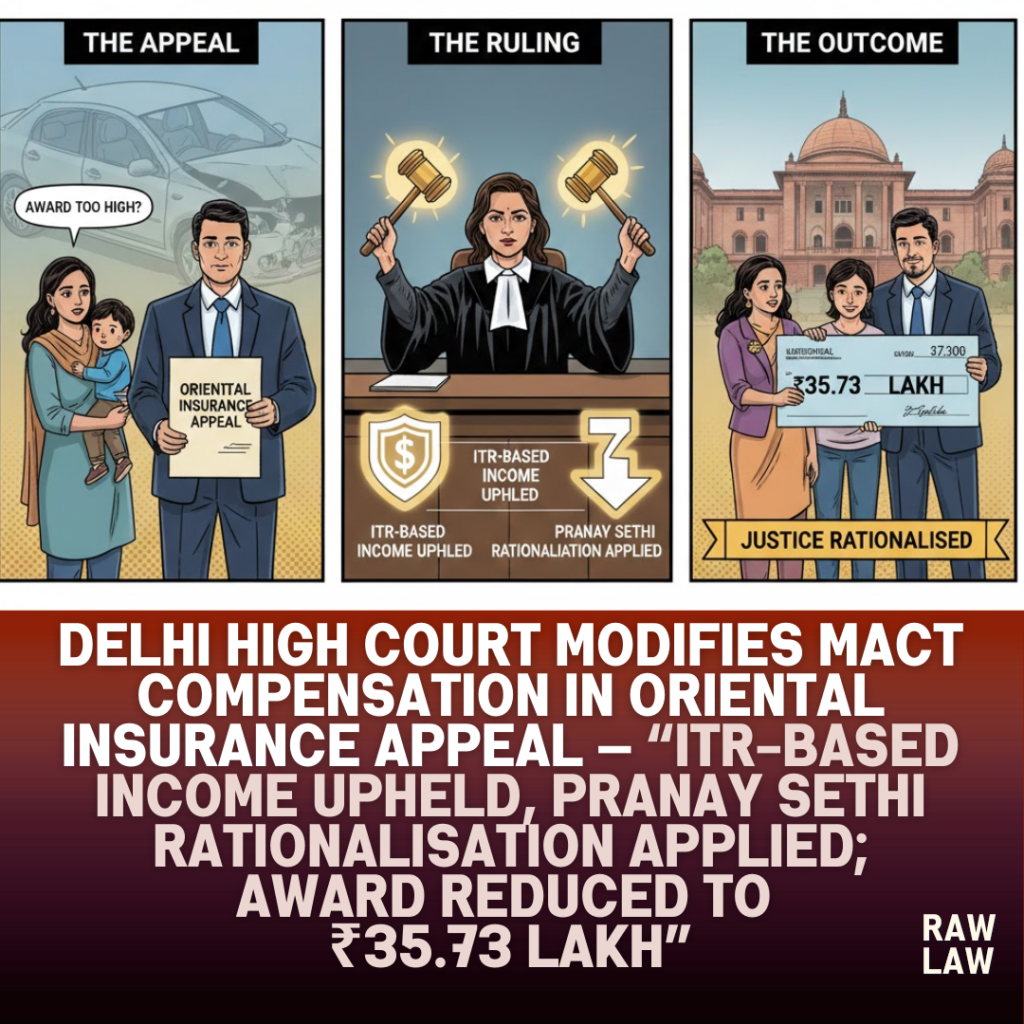
The Delhi High Court partly allowed an appeal filed by Oriental Insurance Company Limited and modified a Motor Accident Claims Tribunal award by recalculating compensation strictly in line with the principles laid down in Pranay Sethi and Satinder Kaur. While rejecting the insurer’s plea to substitute minimum wages for income, the Court upheld reliance on the deceased’s Income Tax Return to assess earnings, but corrected future prospects and conventional heads — compensation reduced from ₹37.04 lakh to ₹35.73 lakh with interest at 9% per annum.
Court’s decision
Justice Anish Dayal disposed of the insurer’s appeal by affirming the benchmark income adopted by the Tribunal and modifying other components of compensation to align with binding Supreme Court precedent. The Court directed deposit of the recalculated balance amount within four weeks and ordered refund of the statutory deposit to the insurer. Pending applications were rendered infructuous.
Facts
The case arose from a fatal motor accident that occurred on 12 May 2013, in which the deceased, aged 45 years, lost his life. The legal heirs filed a claim petition before the Motor Accident Claims Tribunal, Patiala House Courts, New Delhi. By an award dated 3 January 2015, the Tribunal granted compensation of ₹37,04,000 with interest at 9% per annum.
For computing loss of dependency, the Tribunal relied on the deceased’s Income Tax Return for the assessment year 2009–2010, showing a gross income of approximately ₹3 lakh and a net income of ₹2.90 lakh per annum after tax. The insurer challenged the award before the High Court primarily on the assessment of income and on the quantum under conventional heads.
Issues
The principal issues before the High Court were whether the Tribunal erred in relying on an Income Tax Return of 2009–2010 to assess income for an accident that occurred in 2013, and whether the compensation awarded under various heads required modification in light of subsequent Supreme Court jurisprudence governing future prospects, consortium, funeral expenses, and loss of estate.
Appellant’s arguments
The insurer contended that the Tribunal wrongly adopted ₹2.90 lakh per annum as the deceased’s income based on an old ITR, arguing that no subsequent ITRs or independent proof of engagement as a contractor with the Central Public Works Department had been produced. It was urged that income should instead be computed on the basis of minimum wages applicable to a matriculate.
On quantum, the insurer argued that the award was inconsistent with Pranay Sethi. It submitted that future prospects should be restricted to 25% (as the deceased was self-employed and aged 45), consortium should be standardised at ₹40,000 per eligible claimant, loss of estate and funeral expenses should be capped at ₹15,000 each, and the amount awarded for loss of love and affection ought to be deleted as subsumed within consortium.
Respondents’ arguments
Counsel for the claimants fairly accepted that the award required rationalisation in terms of Pranay Sethi and Satinder Kaur. However, on income, it was argued that the Tribunal correctly relied on the available ITR and that it was reasonable to presume continuity of income for a self-employed contractor. It was submitted that the widow was illiterate and inability to produce subsequent ITRs could not be used to disbelieve the established income reflected in the return already on record.
Analysis of the law
The Court examined settled principles governing assessment of income in motor accident compensation cases. It reiterated that where documentary evidence such as an Income Tax Return is produced and is not shown to be fabricated, tribunals are justified in relying upon it rather than reverting to minimum wages.
On quantum, the Court applied the authoritative framework laid down in Pranay Sethi, which standardised future prospects and conventional heads, and the later clarification in Satinder Kaur which held that “loss of love and affection” is not a separate head and stands subsumed within consortium.
Precedent analysis
The Court harmonised the Tribunal’s award with Supreme Court precedent by retaining the income assessment while modifying the add-ons. It applied Pranay Sethi to reduce future prospects from 30% to 25% and to recalibrate conventional heads, and applied Satinder Kaur to delete the separate award for loss of love and affection. These precedents were treated as binding norms for uniformity and certainty in MACT compensation.
Court’s reasoning
The Court rejected the insurer’s argument on income, observing that it was unrealistic to assume that a self-employed contractor’s income would suddenly vanish in the years following the ITR relied upon. It found no reason to doubt the genuineness of the return and upheld the Tribunal’s presumption that income would have been sustained until the date of the accident.
However, the Court accepted the insurer’s objections on computation. It recalculated loss of dependency by reducing future prospects to 25% and adjusted personal expenses accordingly. It awarded consortium of ₹40,000 each to the wife, two children, and mother (₹1.60 lakh in total), deleted the amount for loss of love and affection, and standardised loss of estate and funeral expenses at ₹15,000 each. The total compensation was thus reduced to ₹35,73,338.
Conclusion
The Delhi High Court partly allowed the appeal by modifying the MACT award. While affirming the income assessment, it reduced the total compensation payable to ₹35,73,338 with interest at 9% per annum. The insurer was directed to deposit the balance amount within four weeks, and the statutory deposit was ordered to be refunded.
Implications
This judgment reinforces two important principles in motor accident compensation law. First, credible Income Tax Returns can be relied upon even if they are not from the immediately preceding year, particularly for self-employed victims. Second, all MACT awards must conform to the standardised framework laid down in Pranay Sethi and Satinder Kaur, ensuring uniformity and preventing overcompensation under non-recognised heads. The ruling offers clarity to insurers and claimants alike on the balance between evidentiary pragmatism and doctrinal consistency.
Case law references
- National Insurance Co. Ltd. v. Pranay Sethi: Standardised future prospects and conventional heads of compensation. Applied to modify the award.
- United India Insurance Co. Ltd. v. Satinder Kaur: Held that loss of love and affection is subsumed within consortium. Applied to delete that head.
- Income assessment in MACT claims: Income Tax Returns are reliable evidence absent proof of fabrication. Applied to uphold benchmark income.
FAQs
1. Can an old Income Tax Return be used to calculate compensation?
Yes. Courts may rely on a prior ITR if it is credible and there is no reason to assume income ceased before the accident.
2. Is loss of love and affection still a valid head of compensation?
No. It has been subsumed within consortium as per Supreme Court precedent.
3. How are future prospects calculated for self-employed persons?
For self-employed victims aged between 40 and 50, future prospects are added at 25% of income.


