

Court’s decision
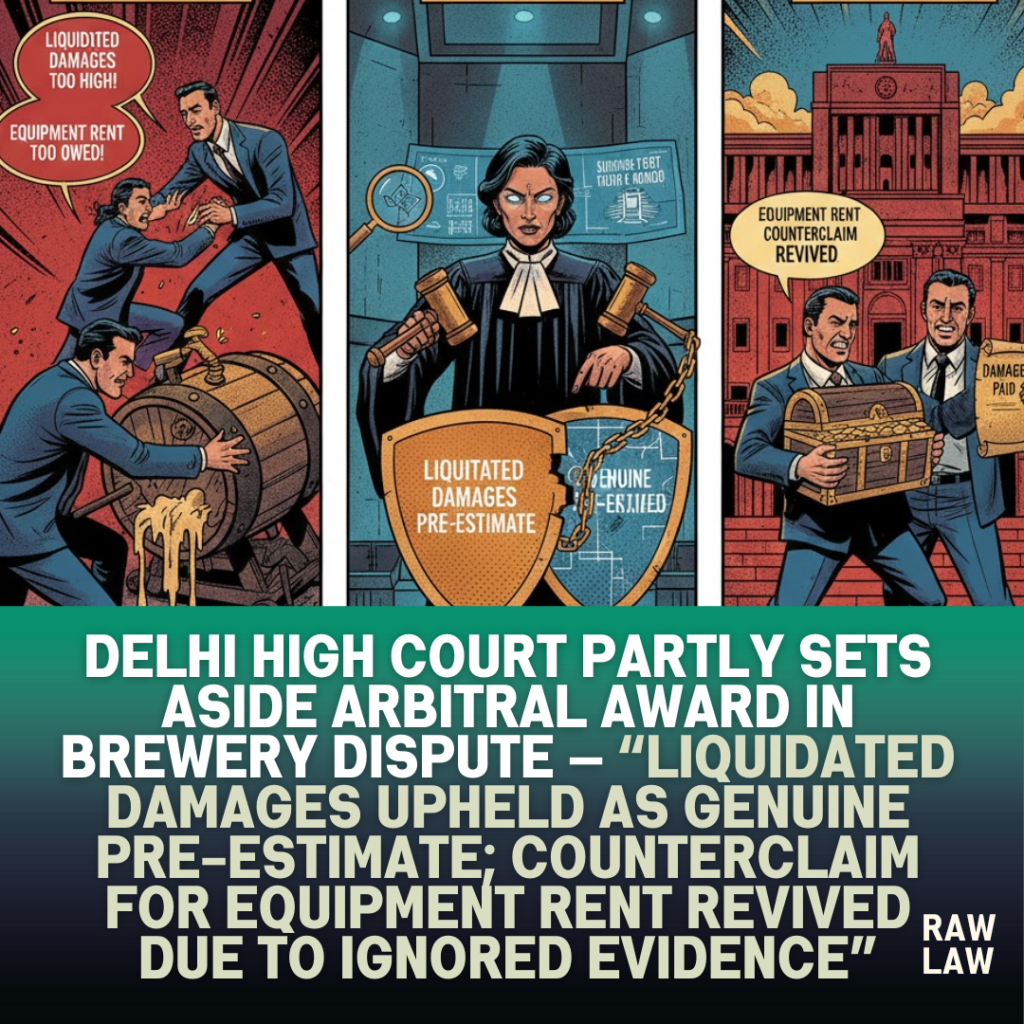
The Delhi High Court partly allowed a petition under Section 34 of the Arbitration and Conciliation Act, upholding an arbitral award of ₹25 lakh as liquidated damages for delay in achieving the contract start date, but setting aside the rejection of one counterclaim after finding that the arbitral tribunal ignored vital documentary and oral evidence. While affirming that Clause 4.3 represented a genuine pre-estimate of loss under Section 74 of the Contract Act, the Court held that the tribunal’s findings on delayed removal of equipment were perverse — award modified by severing the defective portion; remainder sustained.
Court’s decision
Justice Jasmeet Singh dismissed most challenges to the arbitral award dated 15.09.2020 arising from a contract brewing agreement, holding that the tribunal’s interpretation of liquidated damages was plausible and immune from interference under Section 34. However, the Court interfered with the rejection of counterclaim relating to rent/penalty for delayed removal of equipment, concluding that the tribunal overlooked crucial correspondence and cross-examination establishing access and continued occupation. The award was modified to that limited extent.
Facts
The dispute arose out of a Contract Brewing and Packaging Agreement executed in December 2015 between a beer manufacturer and a brewery owner in Jharkhand. Under the agreement, the brewery was required to achieve a defined “Start Date” for contract manufacturing within stipulated timelines and furnish security for specialised bottling and labelling equipment supplied by the manufacturer.
Delays occurred in furnishing the agreed bank guarantee, leading to a subsequent arrangement in June 2016 whereby post-dated cheques were provided as security. The equipment — including a 3G labeller and pull-off crowner — was eventually supplied in October 2016. The brewery alleged that the labeller was defective, causing repeated breakdowns, production loss, and labour issues.
In 2017, following adverse excise policy changes in Jharkhand and financial distress, the brewery sought removal of an exclusivity clause and later terminated the agreement. Arbitration was invoked. The tribunal allowed the manufacturer’s claim for ₹25 lakh as liquidated damages for delay in achieving the Start Date and rejected all counterclaims of the brewery, including claims for electricity charges, equipment rent, and storage of broken glass.
Issues
The High Court was required to decide whether the tribunal erred in awarding liquidated damages without proof of actual loss, whether Clause 4.3 constituted a genuine pre-estimate under Section 74 of the Contract Act, and whether rejection of the brewery’s counterclaims suffered from perversity or patent illegality due to ignoring material evidence. An ancillary issue concerned limitation of the Section 34 petition in light of COVID-19 extensions.
Petitioner’s arguments
The petitioner contended that the tribunal’s findings on delay were contradictory, as it acknowledged that time ceased to be of the essence and that the manufacturer contributed to delays by supplying defective equipment. It was argued that Clause 4.3 could not be treated as a genuine pre-estimate merely because it used the word “fair,” and that under Section 74, proof of loss was mandatory where loss was capable of proof. Reliance was placed on Kailash Nath Associates and later decisions reiterating that liquidated damages cannot be awarded mechanically.
On counterclaims, the petitioner argued that the tribunal ignored clear evidence showing that access for removal of equipment was provided in November 2017 and April 2018, yet the equipment remained on site until at least March 2019. The rejection of rent/penalty claims was said to be perverse and contrary to record.
Respondent’s arguments
The respondent supported the award, submitting that Section 34 does not permit re-appreciation of evidence or substitution of the court’s view for that of the arbitrator. It was argued that Clause 4.3 expressly recorded the parties’ agreement that delay would adversely impact expected sales and quantified ₹25 lakh as fair compensation, thereby constituting a genuine pre-estimate. The respondent emphasised that it had expressly reserved its right to claim damages despite accommodating amendments.
On counterclaims, the respondent argued that no contemporaneous proof established liability for rent or storage charges and that the tribunal’s findings were plausible interpretations of contractual clauses read harmoniously.
Analysis of the law
The Court reiterated the narrow scope of interference under Section 34, emphasising that arbitral awards can be set aside only for patent illegality, perversity, or violation of public policy. It analysed Section 74 of the Contract Act, noting that while loss or damage is a sine qua non, proof of actual loss is not required where parties have agreed upon a genuine pre-estimate and loss is difficult to quantify.
The Court also relied on recent Supreme Court authority recognising the power of Section 34 courts to sever and modify an award where findings are separable, rather than setting aside the award in entirety.
Precedent analysis
The Court applied Kailash Nath Associates to distinguish between penalty clauses and genuine pre-estimates, holding that Clause 4.3 fell in the latter category because the contract itself acknowledged loss of expected sales upon delay. It relied on PSA Sical Terminals to hold that findings contrary to vital evidence are perverse, and on Gayatri Balasamy to justify partial modification of the award through severability. These precedents guided the Court in upholding one part of the award while setting aside another.
Court’s reasoning
On limitation, the Court rejected the respondent’s objection, holding that the petition filed in December 2020 was within time after excluding the COVID-19 period as per Supreme Court directions.
On merits, the Court upheld the award of ₹25 lakh, finding that Clause 4.3 clearly recorded the parties’ agreement that delay would cause loss and quantified a reasonable pre-estimate. The tribunal’s interpretation was held to be plausible and immune from Section 34 interference.
However, the Court found that the tribunal’s rejection of the counterclaim relating to rent/penalty for delayed removal of equipment was unsustainable. It noted that correspondence dated 01.11.2017 and 24.04.2018, minutes of meetings, and cross-examination showed that access had been provided and equipment remained on site long after termination. Ignoring this evidence rendered the finding perverse, warranting interference to that limited extent.
Conclusion
The Delhi High Court upheld the arbitral award insofar as it granted ₹25 lakh as liquidated damages for delay in achieving the Start Date and rejected most counterclaims. It set aside the rejection of the counterclaim relating to rent/penalty for delayed removal of equipment, holding that the tribunal ignored vital evidence. The award was modified by severing the defective portion, with the remainder left intact.
Implications
The ruling reinforces judicial deference to arbitral interpretation of liquidated damages clauses, especially where contracts expressly record loss and quantify compensation as a genuine pre-estimate. At the same time, it signals that arbitral awards remain vulnerable where tribunals ignore material evidence. The judgment also affirms the evolving approach under Section 34 permitting limited modification through severability, promoting efficiency over wholesale annulment.
Case law references
- Kailash Nath Associates v. DDA: Liquidated damages require loss; proof dispensed with only where genuine pre-estimate. Applied to uphold Clause 4.3.
- PSA Sical Terminals v. V.O. Chidambranar Port Trust: Findings ignoring vital evidence are perverse. Applied to set aside rejection of counterclaim.
- Gayatri Balasamy v. ISG Novasoft Technologies: Section 34 courts may sever and modify awards where findings are separable. Applied to partially modify the award.
FAQs
1. Can liquidated damages be awarded without proof of actual loss?
Yes, if the contract stipulates a genuine pre-estimate and loss is difficult to quantify, courts may award reasonable compensation under Section 74.
2. When will a court interfere with rejection of counterclaims in arbitration?
Interference is warranted if the tribunal ignores vital documentary or oral evidence, rendering the finding perverse.
3. Can a court partially modify an arbitral award under Section 34?
Yes. Courts may sever and modify separable portions of an award without setting it aside entirely.


