

Court’s decision
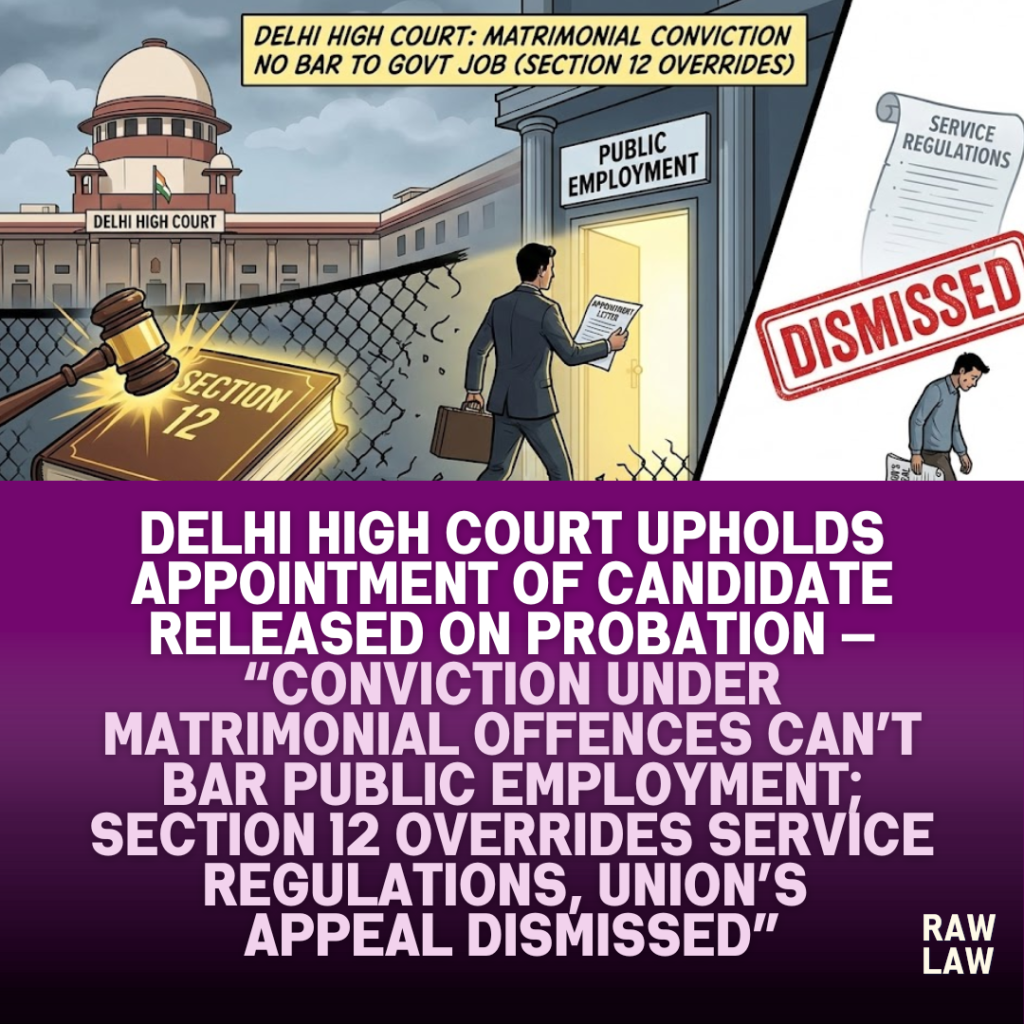
The Delhi High Court dismissed an intra-court appeal filed by the Union of India and the Airports Authority of India, affirming that a candidate who was convicted but later released on probation under the Probation of Offenders Act cannot be denied public appointment on the ground of disqualification attached to conviction. The Court held that Section 12 of the Probation of Offenders Act has overriding effect and neutralises service-rule ineligibility flowing solely from conviction — “where ineligibility stems from conviction, probation statutorily removes that bar”; appointment directed to be honoured, appeal rejected.
Court’s decision
A Division Bench comprising the Chief Justice Devendra Kumar Upadhyaya and Justice Tejas Karia upheld the judgment of the Single Judge which had quashed the Airports Authority of India’s decision cancelling the respondent’s appointment as Junior Executive (Common Cadre). The Bench ruled that the employer’s discretion in antecedent verification cannot defeat the express legislative mandate of Section 12 of the Probation of Offenders Act, 1958, where disqualification is directly linked to conviction alone.
Facts
The respondent was convicted in 2014 by a criminal court in Haryana for offences under Sections 498A and 406 of the Indian Penal Code arising out of a matrimonial dispute. He was sentenced to imprisonment; however, during pendency of his appeal, the marriage was dissolved by mutual consent. In September 2015, the appellate court upheld the conviction but, considering the amicable settlement and lack of grievance by the complainant-wife, released the respondent on probation of good conduct under Section 4 of the Probation of Offenders Act.
Subsequently, the respondent secured public employment as a Library Attendant with the Government of Haryana in 2019, with no adverse service record. In 2024, he applied for recruitment to the post of Junior Executive (Common Cadre) with the Airports Authority of India. He was declared successful and issued an offer of appointment, which he duly accepted.
During verification, the respondent truthfully disclosed his past conviction and probation. The Airports Authority of India, invoking Regulation 6(7)(b) of its Service Regulations which treats persons convicted of offences involving moral turpitude as ineligible, cancelled the appointment. This led to successive writ proceedings, culminating in the Single Judge directing appointment. The Union of India and AAI challenged that decision by way of the present Letters Patent Appeal.
Issues
The central issue before the Division Bench was whether a public employer can deny appointment on the basis of a past conviction involving moral turpitude when the candidate has been released on probation under Section 4 of the Probation of Offenders Act, and whether Section 12 of the Act overrides service regulations prescribing ineligibility based on conviction.
Appellants’ arguments
The Union of India and the Airports Authority of India argued that Section 12 of the Probation of Offenders Act does not obliterate the fact of conviction and does not curtail the employer’s discretion to assess suitability and antecedents. Relying on service Regulation 6(7)(b), it was contended that conviction for an offence involving moral turpitude renders a person ineligible for appointment, irrespective of probation.
It was further argued that release on probation does not wash away the conduct constituting the offence, and that public interest and sensitivity of the post justified strict scrutiny. Heavy reliance was placed on precedents such as Ajit Kumar v. Commissioner of Police, Avtar Singh v. Union of India, and Satish Chandra Yadav v. Union of India to contend that employers retain discretion even where criminal cases end in acquittal or probation.
Respondent’s arguments
The respondent argued that his case squarely attracted the protection of Section 12 of the Probation of Offenders Act, which expressly removes disqualification attaching to conviction. It was submitted that the ineligibility under Regulation 6(7)(b) flowed directly from conviction alone and was therefore neutralised by statutory mandate.
The respondent emphasised that there was no allegation of suppression or misrepresentation, that the offence arose from a matrimonial dispute which stood amicably settled, and that his subsequent public service record was unblemished. Reliance was placed on binding Supreme Court precedent in Shankar Dass v. Union of India and Union of India v. Bakshi Ram, as well as the Delhi High Court’s own Division Bench ruling in Shaitan Singh Meena v. Union of India.
Analysis of the law
The Court undertook a detailed examination of Section 12 of the Probation of Offenders Act, which provides that a person dealt with under Sections 3 or 4 shall not suffer any disqualification attaching to conviction, notwithstanding any other law. The Bench clarified that while conviction as a historical fact is not erased, the legal consequences flowing from conviction — where expressly prescribed as disqualifications — stand removed.
The Court distinguished between disciplinary action against serving employees, which may survive probation, and statutory or regulatory ineligibility that arises solely because of conviction. Where ineligibility is conviction-based, Section 12 operates with overriding force.
Precedent analysis
Relying heavily on Shankar Dass and Bakshi Ram, the Court reiterated that Section 12 removes statutory disqualifications such as ineligibility for office or appointment arising from conviction. The Bench held that the AAI regulations fell squarely within the category of “other law” contemplated by Section 12.
The Court also approved the approach in Shaitan Singh Meena, where Ajit Kumar was distinguished, and clarified that precedents allowing employer discretion in antecedent verification cannot override an express legislative command removing disqualification.
Court’s reasoning
The Bench held that Regulation 6(7)(b) of the AAI Regulations attaches ineligibility purely to conviction for offences involving moral turpitude. Since the respondent was released on probation under Section 4, Section 12 automatically removed that ineligibility. The employer could not reintroduce the same bar under the guise of discretion.
The Court rejected the argument that public employment sensitivity justified ignoring Section 12, observing that Parliament consciously enacted a rehabilitative statute to prevent lifelong stigma. It also noted the respondent’s full disclosure, subsequent clean service, and the matrimonial nature of the offence which had been amicably resolved.
Conclusion
The Delhi High Court dismissed the appeal and upheld the Single Judge’s direction to appoint the respondent as Junior Executive (Common Cadre). The Court held that the cancellation of appointment was legally unsustainable and contrary to Section 12 of the Probation of Offenders Act. No costs were imposed.
Implications
This judgment significantly strengthens the rehabilitative philosophy underlying the Probation of Offenders Act. It clarifies that public employers cannot deny entry into service by relying on conviction-based ineligibility where probation has been granted. The ruling draws a clear constitutional boundary between legitimate antecedent verification and impermissible resurrection of statutory disqualifications, and will have far-reaching consequences for recruitment policies across public authorities.
Case law references
- Shankar Dass v. Union of India: Section 12 removes disqualifications attached to conviction; relied upon to interpret statutory bar.
- Union of India v. Bakshi Ram: Ineligibility for appointment is a disqualification removable by Section 12; applied directly.
- Shaitan Singh Meena v. Union of India: Conviction in family dispute followed by probation cannot bar public employment; followed.
- Ajit Kumar v. Commissioner of Police: Distinguished as not involving Section 12 protection.
FAQs
1. Does probation erase a criminal conviction?
No. Conviction remains, but statutory disqualifications attached to it are removed under Section 12.
2. Can service rules override the Probation of Offenders Act?
No. Section 12 has a non-obstante clause and overrides conflicting service regulations.
3. Can employers still verify antecedents after probation?
Yes, but they cannot deny appointment solely on a conviction-based disqualification removed by statute.


