Delhi High Court holds Section 17(B) wages cannot extend beyond superannuation — “Subsistence protection ends with service tenure, LIC entitled to modification”

1. Court’s decision
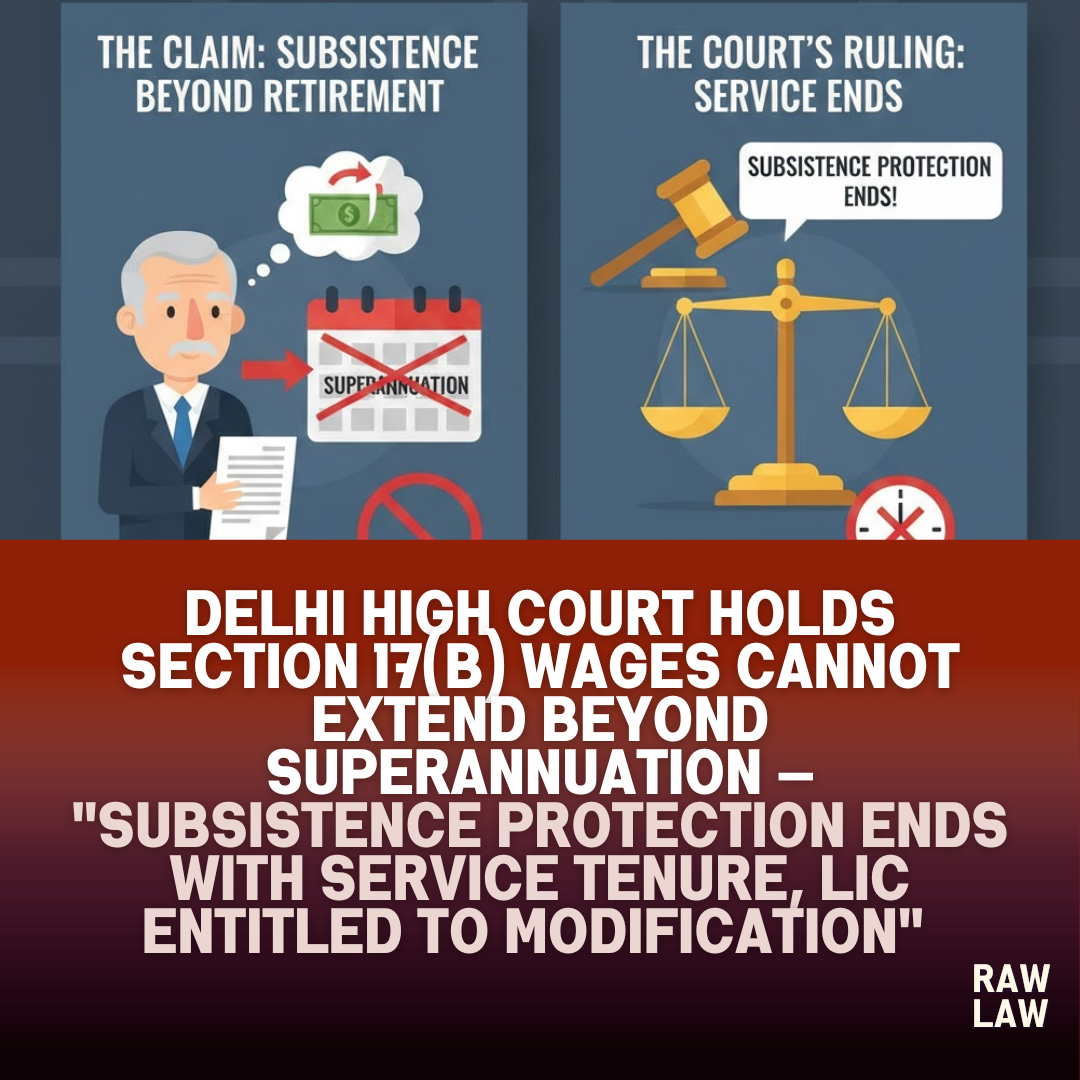
The Delhi High Court partly allowed an application filed by the Life Insurance Corporation of India seeking modification of an earlier interim order passed under Section 17(B) of the Industrial Disputes Act, 1947. The Court held that the statutory obligation to pay “last drawn wages” during pendency of proceedings challenging a reinstatement award cannot survive beyond the date of superannuation of the workman. While recognising the protective object of Section 17(B), the Court ruled that such protection is inseparably linked to the subsistence of an employer–employee relationship and must terminate once the workman ceases to be entitled to remain in service.
2. Facts
The respondent workman was appointed with the petitioner organisation in June 1984 and, at the relevant time, was working as a Higher Grade Assistant in Delhi. Disciplinary proceedings were initiated against him on allegations of insubordination and refusal to comply with office instructions. After the domestic enquiry was held to be invalid, the Central Government Industrial Tribunal passed an award in June 2016 directing reinstatement with full back wages and consequential benefits. The employer challenged the award before the Delhi High Court. During pendency of the writ petition, the workman invoked Section 17(B) of the Industrial Disputes Act, leading to an interim order in November 2017 directing payment of last drawn wages or minimum wages, whichever was higher. Payments were regularly made until April 2024, when the workman attained the age of superannuation.
3. Issues
The core issue before the Court was whether a workman is entitled to continue receiving wages under Section 17(B) of the Industrial Disputes Act after attaining the age of superannuation, during the pendency of proceedings challenging an award of reinstatement. Ancillary to this was the question whether the protective purpose of Section 17(B) could override service rules governing retirement.
4. Petitioner’s arguments
The employer argued that the benefit under Section 17(B) is temporary and conditional, meant only to mitigate hardship during pendency of litigation where reinstatement has been stayed. It was contended that once the workman attains the age of superannuation under applicable service rules, the employer–employee relationship comes to an end, and no legal fiction of deemed continuance can extend beyond that date. Reliance was placed on binding Division Bench judgments of the Delhi High Court holding that Section 17(B) wages are payable only till the date of superannuation and not thereafter. The petitioner submitted that continuing payments beyond retirement would result in an anomalous situation of fastening wage liability even after cessation of service.
5. Respondent’s arguments
The respondent workman opposed the application, contending that Section 17(B) uses broad language and entitles a workman to wages “during the pendency of such proceedings” without any express statutory cut-off at superannuation. It was argued that the provision is in the nature of subsistence allowance and is intended to prevent starvation during prolonged litigation caused by the employer’s challenge to a reinstatement award. Reliance was placed on earlier single-judge authority holding that superannuation does not disentitle a workman from Section 17(B) benefits so long as proceedings remain pending. The respondent also pleaded financial hardship and continued unemployment.
6. Analysis of the law
The Court undertook a detailed examination of the scheme of Section 17(B), noting that the provision is triggered only when an award of reinstatement is passed and its operation is stayed due to proceedings initiated by the employer. The Court emphasised that reinstatement presupposes an existing right to continue in service. Wages, by their very nature, are incidents of employment. The statutory fiction of deemed continuance created for limited purposes cannot be stretched beyond the period for which the employee would otherwise have been entitled to remain in service under applicable service rules.
7. Precedent analysis
The Court relied heavily on binding Division Bench judgments of the Delhi High Court, particularly those holding that Section 17(B) wages cannot be granted beyond the age of superannuation. These decisions have consistently ruled that once a workman attains the age of retirement, the award of reinstatement itself becomes incapable of execution, and therefore the ancillary benefit of wages during pendency must also cease. The Court expressly noted that earlier contrary single-judge views had either not been followed or stood diluted in view of subsequent Division Bench pronouncements. Support was also drawn from judgments of other High Courts, including Gujarat and Bombay, which have taken a similar view.
8. Court’s reasoning
Applying the settled legal position, the Court held that the respondent attained the age of superannuation on 11 April 2024 in terms of the applicable LIC service rules. The interim order directing payment under Section 17(B) was operative only so long as the respondent could legally be deemed to remain in service. Extending the benefit beyond superannuation would amount to reading Section 17(B) in isolation from service jurisprudence and would impose a liability not contemplated by law. The Court acknowledged the respondent’s plea of hardship but held that equitable considerations cannot override binding precedent or statutory limits. At the same time, it directed payment up to the end of the month in which superannuation occurred, consistent with service rules.
9. Conclusion
The Delhi High Court modified its earlier interim order and held that the respondent workman was entitled to Section 17(B) wages only up to 30 April 2024, being the month in which he superannuated. The employer was directed to release the differential amount for that limited period within four weeks. It was clarified that no payment under Section 17(B) would be payable beyond the date of superannuation. The writ petition challenging the reinstatement award was directed to be listed separately for final hearing.
10. Implications
This judgment reinforces a consistent judicial line that Section 17(B) is a protective but limited provision, tethered to the concept of reinstatement and subsisting service. It provides clarity to employers and workmen alike that the benefit cannot be claimed as a post-retirement allowance merely because litigation remains pending. The ruling strengthens doctrinal coherence in labour jurisprudence by aligning interim wage protection with service tenure, while still ensuring that workmen are not left uncompensated during the period they could legally have remained in service.
Case Law References
- Delhi Transport Corporation v. Ramesh Chander – Held that Section 17(B) wages are payable only till the age of superannuation; relied upon as binding precedent.
- Delhi Transport Corporation v. Prem Singh – Clarified that Section 17(B) operates within the employer–employee relationship and cannot extend beyond retirement.
- Essar Projects Ltd. v. N.D. Jagdishwara – Held that entitlement under Section 17(B) ceases once the workman is no longer entitled to reinstatement.
- Management of Centaur Hotel v. P.S. Mohan Nair – Earlier contrary view noted but not followed in light of subsequent binding authority.
FAQs
Q1. Can a workman receive Section 17(B) wages after retirement?
No. Courts have consistently held that Section 17(B) wages are payable only up to the date of superannuation and not thereafter.
Q2. What is the purpose of Section 17(B) of the Industrial Disputes Act?
It is a protective provision intended to provide subsistence to a workman during pendency of proceedings challenging a reinstatement award.
Q3. Does hardship justify extension of Section 17(B) benefits beyond superannuation?
No. While hardship is recognised, statutory benefits under Section 17(B) cannot be extended beyond what binding precedent and service rules permit.