

1. Court’s decision
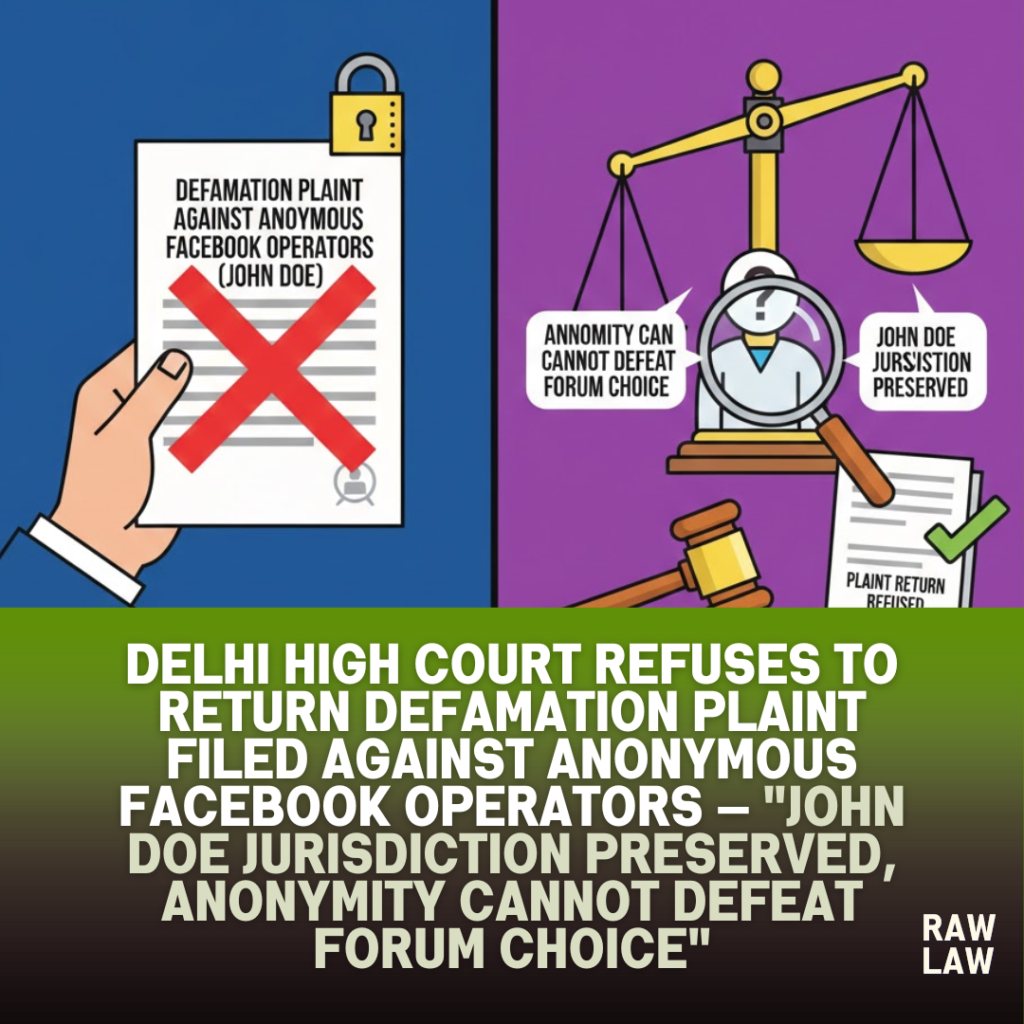
The Delhi High Court dismissed an application seeking return of a defamation plaint under Order VII Rule 10 of the Code of Civil Procedure, 1908, and held that a suit validly instituted in Delhi against unknown (John Doe) defendants cannot be returned merely because the defendants later reveal their identity and place of residence elsewhere. The Court ruled that anonymity adopted by alleged online wrongdoers cannot be used as a procedural weapon to compel re-institution of proceedings and nullify interim protections.
2. Facts
The plaintiffs are charitable and philanthropic foundations engaged in education, book distribution, and allied activities across India, including operations in Delhi. In 2020, anonymous individuals created a Facebook page publishing posts alleging financial irregularities, benami transactions, and misappropriation of donations by the plaintiffs. Claiming that the posts were defamatory and caused serious reputational and financial harm—particularly a sharp decline in donations earmarked for a vocational training centre in Delhi and reduced sales at a Delhi bookstore—the plaintiffs instituted a civil suit in the Delhi High Court against Meta Platforms and unknown operators of the impugned page (John Doe defendants). Interim injunctions were granted. Subsequently, the identities of the page operators, residents of Telangana, were discovered and they were impleaded as defendants.
3. Issues
The primary issue was whether the plaint should be returned for lack of territorial jurisdiction under Order VII Rule 10 CPC on the ground that the defendants resided in Telangana and that the alleged wrong was also committed there. A connected issue was whether the later disclosure of defendants’ identities could retrospectively invalidate a plaint that was lawfully instituted against anonymous defendants at the place where the alleged wrong was pleaded to have occurred.
4. Petitioners’ arguments
The defendants argued that no genuine part of the cause of action arose in Delhi and that the plaintiffs had indulged in forum shopping to harass them. They alleged that letters from foreign donors and emails from Delhi residents relied upon in the plaint were fabricated to manufacture jurisdiction. It was contended that since all parties were based in Telangana and reputational harm, if any, occurred there, the plaint ought to be returned. Reliance was placed on prior Delhi High Court precedent to argue that under Section 19 CPC, where the wrong and the defendant’s residence coincide, the plaintiff has no option to sue elsewhere.
5. Respondents’ arguments
The plaintiffs contended that an application under Order VII Rule 10 must be decided on a demurrer, accepting the plaint averments as true. They argued that at the time of institution, the defendants were anonymous, making Delhi—where harm, loss of donations, reduced sales, and access to defamatory content were pleaded—the proper forum. It was submitted that jurisdiction must be assessed as on the date of filing and that subsequent disclosure of defendants’ residence cannot defeat a suit validly instituted against John Doe defendants. The plaintiffs further argued that allegations of fabrication required evidence and could not be adjudicated at the threshold.
6. Analysis of the law
The Court analysed Section 19 CPC, which governs suits for compensation for wrongs to person or property, including defamation, and clarified that “wrong done” includes both the act and its consequences. It reiterated that objections under Order VII Rule 10 are to be determined on the plaint as filed, treating pleadings as correct. The Court examined the jurisprudence on cyber defamation, territorial jurisdiction, and the permissibility of instituting proceedings against unknown defendants where immediate relief is warranted.
7. Precedent analysis
The Court relied on Supreme Court authority in Exphar v. Eupharma Laboratories to reiterate the demurrer principle. It analysed and followed the Delhi High Court’s earlier rulings, including Escorts Ltd. v. Tejpal Singh Sisodia, as subsequently explained in Sameer Dnyandev Wankhede v. Red Chillies Entertainment. The Court endorsed the “Merger Rule” under Section 19 CPC but clarified its limited application, particularly where defendants’ identities were unknown at the time of filing and the suit was instituted at the place of alleged harm.
8. Court’s reasoning
On the pleadings, the Court found that the plaintiffs had specifically alleged reputational and financial harm in Delhi, including loss of donations for a Delhi-based project, reduced sales at a Delhi bookstore, and access to defamatory content in Delhi. Allegations that supporting materials were fabricated could not be examined without evidence and were unsuitable for determination at the threshold. While the Court accepted that reputational harm was also pleaded to have occurred in Telangana—thereby attracting the Merger Rule—it held that this could not be used to return a plaint that was validly instituted when the defendants’ residence was unknown. Allowing such a course would reward anonymity and nullify interim orders, causing grave prejudice to bona fide plaintiffs.
9. Conclusion
The Delhi High Court concluded that the suit was validly instituted in Delhi against John Doe defendants and that subsequent disclosure of defendants’ identities did not warrant return of the plaint. The application under Order VII Rule 10 CPC was dismissed, with liberty to the defendants to raise jurisdictional objections at an appropriate stage during trial based on evidence.
10. Implications
This judgment is significant for online defamation and digital harms litigation. It protects the efficacy of John Doe actions, ensures that anonymity cannot be exploited to derail proceedings, and clarifies that territorial jurisdiction is assessed at the time of institution. The ruling strengthens access to remedies for victims of anonymous online defamation and preserves interim protections granted by courts in such cases.
Case Law References
- Exphar v. Eupharma Laboratories – Held that jurisdictional objections under Order VII Rule 10 must proceed on the plaint averments as true.
- Escorts Ltd. v. Tejpal Singh Sisodia – Discussed territorial jurisdiction in defamation suits; analysed and applied with limitations.
- Sameer Dnyandev Wankhede v. Red Chillies Entertainment – Clarified the Merger Rule under Section 19 CPC and reconciled earlier precedents.
- Frank Finn Management Consultants v. Subhash Motwani – Recognised publication and reputational harm as bases for jurisdiction in defamation cases.
FAQs
Q1. Can a defamation suit filed against anonymous online users be returned once their identity is discovered?
No. If the suit was validly instituted against John Doe defendants at the place of alleged harm, later disclosure of identity does not invalidate jurisdiction.
Q2. How is territorial jurisdiction decided in online defamation cases?
Jurisdiction is assessed on the plaint as filed, considering where the wrong and its consequences are pleaded to have occurred.
Q3. Does anonymity protect online publishers from being sued in a chosen forum?
No. Courts have held that anonymity cannot be used to defeat jurisdiction or nullify interim reliefs granted to protect reputation.


