

Court’s decision
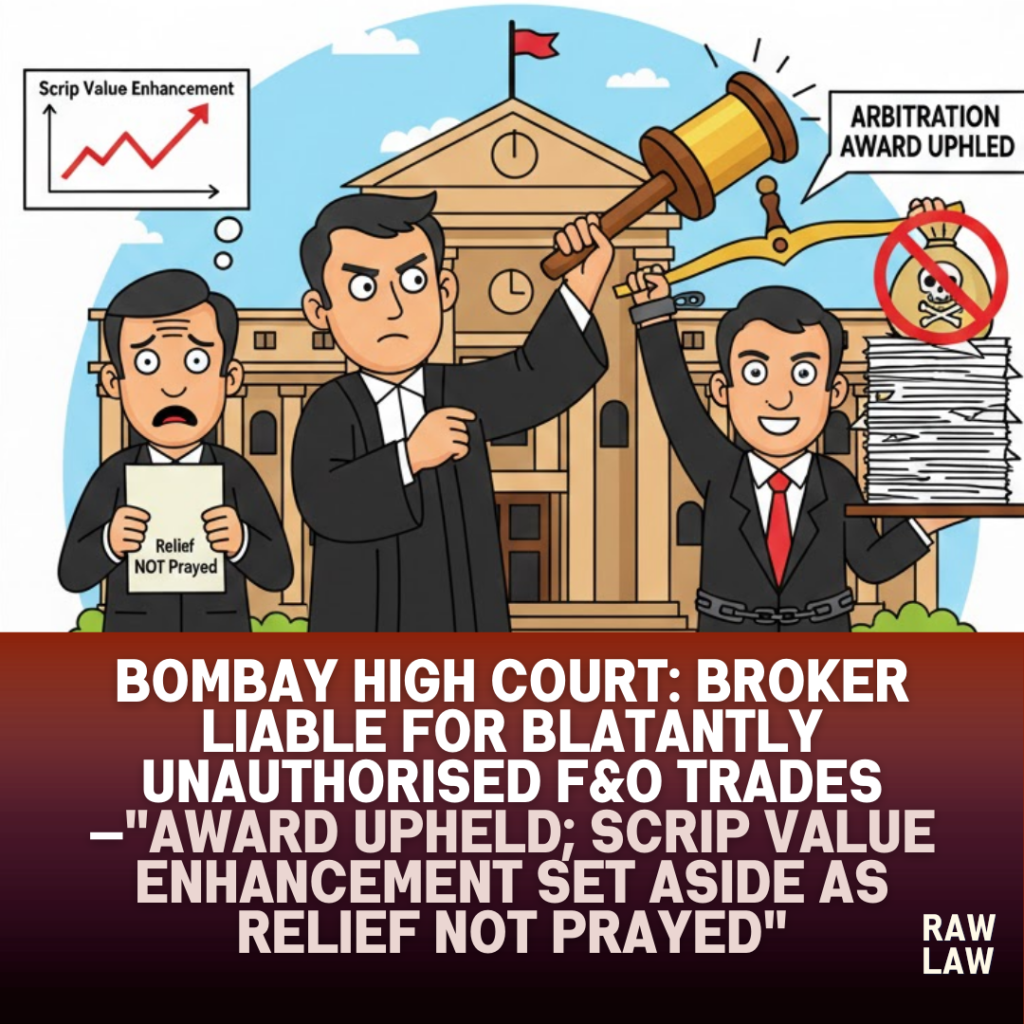
The Bombay High Court (Commercial Division) partly allowed petitions under Section 34 of the Arbitration and Conciliation Act, 1996, challenging an appellate arbitral award rendered under the bye-laws of the National Stock Exchange. The Court upheld the finding that the broker had executed blatantly unauthorised Futures & Options trades in the clients’ accounts, thereby affirming compensation. However, it set aside the enhancement granted by the Appellate Panel awarding prevailing scrip value as on the date of the arbitral award, holding that relief not specifically prayed for cannot be granted on equitable grounds.
Facts
The petitioner brokerage firm, a registered trading member of the National Stock Exchange and Bombay Stock Exchange, and a SEBI-registered depository participant, had opened trading accounts for the respondents, a husband and wife. Initially, the respondents opted to trade in the cash segment. Subsequently, activation of the Futures & Options (F&O) segment was recorded on 17 January 2020.
Thereafter, multiple F&O trades were executed, leading to substantial losses and complete erosion of the respondents’ portfolio. The respondents alleged that trades between 21 January 2020 and 18 June 2020 were unauthorised and induced by the petitioner’s relationship manager, who allegedly misrepresented assured profits and coached them to respond affirmatively to confirmation calls.
The Grievance Redressal Committee partly allowed one claim but rejected the other. The Sole Arbitrator, however, held the trades unauthorised and granted relief. The Appellate Panel upheld liability and modified the award by directing payment based on prevailing scrip value as on the date of the award.
Issues
The High Court examined:
- Whether the arbitral finding of unauthorised trading suffered from patent illegality.
- Whether absence of pre-trade authorisation under the SEBI Circular dated 22 March 2018 rendered trades automatically unauthorised.
- Whether the Appellate Panel exceeded jurisdiction by awarding relief not prayed for.
- Scope of interference under Section 34 in stock-broker arbitration disputes.
Petitioner’s arguments
The broker contended that the Appellate Panel ignored vital documentary evidence including SMS logs, electronic contract notes, margin statements, ledger entries, and call recordings evidencing post-trade confirmations. It argued that SEBI’s pre-trade authorisation requirement is directory, not mandatory, and absence of written pre-consent does not automatically invalidate trades.
Reliance was placed on precedents holding that absence of prior written authorisation is not evidence of absence of instruction. The petitioner further argued that awarding prevailing scrip value amounted to granting relief beyond pleadings, violating fundamental policy of Indian law.
Respondents’ arguments
The respondents maintained that they were senior citizens unfamiliar with F&O trading and were misled into activating the derivatives segment. They contended that trades were initiated by the broker’s relationship manager, not by them.
They relied on call transcripts showing only “yes” or “ok” responses after trades were initiated. It was argued that post-trade SMS alerts do not cure unauthorised execution. They further submitted that scope of interference under Section 34 is limited and arbitral findings based on appreciation of evidence cannot be disturbed.
Analysis of the law
The Court reiterated the narrow scope of interference under Section 34. An arbitral award can be interfered with only if it is perverse, irrational, or ignores vital evidence.
While acknowledging that SEBI Circular dated 22 March 2018 regarding pre-trade confirmation is directory, the Court clarified that unauthorised trading must be assessed holistically.
The Court distinguished between absence of pre-trade authorisation and blatantly unauthorised trades initiated by broker employees without client mandate. Where trades are initiated by the broker without authorisation, principles of acquiescence or delayed objection do not apply.
On the question of relief, the Court held that arbitral tribunals cannot award relief beyond what is claimed unless expressly authorised under Section 28(2) to decide ex aequo et bono.
Precedent analysis
The Court relied upon:
- Ulhas Dandekar v. Sushil Financial Services Pvt. Ltd. – SEBI circular requirement is directory; arbitral tribunals may examine surrounding evidence.
- Erach Khavar v. Nirmal Bang Securities – Distinction between absence of pre-authorisation and blatantly unauthorised trades.
- Sharekhan Ltd. v. Monita Kisan Khade – Broker liable for blatantly unauthorised trades; silence of passive investor does not imply consent.
- Associate Builders v. DDA and Ssangyong Engineering v. NHAI – Limited scope of Section 34 review.
- TJSB Sahakari Bank v. Amritlal Shah – Relief not prayed for violates fundamental policy of Indian law.
Court’s reasoning
The Court found that the Appellate Panel did not rely solely on absence of pre-trade confirmations but considered attendant circumstances including misrepresentation of F&O benefits, coaching in call confirmations, failure to assess client risk tolerance, and transcripts evidencing initiation by broker employees.
The respondents were senior citizens unfamiliar with derivatives trading, and their portfolio was completely wiped out. Call transcripts demonstrated that trades were initiated by the broker’s representatives without client mandate.
Thus, the finding of unauthorised trades was a plausible view based on cumulative assessment and did not warrant interference under Section 34.
However, the Appellate Panel’s award of prevailing scrip value as on the date of the award was beyond the pleadings. The respondents had claimed original portfolio value with interest. Granting enhanced market value on equitable grounds was impermissible.
Conclusion
The High Court partly allowed the petitions. It:
- Confirmed respondents’ entitlement to original portfolio value of ₹17,76,581 and ₹15,32,073 respectively with 18% interest from 10 August 2020 till realization, along with costs.
- Set aside the modification awarding prevailing scrip value as on 7 May 2024.
The award stood modified to this extent.
Implications
This ruling reinforces accountability of stock brokers in cases of blatantly unauthorised derivatives trading. It clarifies that regulatory compliance with SEBI circulars does not immunize brokers where initiation of trade is unauthorised.
Simultaneously, the judgment underscores limits on arbitral discretion: relief must align strictly with pleadings. Even in equity-driven disputes, arbitral tribunals cannot award amounts beyond claims.
The decision is significant for stock-broker arbitration, F&O disputes, and Section 34 jurisprudence in commercial courts.
Case Law References
- Ulhas Dandekar v. Sushil Financial Services Pvt. Ltd.
- Erach Khavar v. Nirmal Bang Securities
- Sharekhan Ltd. v. Monita Kisan Khade
- Associate Builders v. Delhi Development Authority
- Ssangyong Engineering & Construction Co. Ltd. v. NHAI
- TJSB Sahakari Bank Ltd. v. Amritlal P. Shah
FAQs
1. Are stock brokers liable for unauthorised F&O trades?
Yes. If trades are initiated by broker employees without client authorisation, brokers can be held liable for resulting losses.
2. Does absence of pre-trade confirmation automatically make trades illegal?
Not necessarily. However, if evidence shows trades were initiated without client mandate, they may be treated as blatantly unauthorised.
3. Can an arbitral tribunal grant relief not specifically claimed?
No. Granting relief beyond pleadings violates fundamental policy of Indian law unless expressly authorised.


