

Court’s decision
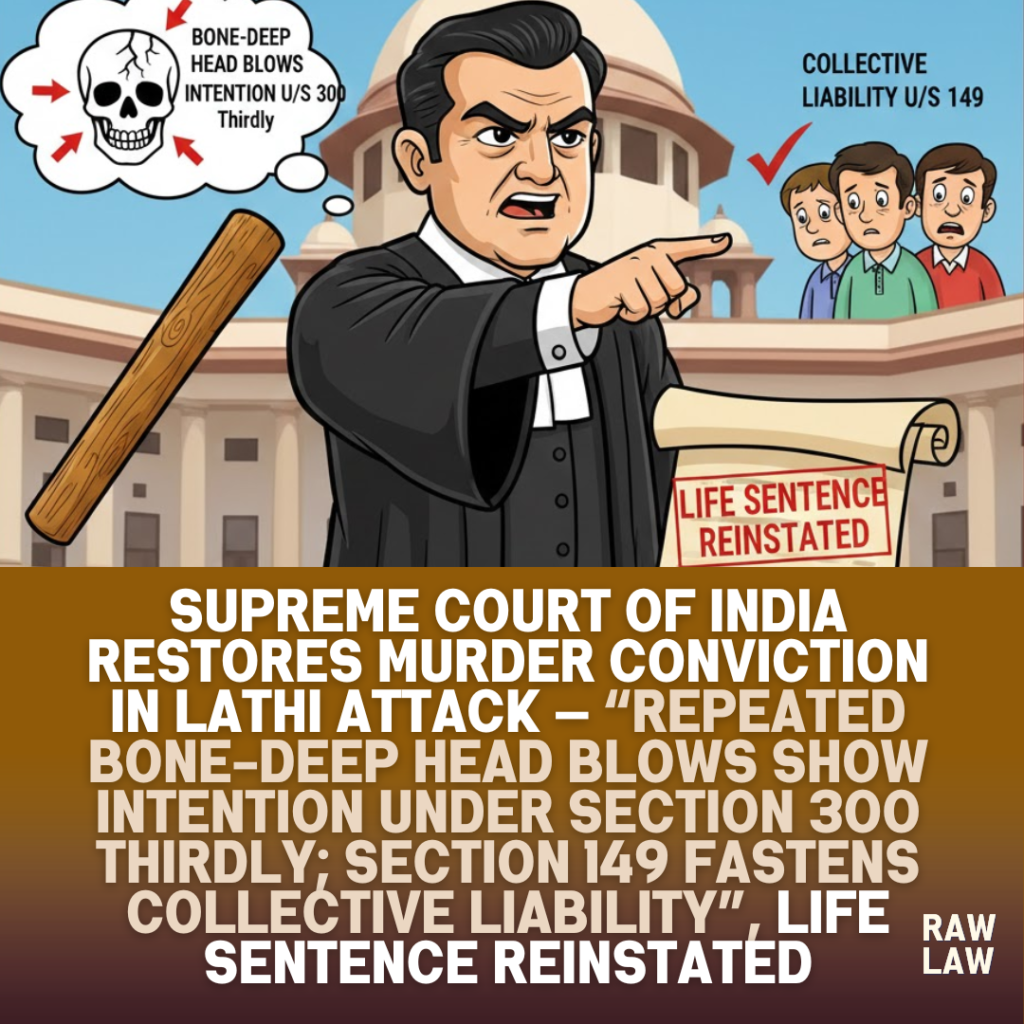
The Supreme Court of India allowed the appeals filed by the de facto complainant and the State, set aside the Madhya Pradesh High Court’s alteration of conviction, and restored the trial court’s judgment convicting the accused under Section 302 read with Section 149 of the Indian Penal Code.
The Court held that the High Court erred in downgrading the offence to culpable homicide not amounting to murder under Section 304 Part II. It ruled that multiple bone-deep head injuries, inflicted in a premeditated assault by an unlawful assembly, squarely attracted Clause (3) of Section 300 IPC. The sentence of life imprisonment was accordingly reinstated.
Facts
The case arose from a brutal attack in July 2003 in Madhya Pradesh. The deceased was travelling in a mini-bus when the accused allegedly obstructed the road by placing tube-well pipes across it. Upon stopping the vehicle, the occupants were assaulted with lathis.
The deceased sustained 29 injuries, including multiple bone-deep lacerations on the parietal and temporal regions of the skull. The post-mortem report recorded a linear fracture of the parietal bone with extradural and subarachnoid haemorrhage. Death was attributed to coma resulting from head injury.
The trial court convicted the accused under Sections 148, 323/149, 325/149 and 302/149 IPC. The High Court altered the conviction to Section 304 Part II read with Section 149 IPC and reduced the sentence to six years.
Issues
The Supreme Court confined the controversy to a narrow but significant question:
Whether the proven facts attracted murder under Section 302 IPC read with Section 149 IPC, or culpable homicide not amounting to murder under Section 304 Part II IPC.
The applicability of Section 149 IPC, and the existence of an unlawful assembly, had attained finality. The only surviving issue was the degree of culpability.
Petitioner’s arguments
The appellants contended that the High Court committed grave error in downgrading the conviction despite overwhelming medical and ocular evidence. It was argued that the assault was premeditated and retaliatory, arising from an earlier altercation the same day.
Counsel emphasised that 63 injuries were caused in total, of which 29 were inflicted on the deceased, including five serious head injuries. The repeated blows on vital parts demonstrated intention to inflict bodily injury sufficient in the ordinary course of nature to cause death.
It was further submitted that once Section 149 IPC applied, individual attribution of the fatal blow was immaterial.
Respondent’s arguments
The accused contended that only one injury was fatal and the remaining injuries were simple. They argued that lathis are not inherently deadly weapons and that the common object was merely to chastise the deceased.
It was also urged that the doctor who conducted the post-mortem was not examined, thereby weakening the prosecution’s case. According to the defence, the case at best fell within Section 304 Part II IPC.
Analysis of the law
The Court undertook a detailed exposition of the distinction between culpable homicide and murder, relying on precedent including Daya Nand v. State of Haryana and Virsa Singh v. State of Punjab.
It reiterated that under Clause (3) of Section 300 IPC, murder is made out if the accused intended to inflict the particular bodily injury that was sufficient in the ordinary course of nature to cause death. Intention to cause death is not mandatory if the intended injury itself meets the threshold.
The Court adopted a structured three-stage test: (1) homicide; (2) culpable homicide under Section 299; and (3) whether it falls within Section 300 or its exceptions.
Precedent analysis
The Court relied on:
- Daya Nand v. State of Haryana — clarified the genus-species relationship between Sections 299 and 300 IPC.
- Virsa Singh v. State of Punjab — laid down the four-step test for Clause (3) of Section 300 IPC.
- Pulicherla Nagaraju v. State of A.P. — enumerated factors for determining intention, including nature of weapon, part of body targeted, number of blows, and premeditation.
- Nitya Nand v. State of U.P. — reiterated that Section 149 IPC imposes vicarious liability once common object is established.
Applying these authorities, the Court found that the High Court misapplied the law by treating the death as the result of a solitary blow.
Court’s reasoning
The Supreme Court found the High Court’s observation that only one scalp injury existed to be perverse and contrary to the medical record. The post-mortem report disclosed four bone-deep lacerations on the head region, along with a fatal fracture.
The Court noted that the accused had deliberately blocked the road and lay in wait, indicating preparation and premeditation. The repeated blows to the head, a vital part of the body, demonstrated intention to inflict injuries sufficient to cause death.
The absence of the doctor’s oral testimony was held immaterial, as the post-mortem report had been admitted by the defence under Section 294 CrPC.
Once common object and unlawful assembly were established, Section 149 IPC fastened collective liability, making individual attribution unnecessary.
Conclusion
The Supreme Court concluded that the case squarely fell within Clause (3) of Section 300 IPC. The assault was neither sudden nor accidental, and none of the Exceptions to Section 300 were attracted.
The High Court’s alteration of conviction was set aside as legally unsustainable. The trial court’s conviction under Section 302 read with Section 149 IPC and the sentence of life imprisonment were restored.
Implications
This judgment reinforces the doctrinal clarity between murder and culpable homicide. It reiterates that repeated blows on vital parts, even with lathis, can amount to murder where intention to inflict sufficient bodily injury is established.
The ruling also strengthens the principle of vicarious liability under Section 149 IPC, preventing members of unlawful assemblies from escaping liability due to lack of individual attribution.
For criminal jurisprudence, the decision serves as a reaffirmation of the Virsa Singh doctrine and a caution against unwarranted dilution of murder convictions.
Case Law References
- Daya Nand v. State of Haryana (2008) 15 SCC 717 – Explained the three degrees of culpable homicide.
- Virsa Singh v. State of Punjab (1958 SCR 1495) – Established the four-step test for Clause (3) of Section 300 IPC.
- Pulicherla Nagaraju v. State of A.P. (2006) 11 SCC 444 – Laid down factors to determine intention.
- Nitya Nand v. State of U.P. (2024) 9 SCC 314 – Clarified vicarious liability under Section 149 IPC.
The Court applied these principles to restore the conviction for murder.
FAQs
1. When does culpable homicide become murder under Section 300 IPC?
It becomes murder when the accused intends to inflict a bodily injury that is sufficient in the ordinary course of nature to cause death, even if there is no explicit intention to kill.
2. Does using a lathi exclude murder charges?
No. Even a lathi can be a lethal weapon depending on how it is used, the force applied, and the part of the body targeted.
3. Is identifying the person who inflicted the fatal blow necessary under Section 149 IPC?
No. Once common object and unlawful assembly are proved, all members can be held vicariously liable for murder.


