

Court’s decision
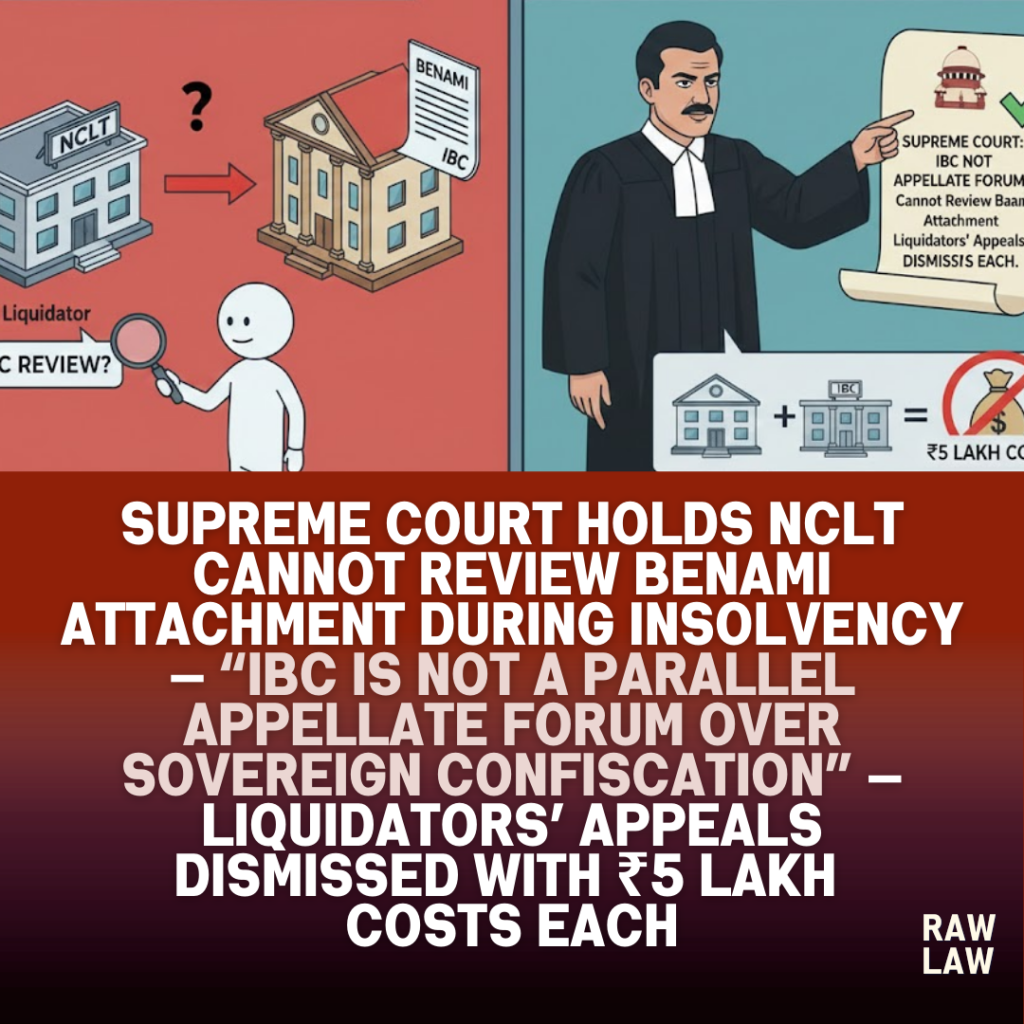
The Supreme Court dismissed a batch of appeals filed by liquidators challenging provisional attachment orders passed under the Prohibition of Benami Property Transactions Act, 1988. Affirming concurrent findings of the National Company Law Tribunal and National Company Law Appellate Tribunal, the Court held that the legality of attachment under the Benami Act cannot be questioned before authorities under the Insolvency and Bankruptcy Code, 2016.
The Court ruled that proceedings under the Benami Act are sovereign actions in rem and lie outside the jurisdiction of the NCLT under Section 60(5) IBC. Finding the appeals to be an abuse of process, it imposed exemplary costs of ₹5 lakh in each case.
Facts
The controversy arose from proceedings involving corporate debtors whose properties were provisionally attached under Section 24 of the Benami Act. Investigation revealed that promoters had allegedly transferred 100% shareholding of a sugar mill company to a beneficial owner through an intermediary for ₹450 crore paid in demonetised currency.
During search and seizure operations under the Income Tax Act, incriminating documents and share certificates were recovered. Statements recorded under oath confirmed receipt of consideration in demonetised currency and execution of blank memoranda to effectuate the transfer.
Meanwhile, insolvency proceedings under the IBC were initiated against the corporate debtor. CIRP commenced and, upon failure of resolution, liquidation was ordered.
During this period, the Benami authorities issued a provisional attachment order and later confirmed attachment of the immovable properties, characterising the corporate debtor as a benamidar holding property for the beneficial owner.
The liquidators approached the NCLT seeking to stay the attachment and treat the attached properties as part of the liquidation estate. The NCLT declined jurisdiction, holding that the Benami Act provides a separate adjudicatory mechanism. NCLAT affirmed. The matter reached the Supreme Court.
Issues
The Supreme Court framed the central question:
Whether the legality and validity of an attachment order passed under the Benami Act can be challenged before statutory authorities under the IBC?
Incidental issues included:
- Whether Section 238 IBC overrides the Benami Act.
- Whether the moratorium under Section 14 IBC bars attachment proceedings.
- Whether Section 32A protects attached assets.
- Whether Section 60(5) confers jurisdiction upon NCLT to review sovereign attachment orders.
Appellants’ arguments
The liquidators argued that permitting Benami proceedings to prevail would deplete the liquidation estate and undermine maximisation of value under the IBC. They contended that IBC is a comprehensive, later enactment with overriding effect under Section 238.
It was submitted that attachment proceedings fall within “proceedings” barred by Section 14 moratorium. Reliance was placed on Section 32A, asserting legislative intent to insulate corporate debtor property from past liabilities upon resolution or liquidation sale.
The appellants further argued that Section 60(5) grants wide residuary jurisdiction to NCLT over all questions of law or fact arising in relation to insolvency, including attachment interfering with liquidation.
Respondent’s arguments
The Revenue contended that the Benami Act is a self-contained special statute governing identification, attachment and confiscation of benami property, with its own appellate hierarchy.
It was argued that confiscation under Section 27 results in absolute vesting of property in the Central Government. Such sovereign action cannot be nullified through insolvency proceedings.
The Revenue emphasised that only assets beneficially owned by the corporate debtor form part of the liquidation estate under Section 36 IBC. Benami property, by definition, is held without beneficial ownership and never becomes part of distributable assets.
Analysis of the law
The Court undertook a comparative analysis of the Benami Act and the IBC.
The Benami Act, particularly after its 2016 amendments, constitutes a complete code providing for notice, provisional attachment, adjudication, confiscation, vesting, and appeal. Section 67 grants overriding effect.
Conversely, the IBC aims at insolvency resolution and maximisation of value of assets beneficially owned by the corporate debtor.
Applying principles governing conflicts between special statutes, the Court observed that where two special laws operate in potentially overlapping domains, the dominant purpose must be examined.
The Benami Act operates in the public law sphere to extinguish unlawful holdings and confiscate tainted property. IBC operates in the private law domain concerning insolvency resolution of legitimate assets.
The Court held that NCLT’s jurisdiction under Section 60(5) cannot extend to reviewing sovereign actions taken under penal statutes.
Precedent analysis
The Court relied upon its earlier rulings including:
- Embassy Property Developments Pvt. Ltd. v. State of Karnataka, holding that NCLT cannot exercise judicial review over public law decisions.
- Gujarat Urja Vikas Nigam Ltd. v. Amit Gupta, clarifying that disputes arising dehors insolvency must be pursued before competent forums.
- State Bank of India v. Union of India (2026 INSC 153), setting out principles for resolving conflicts between special statutes.
The Court reiterated that IBC cannot be used as a bypass to challenge sovereign determinations under specialised statutes.
Court’s reasoning
The Court held that attachment and confiscation under the Benami Act are sovereign proceedings in rem, distinct from creditor enforcement actions. The moratorium under Section 14 protects against creditor recovery actions, not penal confiscation proceedings.
Section 36 IBC restricts the liquidation estate to assets beneficially owned by the corporate debtor. If property is determined to be benami, the corporate debtor has no beneficial interest.
Section 32A is event-based and applies only after approval of a resolution plan or completion of liquidation sale. It does not validate defective title or immunise benami property.
Permitting NCLT to review Benami attachment would amount to converting it into a parallel appellate forum — an impermissible expansion of jurisdiction.
The Court found the appeals to be an attempt to circumvent statutory remedies under the Benami Act.
Conclusion
The Supreme Court dismissed the appeals, holding that attachment orders under the Benami Act cannot be challenged before NCLT or NCLAT under the IBC.
The proper remedy lies within the adjudicatory and appellate framework of the Benami Act.
Finding abuse of process, the Court imposed costs of ₹5 lakh in each appeal, payable to the Supreme Court Advocates-on-Record Association within four weeks.
Implications
This ruling significantly clarifies the interface between insolvency law and sovereign confiscatory statutes.
Key takeaways:
- IBC does not override Benami Act proceedings.
- NCLT cannot review sovereign attachment orders.
- Moratorium under Section 14 does not bar penal confiscation.
- Only beneficially owned assets form part of liquidation estate.
The judgment reinforces jurisdictional boundaries and prevents insolvency forums from becoming appellate platforms over public law actions.
Case law references
- Embassy Property Developments Pvt. Ltd. v. State of Karnataka (2020) 13 SCC 308 — NCLT lacks jurisdiction over public law decisions.
- Gujarat Urja Vikas Nigam Ltd. v. Amit Gupta (2021) 7 SCC 209 — disputes dehors insolvency must be pursued before competent authority.
- State Bank of India v. Union of India (2026 INSC 153) — principles for resolving conflicts between special statutes.
- Swiss Ribbons Pvt. Ltd. v. Union of India (2019) 4 SCC 17 — IBC’s objective is revival and value maximisation.
FAQs
1. Can NCLT set aside attachment under the Benami Act during insolvency?
No. The Supreme Court has held that attachment orders under the Benami Act must be challenged within that Act’s appellate framework.
2. Does Section 14 IBC moratorium stop Benami proceedings?
No. The moratorium applies to creditor recovery actions, not sovereign confiscation proceedings under penal statutes.
3. Do attached benami properties form part of liquidation estate?
No. Only assets beneficially owned by the corporate debtor can be included in the liquidation estate under Section 36 IBC.


