

Court’s decision
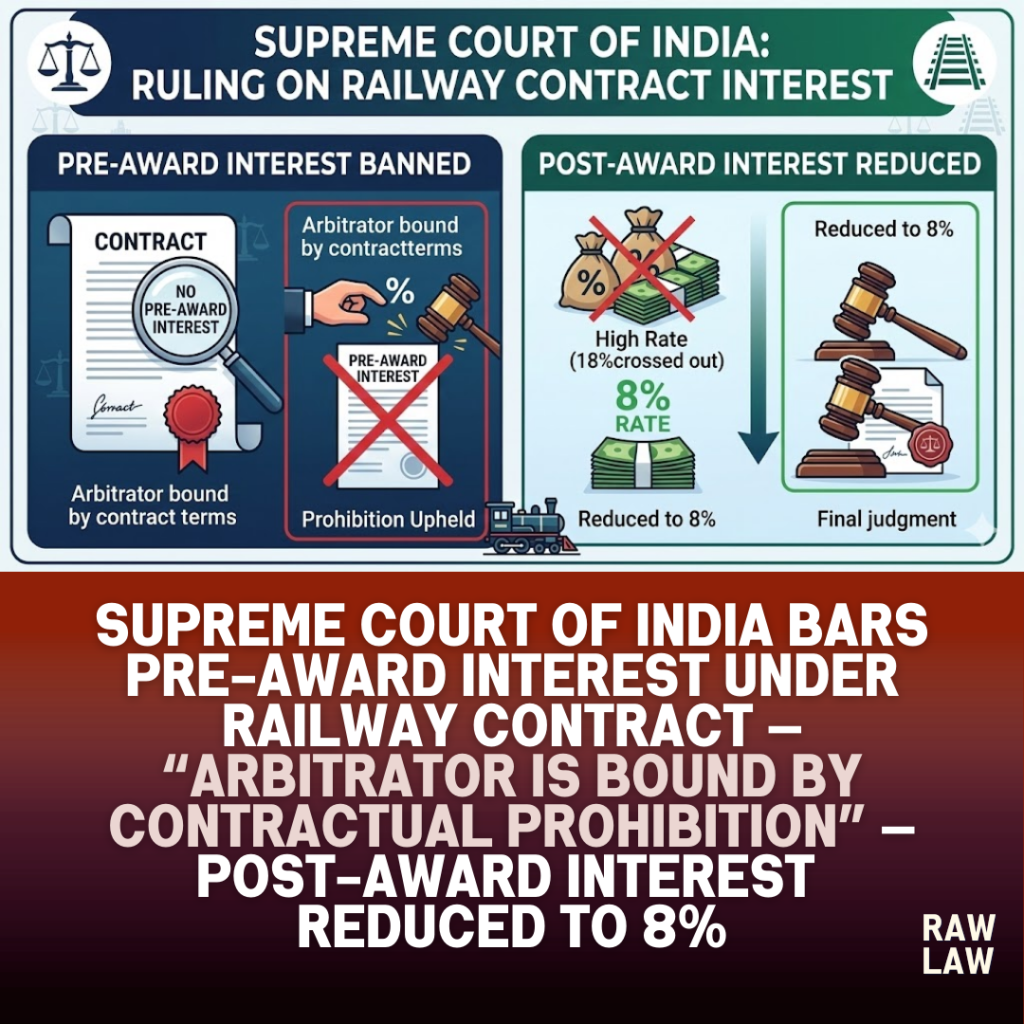
The Supreme Court of India has held that an arbitral tribunal cannot award pre-award or pendente lite interest when the contract expressly bars such interest. Interpreting Clauses 16(3) and 64(5) of the General Conditions of Contract in a railway modernization project, the Court set aside the award of pre-award interest granted under three claims.
However, the Court upheld the grant of post-award interest under Section 31(7)(b) of the Arbitration and Conciliation Act, 1996, modifying the rate from 12% to 8% per annum. The appeal was partly allowed, and the arbitral award stood modified accordingly.
Facts
The dispute arose out of a 2011 turnkey contract between the Union of India (North Central Railway) and Larsen & Toubro Limited for modernization of the Jhansi Workshop. The contract value was over ₹93 crore, with an original completion period of 18 months. The project suffered delays, and the completion timeline was extended multiple times.
Disputes emerged regarding delayed payments, price variation components, foreign exchange variations, and indirect costs during the extended period. The contract contained an arbitration clause under Clause 64 of the General Conditions of Contract (GCC). A three-member arbitral tribunal was constituted in 2018.
The tribunal awarded ₹5.53 crore in favour of Larsen & Toubro Limited, including amounts under claims relating to financing charges, non-payment of price variation component, and final bill payments. It rejected a separate claim for pendente lite interest but effectively included interest components within certain claims. Post-award interest at 12% per annum was granted in case of default.
The Commercial Court and the Allahabad High Court upheld the award under Sections 34 and 37 of the Arbitration Act. The Union of India appealed to the Supreme Court.
Issues
The Supreme Court framed three core issues:
- Whether the arbitral tribunal was justified in awarding pre-award or pendente lite interest despite contractual prohibitions under Clauses 16(3) and 64(5) of the GCC.
- Whether post-award interest could be granted notwithstanding the contractual bar.
- Whether the courts below erred in upholding the award under Sections 34 and 37 of the Arbitration and Conciliation Act, 1996.
Petitioner’s arguments
The Union of India argued that Clause 16(3) of the GCC categorically barred interest on earnest money, security deposits, and “amounts payable to the contractor under the contract.” According to the appellants, this prohibition was absolute and covered all claims arising from delayed payments under the contract.
It was submitted that Section 31(7)(a) of the Arbitration Act subordinates the arbitrator’s power to the agreement between the parties. Since the contract expressly excluded interest, the arbitral tribunal had no jurisdiction to award it in any form, including as “compensation.”
Reliance was placed on precedents holding that arbitrators cannot override contractual prohibitions on interest.
Respondent’s arguments
Larsen & Toubro Limited contended that Clause 16(3) should be interpreted ejusdem generis and confined to deposits like earnest money and security deposits. It was argued that the claims involved admitted sums and compensation for delayed payments, not contractual deposits.
The respondent further submitted that post-award interest flows statutorily under Section 31(7)(b), which is distinct from pre-award interest. It was argued that even if pre-award interest were barred, post-award interest cannot be excluded unless expressly prohibited.
The respondent also relied on earlier Supreme Court decisions interpreting similar clauses.
Analysis of the law
The Court examined Clause 16(3) of the GCC, which states that no interest shall be payable on earnest money, security deposit, or amounts payable under the contract. It rejected the ejusdem generis argument, holding that the use of the word “or” indicates disjunctive categories, not a limited genus.
Referring to Section 28(3) and Section 31(7)(a) of the Arbitration Act, the Court reiterated that arbitral tribunals must decide disputes in accordance with contractual terms. The expression “unless otherwise agreed by the parties” makes contractual prohibitions binding on arbitrators.
The Court observed that earlier judgments under the 1940 Arbitration Act cannot override the clear statutory scheme under the 1996 Act, which grants primacy to party autonomy.
Precedent analysis
The Court relied heavily on Union of India v. Bright Power Projects (India) Pvt. Ltd., Manraj Enterprises v. Union of India, and Sree Kamatchi Amman Constructions v. Railways, all of which held that arbitrators cannot award pre-award or pendente lite interest where the contract expressly bars it.
It distinguished earlier rulings under the 1940 Act such as Ambica Construction and Raveechee & Co., noting that the 1996 Act introduced a materially different statutory regime.
On post-award interest, the Court relied on RP Garg v. Chief General Manager, Telecom Department and Morgan Securities v. Videocon Industries Ltd., which clarified that Section 31(7)(b) is not subject to party autonomy in the same manner as Section 31(7)(a).
Court’s reasoning
The Court found that the arbitral tribunal had committed a serious error in awarding pre-award or pendente lite interest under Claim Nos. 1, 3, and 6. Even if labeled as “compensation,” such amounts were effectively interest on delayed payments and directly hit by Clause 16(3).
The tribunal itself had acknowledged the bar while rejecting a separate interest claim. Therefore, including interest components within other claims was inconsistent with the contractual framework.
However, the Court held that Clause 64(5) barred interest only “till the date on which the award is made.” There was no express prohibition against post-award interest.
Under Section 31(7)(b), post-award interest operates as a statutory mandate to ensure timely compliance. The Court clarified that contractual bars applicable to pre-award interest cannot be impliedly extended to post-award interest.
Nevertheless, the Court found 12% per annum excessive in the contemporary economic context. Exercising its power to modify post-award interest, it reduced the rate to 8% per annum.
Conclusion
The Supreme Court partly allowed the appeal. It set aside the arbitral award to the extent that it granted pre-award or pendente lite interest under Claim Nos. 1, 3, and 6. It upheld the grant of post-award interest but reduced the rate from 12% to 8% per annum from the date of award till realization.
The judgment reaffirms that arbitrators are strictly bound by contractual prohibitions under the Arbitration and Conciliation Act, 1996.
Implications
This ruling significantly strengthens contractual autonomy in arbitration. It underscores that:
- Contractual bars on interest are binding under Section 31(7)(a).
- Arbitrators cannot circumvent such bars by labeling interest as compensation.
- Post-award interest under Section 31(7)(b) operates independently unless expressly excluded.
- Courts may modify excessive post-award interest rates without setting aside the entire award.
The judgment will have wide implications for government contracts, infrastructure disputes, and railway arbitration matters.
Case law references
- Union of India v. Bright Power Projects (India) Pvt. Ltd. (2015)
Held that arbitrators cannot award interest where the contract expressly bars it. - Manraj Enterprises v. Union of India (2022)
Reaffirmed that contractual prohibitions on interest override arbitral discretion under the 1996 Act. - Sree Kamatchi Amman Constructions v. Railways (2010)
Held that arbitral tribunals are bound by contractual bars on interest. - RP Garg v. Chief General Manager, Telecom Department (2024)
Clarified that post-award interest under Section 31(7)(b) is distinct and not automatically subject to contractual prohibition.
FAQs
1. Can an arbitrator award interest if the contract prohibits it?
No. Under Section 31(7)(a) of the Arbitration and Conciliation Act, 1996, arbitrators are bound by contractual prohibitions on pre-award and pendente lite interest.
2. Is post-award interest automatically barred if the contract bars interest?
Not necessarily. Post-award interest under Section 31(7)(b) operates independently unless expressly excluded in the contract.3. Can courts reduce the rate of post-award interest?
Yes. Courts can modify excessive post-award interest rates without setting aside the entire arbitral award


