

Court’s decision
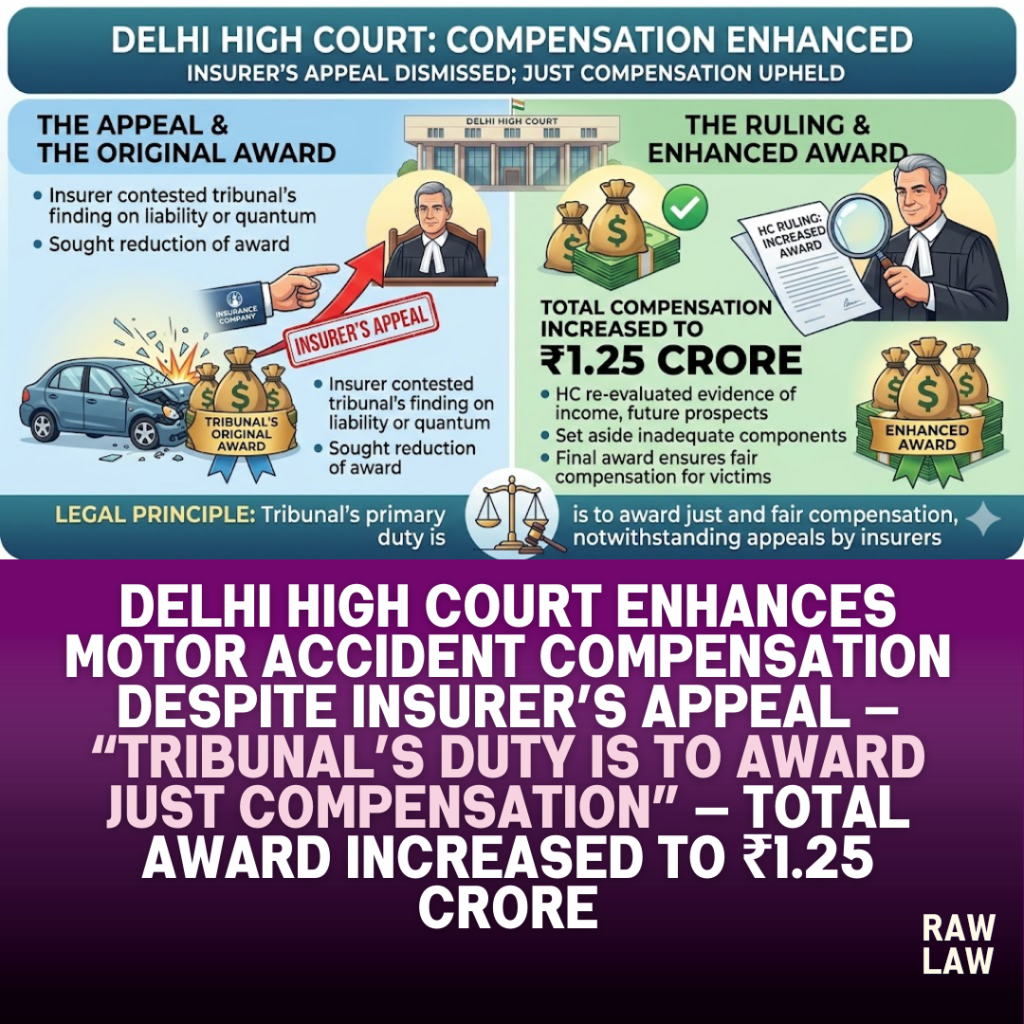
The Delhi High Court partly allowed an appeal filed by an insurance company against a Motor Accident Claims Tribunal award of ₹1,25,35,440/- in a grievous injury case, but ultimately enhanced the compensation to ₹1,25,84,913/-.
While reducing certain pecuniary heads such as medical expenses and recalculating loss of income and future earnings, the Court significantly increased compensation for future medical expenses and loss of amenities. The judgment reiterates that appellate courts can enhance compensation even in the absence of cross-appeal, if required to ensure “just compensation” under the Motor Vehicles Act.
Facts
The case arose from a road accident on 13 August 2016 at Dadri, Uttar Pradesh. The claimant was standing roadside near a college when a car allegedly driven rashly struck him. He sustained severe head injuries and was taken to Columbia Asia Hospital, Ghaziabad.
The medical records, as discussed in detail between pages 16–18 of the judgment, show that he suffered Diffuse Axonal Injury (traumatic brain injury) and a bimalleolar fracture. He underwent prolonged hospitalization from August to October 2016, including intubation and tracheostomy.
Subsequent medical records from G.B. Pant Institute reveal persistent neurological deficits, aggressive behaviour, psychiatric complications, and long-term dependency. A disability certificate issued on 24 January 2023 assessed him at 90% profound disability (page 17).
The Motor Accident Claims Tribunal awarded ₹1.25 crore with 7.5% interest. The insurance company appealed.
Issues
The High Court considered:
- Whether the insured vehicle was falsely implicated due to delay in FIR and alleged inconsistencies in medical records.
- Whether the Tribunal erred in awarding excessive compensation under various heads.
- Whether interest should have been denied for the period during which the claim petition was dismissed for default.
- Whether the appellate court could enhance compensation without cross-objections.
Appellant’s arguments
The insurance company argued that the vehicle was falsely implicated. It relied on a 12-day delay in FIR registration and discrepancies between the Medico-Legal Certificate and oral testimony. It also attacked the credibility of the eye-witness, pointing out that he could not read English alphabets forming part of the vehicle registration number.
On quantum, it contended that several heads—future medical expenses, pain and suffering, special diet, attendant charges—were unsupported by documentary proof. It relied on Supreme Court precedent in ICICI Lombard v. Ajay Kumar Mohanty to argue that loss of income should be calculated using the average of three years’ income tax returns.
The insurer also challenged grant of interest during the period when the petition stood dismissed for default.
Respondent’s arguments
The claimant argued that the delay in FIR was explained because he was immediately hospitalized in critical condition. The police were aware from the beginning and ultimately filed a charge-sheet.
He defended the Tribunal’s findings on negligence and quantum, emphasizing his 90% disability, psychiatric complications, and permanent inability to earn. He contended that the award was fair and in fact conservative given the extent of suffering.
Analysis of the law
On negligence, the Court reiterated that MACT proceedings are decided on a preponderance of probabilities, not strict criminal standards. It relied on Supreme Court authorities such as Anita Sharma, Sunita v. Rajasthan SRTC, and Bimla Devi, noting that filing of a charge-sheet itself is sufficient corroborative evidence.
The Court distinguished New India Assurance v. Velu, holding that delay in FIR is not fatal unless accompanied by contradictory medical evidence or police closure. Here, investigation resulted in charge-sheet.
On quantum, the Court applied principles from Raj Kumar v. Ajay Kumar, Sarla Verma, and Pranay Sethi regarding functional disability, multiplier, and future prospects.
Precedent analysis
The Court carefully applied Raj Kumar to assess 100% functional disability, observing that though medical disability was 90%, the claimant’s earning capacity was entirely destroyed.
It applied Sarla Verma and Pranay Sethi to confirm multiplier of 15 and 40% future prospects for a 38-year-old self-employed person.
It referred to Kajal v. Jagdish Chand and Abhimanyu Partap Singh to uphold multiplier-based computation of attendant charges.
Significantly, relying on Surekha v. Santosh, the Court held that compensation can be enhanced even without cross-appeal if justice so demands.
Court’s reasoning
The Court rejected the insurer’s challenge to negligence, holding that minor inconsistencies in the MLC could not override consistent oral evidence and the charge-sheet.
On medical expenses, it deducted ₹30,000/- for unsupported miscellaneous claims.
On income, it averaged two assessment years due to abnormal post-accident variation, reducing annual income slightly. This led to recalculation of loss of future earnings from ₹70.71 lakh to ₹66.70 lakh.
However, the Court enhanced future medical expenses from ₹5 lakh to ₹7 lakh, noting lifelong psychiatric and neurological care requirements.
It also increased loss of amenities from ₹2 lakh to ₹5 lakh, observing that the claimant’s social, familial, and economic life stood permanently devastated.
The comparative table on page 25 shows the recalculated heads and resulting enhancement of ₹49,473/-.
Conclusion
The Delhi High Court modified the award and enhanced total compensation to ₹1,25,84,913/- with 7.5% interest from the date of filing (31 July 2018).
The insurer was directed to deposit the enhanced amount within eight weeks. The disbursement scheme requiring ₹1 crore to be kept in fixed deposits was maintained.
The appeal was disposed of with directions for compliance and appearance before the Tribunal on 23 March 2026.
Implications
This ruling reinforces several critical principles in motor accident compensation law:
- Delay in FIR is not automatically fatal to a claim.
- Filing of a charge-sheet strongly supports negligence findings.
- Functional disability, not merely medical disability, governs loss of earning capacity.
- Courts may enhance compensation even in insurer appeals.
- “Just compensation” remains the guiding statutory mandate.
The decision is particularly significant for catastrophic injury cases involving traumatic brain injury and psychiatric sequelae, where long-term care costs and non-pecuniary losses must be realistically assessed.
Case Law References
- Raj Kumar v. Ajay Kumar (2011) – Functional disability must reflect impact on earning capacity.
- Sarla Verma v. DTC (2009) – Standardized multiplier method.
- National Insurance Co. Ltd. v. Pranay Sethi (2017) – Future prospects framework.
- Kajal v. Jagdish Chand (2020) – Multiplier method valid for attendant charges.
- Surekha v. Santosh (2021) – Appellate court may enhance compensation without cross-appeal.
FAQs
1. Can compensation be enhanced in an insurer’s appeal?
Yes. Courts can enhance compensation if required to ensure “just compensation,” even without cross-appeal by the claimant.
2. Is delay in FIR fatal in motor accident cases?
No. Courts assess delay holistically. If police investigation supports the accident, delay alone is insufficient to dismiss a claim.
3. How is loss of future income calculated in permanent disability cases?
Courts apply functional disability, add future prospects, and use multiplier method as per Sarla Verma and Pranay Sethi.


