

1. Court’s decision
The Madras High Court partly allowed appeals filed by both the injured minor claimant and the insurance company in a motor accident compensation dispute.
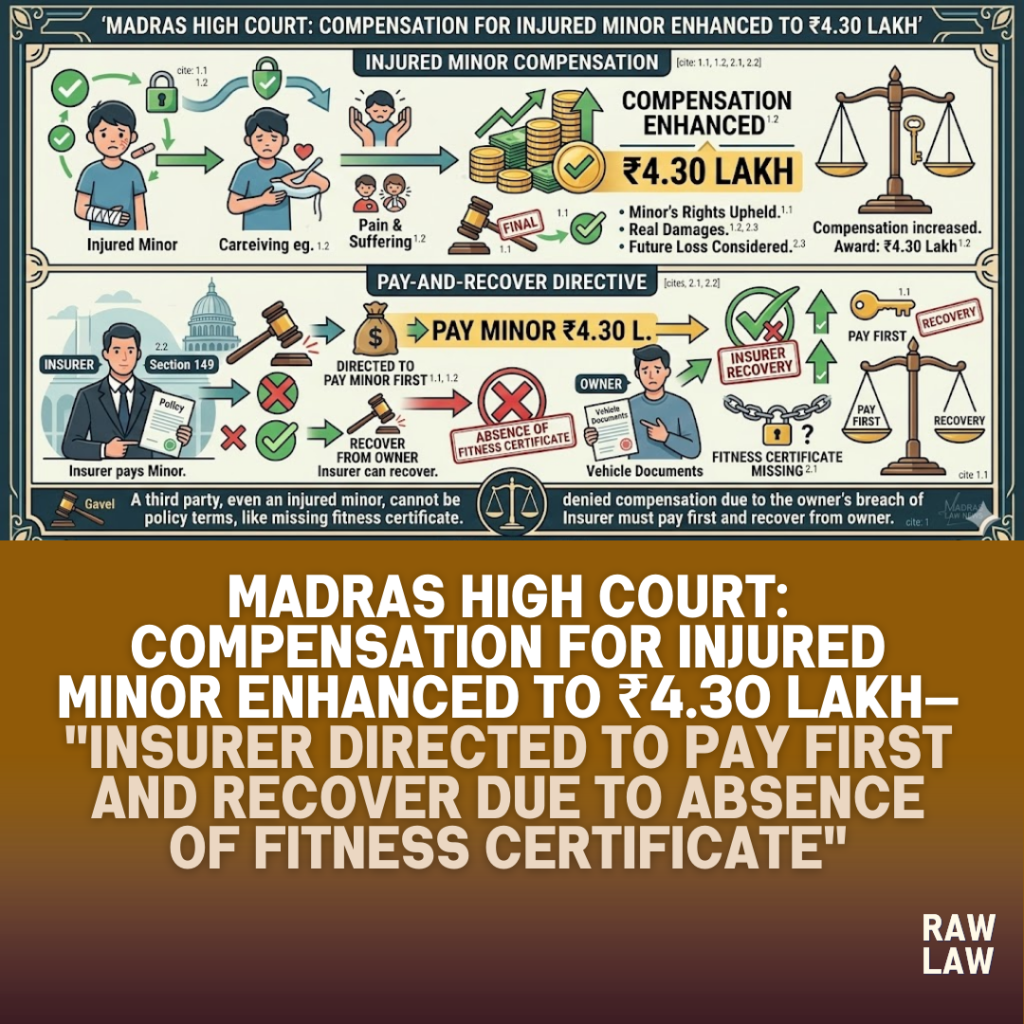
The Court enhanced the compensation awarded by the Motor Accident Claims Tribunal and modified the liability of the insurer.
While directing the insurer to deposit the compensation amount at the first instance, the Court granted it liberty to recover the amount from the owner of the offending vehicle due to violation of statutory requirements relating to the vehicle’s fitness certificate.
2. Facts
The case arose from a road accident that occurred on 3 December 2015 at around 6:10 p.m. on Unnamalai Chettychavadi Main Road near Iyyanar Temple.
The minor claimant was travelling as a pillion rider on a motorcycle driven by his father when a car coming from the opposite direction collided with the motorcycle due to rash and negligent driving.
As a result of the accident, the minor suffered a fracture in his right leg and multiple injuries. He was first admitted to the Government Hospital in Cuddalore and subsequently received treatment at a private hospital.
The claimant filed a compensation claim seeking ₹15,00,000 before the Motor Accident Claims Tribunal.
3. Issues
The High Court examined two main issues in the appeals.
First, whether the compensation awarded by the Motor Accident Claims Tribunal was adequate considering the injuries and permanent disability sustained by the minor claimant.
Second, whether the insurance company could avoid liability on the ground that the offending vehicle lacked a valid fitness certificate at the time of the accident.
The Court also considered whether the Tribunal should have applied the “pay and recover” principle while fixing liability.
4. Petitioner’s arguments
The minor claimant argued that the compensation awarded by the Tribunal was inadequate, particularly the amount granted for permanent disability.
The claimant’s counsel submitted that the Medical Board had assessed the minor’s disability at 30%, which was permanent in nature.
Relying on Supreme Court precedent, it was argued that a higher amount should have been awarded under the head of permanent disability in cases involving injured minors.
The claimant therefore sought enhancement of compensation by the High Court.
5. Respondent’s arguments
The insurance company argued that the Tribunal erred in directing it to pay compensation without considering that the offending vehicle lacked a valid fitness certificate at the time of the accident.
According to the insurer, operating a vehicle without a valid fitness certificate constituted a violation of statutory provisions under the Motor Vehicles Act.
The insurer therefore contended that it should either be exonerated from liability or that the Tribunal should have ordered “pay and recover”, allowing the insurer to recover the compensation amount from the vehicle owner after payment.
6. Analysis of the law
The Court examined the statutory framework under the Motor Vehicles Act, 1988 governing vehicle permits and roadworthiness requirements.
Under the Act and the Central Motor Vehicles Rules, a transport vehicle must possess a valid fitness certificate certifying its roadworthiness.
The Court observed that ensuring the mechanical fitness of vehicles is essential for protecting the safety of passengers, pedestrians and other road users.
Failure to possess a valid fitness certificate constitutes a breach of statutory obligations by the vehicle owner.
7. Precedent analysis
The Court relied on the judgment of the Supreme Court of India in Amrit Paul Singh v. Tata AIG General Insurance Co. Ltd..
In that case, the Supreme Court held that absence of a valid fitness certificate constitutes a fundamental breach of insurance conditions, allowing the insurer to recover the compensation amount from the vehicle owner after satisfying the award.
The Court also relied on the Supreme Court’s decision in Master Mallikarjun v. Divisional Manager, National Insurance Co. Ltd. regarding compensation for permanent disability suffered by minors.
8. Court’s reasoning
The High Court noted that the minor claimant had suffered permanent disability assessed at 30% by the Medical Board.
Applying the principles laid down by the Supreme Court in cases involving injured minors, the Court held that the compensation awarded by the Tribunal under the head of permanent disability was insufficient.
Accordingly, the Court enhanced the amount awarded for permanent disability to ₹3,00,000.
The Court also accepted the insurer’s contention that the offending vehicle did not possess a valid fitness certificate at the time of the accident.
In such circumstances, the appropriate course was to direct the insurer to pay the compensation to the claimant and subsequently recover the amount from the vehicle owner.
9. Conclusion
The High Court enhanced the compensation payable to the minor claimant from ₹2,50,216 to ₹4,30,216 with interest at 7.5% per annum from the date of filing of the claim petition.
The insurance company was directed to deposit the compensation amount within four weeks and was granted liberty to recover the amount from the owner of the offending vehicle.
The Court further directed that the compensation amount be deposited in a fixed deposit in a nationalised bank until the minor attains majority, with the guardian permitted to withdraw the accrued interest periodically.
10. Implications
The judgment reinforces the principle that courts must ensure fair compensation for injured minors, particularly where permanent disability affects their future prospects.
It also reiterates that insurers may be granted recovery rights when statutory requirements—such as possession of a valid fitness certificate—are violated by the vehicle owner.
The ruling illustrates the judiciary’s approach in balancing victim compensation with enforcement of statutory compliance in motor accident cases.
Case Law References
- Master Mallikarjun v. Divisional Manager, National Insurance Co. Ltd. (2013)
The Supreme Court laid down guidelines for awarding compensation to minors suffering permanent disability in motor accident cases. - Amrit Paul Singh v. Tata AIG General Insurance Co. Ltd. (2018)
The Supreme Court held that absence of a valid fitness certificate constitutes a fundamental breach of insurance policy conditions, enabling insurers to recover compensation from vehicle owners.
FAQs
1. How do courts calculate compensation for injured minors in road accidents?
Courts rely on Supreme Court guidelines and consider factors such as the extent of permanent disability, medical expenses, pain and suffering, and the long-term impact on the minor’s life.
2. What happens if a vehicle involved in an accident does not have a valid fitness certificate?
Courts may apply the “pay and recover” rule, requiring the insurance company to pay compensation to the victim first and later recover the amount from the vehicle owner.
3. Can compensation awarded by a Motor Accident Claims Tribunal be increased by the High Court?
Yes. If the High Court finds that the Tribunal awarded inadequate compensation or misapplied legal principles, it may enhance the compensation amount.


