

Court’s decision
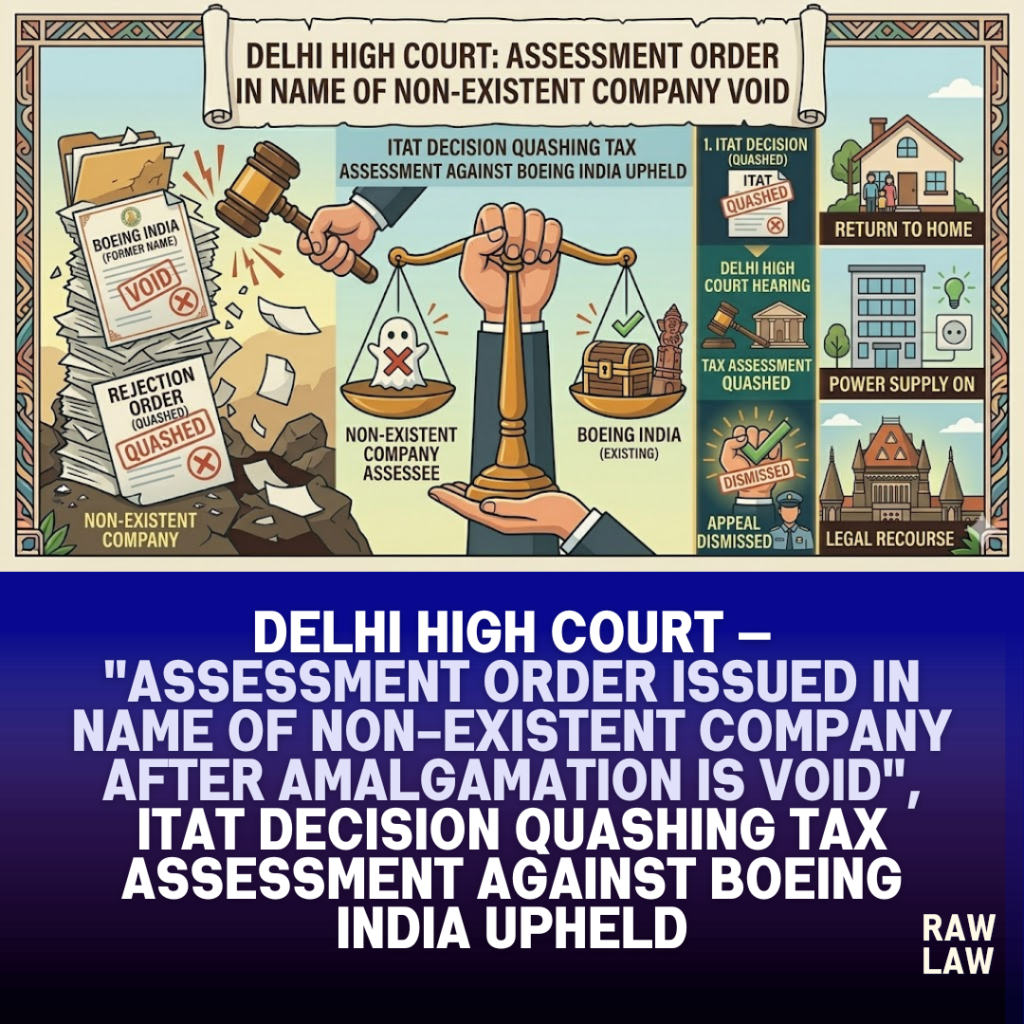
The Delhi High Court held that the Income Tax Appellate Tribunal was correct in quashing the final assessment order passed by the assessing officer for the assessment year 2016–17. The Court concluded that the order dated 30 March 2021 was issued in the name of a company that had already ceased to exist following amalgamation.
The Bench clarified that issuing an assessment order against a non-existent entity is a jurisdictional defect that renders the entire proceeding void. The Court rejected the revenue’s argument that the error was a technical irregularity caused by limitations in the Income Tax Business Application portal.
Consequently, the appeal filed by the Principal Commissioner of Income Tax was dismissed and the tribunal’s order in favour of Boeing India was upheld.
Facts
The case arose out of income tax proceedings for assessment year 2016–17 relating to a corporate restructuring within the Boeing group in India. Initially, the return of income for the relevant assessment year was filed in November 2016 by Boeing International Corporation India Private Limited.
Subsequently, the company underwent amalgamation with Boeing India Private Limited pursuant to a scheme of merger approved in February 2018. Under the approved scheme, the amalgamating entity ceased to exist and all its assets, liabilities, and obligations were transferred to the amalgamated entity.
Following the merger, the assessee formally informed the income tax authorities about the amalgamation through written communication in April 2018. The tax authorities therefore had prior knowledge that the earlier corporate entity no longer existed.
During the course of assessment proceedings, the Transfer Pricing Officer issued an order in October 2019 in the name of the amalgamated entity. The Dispute Resolution Panel also issued directions in the name of the successor company.
However, despite these developments, the assessing officer eventually passed the final assessment order in March 2021 in the name of the amalgamating entity that had already ceased to exist.
Aggrieved by the assessment order, the assessee approached the Income Tax Appellate Tribunal. The tribunal quashed the assessment on the ground that the order had been issued against a non-existent company. The revenue then challenged that decision before the Delhi High Court.
Issues
The Delhi High Court was required to decide the following legal questions:
- Whether an assessment order issued in the name of an amalgamating company that had ceased to exist after merger is legally valid.
- Whether such an error could be treated as a procedural defect curable under Section 292B of the Income Tax Act.
- Whether the tribunal erred in quashing the assessment order despite the revenue’s claim that the mistake occurred due to technical limitations of the Income Tax Business Application portal.
- Whether prior judicial precedents concerning amalgamation and assessment proceedings applied to the present dispute.
Petitioner’s arguments
The revenue argued that the tribunal had erred in quashing the assessment order because the proceedings had been initiated correctly in the name of the original entity before the amalgamation occurred. According to the revenue, the scrutiny notice issued under Section 143(2) was valid since it was issued before the merger took effect.
The revenue further contended that the final assessment order had been issued in the name of the predecessor company due to a technical limitation within the Income Tax Business Application portal. Since the assessment proceedings had been initiated with the original Permanent Account Number, the system automatically reflected the earlier company name in the final order.
It was submitted that the error was purely procedural and should be treated as a curable defect under Section 292B of the Income Tax Act. The revenue also relied on judicial precedents which recognized that clerical or technical mistakes should not invalidate otherwise valid proceedings.
Additionally, the revenue argued that substantial compliance had been achieved because various stages of the proceedings, including orders of the Transfer Pricing Officer and the Dispute Resolution Panel, were issued in the name of the amalgamated entity.
Respondent’s arguments
The assessee argued that the tribunal correctly applied settled legal principles which prohibit assessment proceedings against non-existent entities. It was emphasized that the amalgamation had been formally communicated to the tax authorities well before the final assessment order was passed.
According to the assessee, once the authorities were informed that the earlier company had ceased to exist, they were obligated to substitute the successor entity in the proceedings. Continuing to issue an assessment order in the name of the dissolved entity rendered the order invalid.
The assessee also argued that the defect was not a minor procedural irregularity but a jurisdictional error. Section 292B of the Income Tax Act could not cure such a defect because the assessment had been issued against a legally non-existent person.
Furthermore, the assessee rejected the revenue’s explanation regarding the technical limitations of the Income Tax Business Application portal, contending that administrative or technological limitations cannot override statutory requirements.
Analysis of the law
The Court examined the statutory provisions governing assessment proceedings under the Income Tax Act, particularly Section 143, Section 144C, and Section 292B.
Section 292B protects assessment proceedings from being invalidated due to minor mistakes or technical errors if the proceedings substantially conform to the intent of the Act. However, the Court clarified that this provision cannot cure jurisdictional defects.
When a company undergoes amalgamation, the amalgamating entity ceases to exist as a legal person. Any assessment proceedings must therefore be conducted against the successor entity. Issuing an assessment order against a non-existent company violates fundamental principles of jurisdiction and legal personality.
The Court observed that once the assessing officer had been informed of the merger, it was incumbent upon the department to ensure that subsequent proceedings reflected the correct legal entity.
Precedent analysis
The Court relied heavily on the Supreme Court’s decision in PCIT v. Maruti Suzuki India Ltd., which held that issuing a notice or assessment order against a non-existent entity following amalgamation constitutes a substantive illegality.
The Court also referred to Spice Entertainment Ltd. v. Commissioner of Income Tax, where it was held that an assessment made against an amalgamating company is void because the entity no longer exists.
The revenue relied on PCIT v. Mahagun Realtors Pvt. Ltd., where the Supreme Court upheld an assessment order despite the amalgamation. However, the Delhi High Court distinguished that judgment on factual grounds because, in that case, the assessee had not properly informed the tax authorities about the merger.
In the present case, the amalgamation had been explicitly communicated to the assessing officer well before the assessment order was issued.
Court’s reasoning
The Court held that the revenue’s argument regarding a technical limitation in the Income Tax Business Application portal was unpersuasive. Administrative or technological constraints cannot justify a violation of statutory requirements.
The Bench emphasized that once the merger was brought to the notice of the assessing officer, it became mandatory for the department to conduct proceedings against the successor entity.
The Court also observed that the final assessment order did not even mention the amalgamation or explain why the order was issued in the name of the earlier entity.
Since the amalgamating company had ceased to exist in law, issuing the assessment order against it amounted to a fundamental jurisdictional defect. Such a defect cannot be cured by invoking Section 292B.
Conclusion
The Delhi High Court concluded that the final assessment order issued in the name of the amalgamating company was legally unsustainable. The Court affirmed the tribunal’s decision declaring the order void and dismissed the revenue’s appeal.
The Court reiterated that assessment proceedings against a non-existent entity are invalid and cannot be treated as mere procedural irregularities.
Implications
This judgment reinforces an important principle in tax law: once a company merges and ceases to exist, all tax proceedings must be conducted against the successor entity.
The ruling also clarifies that technological limitations within tax administration systems cannot override statutory compliance. Revenue authorities must ensure that their digital platforms and procedures align with legal requirements.
For corporate taxpayers, the judgment provides greater certainty that once amalgamation is formally communicated to the tax authorities, subsequent assessment proceedings must reflect the correct legal entity.
The decision further strengthens the precedent set by the Supreme Court in Maruti Suzuki and continues the judiciary’s consistent stance against assessments made in the name of non-existent companies.
Case Law References
PCIT v. Maruti Suzuki India Ltd. (2020)
The Supreme Court held that issuing a notice or assessment order against a non-existent company following amalgamation constitutes a jurisdictional defect and renders the assessment void.
Spice Entertainment Ltd. v. Commissioner of Income Tax (2012)
The Delhi High Court ruled that assessment proceedings against an amalgamating company after merger are invalid and cannot be cured by Section 292B of the Income Tax Act.
PCIT v. Mahagun Realtors Pvt. Ltd. (2022)
The Supreme Court distinguished cases where the assessee itself continued to represent the amalgamating entity and failed to disclose the merger to the authorities.
FAQs
1. Is a tax assessment order valid if issued against a company that has merged and ceased to exist?
No. Courts have consistently held that assessment orders issued against non-existent entities following amalgamation are void because they suffer from a jurisdictional defect.
2. Can Section 292B of the Income Tax Act cure an assessment order issued in the name of a non-existent company?
No. Section 292B only cures technical or clerical errors. Issuing an assessment order against a non-existent entity is considered a substantive legal defect.
3. What must tax authorities do after being informed about a corporate merger?
Once informed about an amalgamation, authorities must substitute the successor entity in assessment proceedings and issue all notices and orders in the name of the amalgamated company.


