

Court’s decision
The Delhi High Court upheld the order dated 8 January 2025 passed by the District Judge granting a decree of possession in favour of the respondent under Order XII Rule 6 CPC.
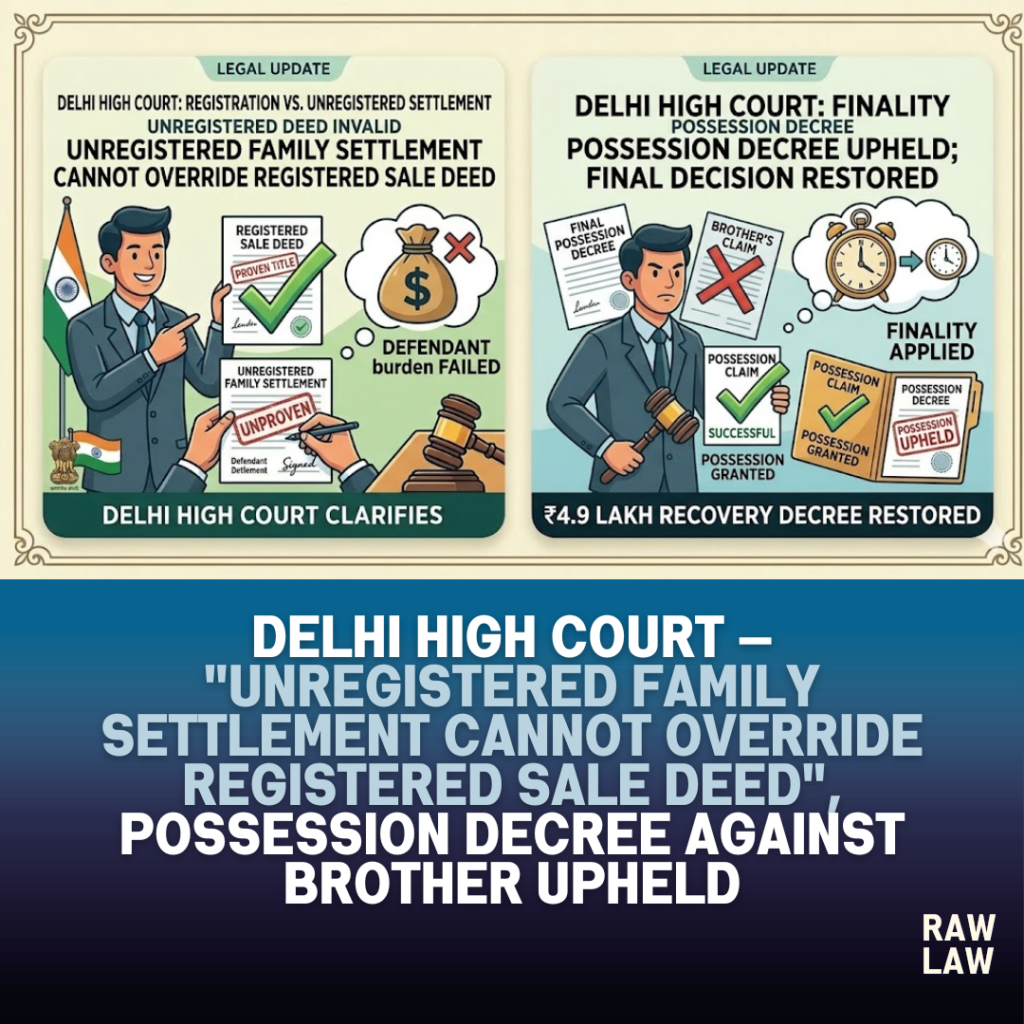
The Court concluded that the respondent had a clear and undisputed title based on a registered sale deed, whereas the appellant’s reliance on informal documents failed to establish any legal ownership or interest in the property.
Since the appellant’s defence did not raise any triable issue and even if proved would not confer ownership rights, the trial court correctly exercised its power to pass judgment on admissions. The appeal was therefore dismissed.
Facts
The dispute concerned a property located on Arya Samaj Road, Uttam Nagar, New Delhi.
The respondent purchased the property through a registered sale deed dated 30 September 2005, and subsequently carried out reconstruction of the premises.
According to the respondent, after the death of his wife and during a difficult personal phase, he permitted his father and younger brother (the appellant) to reside in the property out of familial goodwill.
Following the father’s death in 2011, the appellant allegedly began asserting ownership over part of the property and refused to vacate the premises despite repeated requests.
The respondent alleged that the appellant and other family members had taken advantage of his physical and emotional vulnerability and obtained signatures on certain blank documents.
When attempts to regain possession failed, the respondent filed a civil suit seeking:
- Possession of the first floor of the property
- Mesne profits
- Permanent injunction
The District Judge eventually decreed the suit under Order XII Rule 6 CPC, prompting the appellant to file the present appeal before the High Court.
Issues
The Delhi High Court considered the following legal questions:
- Whether the trial court was justified in decreeing the suit under Order XII Rule 6 CPC based on admissions.
- Whether documents such as a Rajinama, declaration, and family settlement created ownership rights in favour of the appellant.
- Whether the existence of a registered sale deed in favour of the respondent conclusively established title.
Petitioner’s arguments
The appellant argued that the trial court had wrongly decreed the suit under Order XII Rule 6 CPC because the dispute involved complex questions of fact and law.
He contended that a family settlement dated 15 December 2011 had divided the property between family members and that the respondent had executed documents in his favour in accordance with that settlement.
The appellant also relied on earlier documents including:
- A Rajinama dated 21 April 2005
- A Declaration dated 26 April 2005
These documents allegedly acknowledged the rights of the appellant in the property.
The appellant further argued that judgment on admission is permissible only where admissions are clear and unequivocal, relying on Supreme Court decisions such as Himani Alloys Ltd. v. Tata Steel Ltd. and Hari Steel & General Industries Ltd. v. Diljit Singh.
According to the appellant, since his defence raised several factual issues, the matter required a full trial rather than summary adjudication.
Respondent’s arguments
The respondent argued that his ownership of the property was conclusively established by a registered sale deed dated 30 September 2005.
It was submitted that the documents relied upon by the appellant did not confer ownership rights and were legally ineffective.
The respondent contended that the Rajinama and declaration merely reflected informal arrangements between family members and did not transfer any legal interest in the property.
Similarly, the alleged family settlement relied upon by the appellant was unregistered and therefore incapable of transferring rights in immovable property.
The respondent maintained that the appellant’s possession was merely permissive and that the trial court correctly granted a decree of possession based on the admissions contained in the pleadings.
Analysis of the law
The Court examined the legal principles governing judgment on admissions under Order XII Rule 6 CPC.
This provision allows courts to pass a decree without a full trial when admissions in the pleadings or documents clearly establish the entitlement of one party.
However, such power must be exercised cautiously and only when the admissions are unambiguous.
The Court also analysed the legal framework governing transfer of immovable property.
Under Section 54 of the Transfer of Property Act, ownership of immovable property can be transferred only through a registered sale deed.
Similarly, under Section 17 of the Registration Act, documents that create or transfer rights in immovable property must be compulsorily registered.
Precedent analysis
The appellant relied on Himani Alloys Ltd. v. Tata Steel Ltd., where the Supreme Court held that judgment on admission should be granted only when the admission is clear and unconditional.
The Court also considered Hari Steel & General Industries Ltd. v. Diljit Singh, which reiterates that ambiguous or disputed admissions cannot form the basis for a decree under Order XII Rule 6 CPC.
Additionally, reference was made to Rajesh Kumar Mitra v. Karnani Properties Ltd., where the Supreme Court emphasised that courts must exercise caution before granting summary decrees.
However, the High Court concluded that the present case was distinguishable because the respondent’s title was conclusively established through a registered sale deed.
Court’s reasoning
The Court noted that the registered sale deed dated 30 September 2005 unequivocally established the respondent as the owner of the property.
The documents relied upon by the appellant did not create any ownership rights.
The Rajinama and declaration were executed before the sale deed and merely recorded certain informal understandings between family members.
The alleged family settlement dated 15 December 2011 was also ineffective because it was unregistered, even though it purported to transfer rights in immovable property.
The Court held that such a document cannot be relied upon to establish ownership.
The Court therefore concluded that even if all documents relied upon by the appellant were accepted as genuine, they would not confer any legal title upon him.
Consequently, the appellant’s possession could only be treated as permissive.
Conclusion
The Delhi High Court concluded that the respondent’s ownership of the property was conclusively established by the registered sale deed.
Since the appellant failed to produce any legally valid document conferring ownership rights, the trial court was justified in decreeing the suit under Order XII Rule 6 CPC.
The appeal was accordingly dismissed.
Implications
This judgment reinforces the primacy of registered sale deeds in determining ownership of immovable property.
The ruling clarifies that informal documents such as declarations, family arrangements, or unregistered settlements cannot override registered title documents.
The decision also highlights the scope of Order XII Rule 6 CPC, confirming that courts may grant summary decrees where the defence lacks legal merit.
For property disputes involving family members, the judgment underscores the importance of executing and registering proper legal instruments to create enforceable rights.
Case Law References
- Himani Alloys Ltd. v. Tata Steel Ltd. (2011)
The Supreme Court held that judgment on admission can be granted only when the admission is clear, unequivocal, and unconditional. - Hari Steel & General Industries Ltd. v. Diljit Singh (2019)
The Court reiterated that ambiguous or disputed admissions cannot justify a decree under Order XII Rule 6 CPC. - Rajesh Kumar Mitra v. Karnani Properties Ltd. (2024)
The Supreme Court emphasised caution in granting summary decrees based on admissions.
FAQs
1. What is Order XII Rule 6 CPC?
Order XII Rule 6 of the Code of Civil Procedure allows courts to pass judgment based on admissions made in pleadings or documents when the facts are clear and undisputed.
2. Can an unregistered family settlement transfer ownership of property?
No. If a family settlement creates or transfers rights in immovable property, it must be registered under the Registration Act to be legally enforceable.
3. Does a registered sale deed override informal property agreements?
Yes. A registered sale deed is the strongest proof of ownership and generally prevails over informal or unregistered documents.


