

Court’s Decision
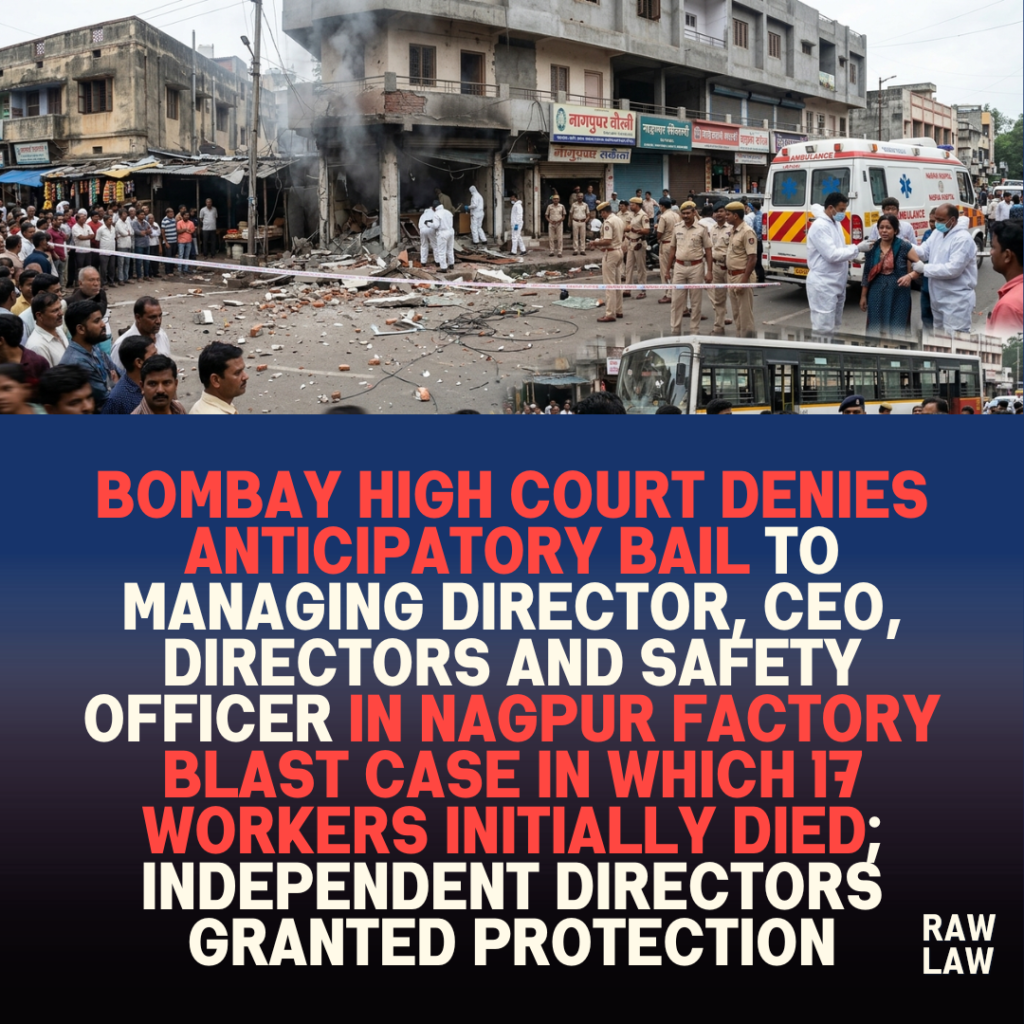
The Bombay High Court, Nagpur Bench, partly allowed and partly rejected a batch of anticipatory bail applications arising out of a factory explosion at SBL Company’s Unit No. 16-B, within the jurisdiction of Kalmeshwar Police Station, Nagpur Rural.
The Court rejected anticipatory bail to the Managing Director, CEO/Director, two Directors, and the Deputy Manager Safety, holding that a prima facie case was made out against them in relation to statutory safety lapses in a hazardous factory unit. However, the Court granted anticipatory bail to three Independent / Non-Executive Directors, observing that their criminal liability could not arise merely from their designation unless knowledge, consent, connivance or lack of due diligence attributable through board process was shown.
Facts
The case arose from an explosion that allegedly took place on 1 March 2026 between 7:00 a.m. and 7:30 a.m. in Factory Shed No. 16-B of SBL Company situated at Rahulgaon Shivar, within Kalmeshwar Police Station limits. According to the prosecution, the police and superior officers visited the spot, and preliminary inquiry revealed that 17 workers had died and 24 workers had suffered grievous or simple injuries.
Initially, a Marg inquiry under Section 194 BNSS was registered. Since the deceased workers could not be identified immediately, blood samples of relatives and samples of the deceased were collected for identification.
During inquiry, correspondence was exchanged with the Chief Controller of Explosives and the Directorate of Industrial Safety and Health, Nagpur. The FIR alleged that the explosion occurred in the NONEL crimping plant / packing section and that explosives had allegedly accumulated in the building instead of being shifted immediately to the next process building or magazine. The DISH report also recorded several alleged non-compliances, including failure to carry out risk assessment, absence of fire trailer pump, appointment of only one safety officer instead of two, absence of factory medical officer, non-installation of flameproof CCTVs, non-submission of internal safety audit, incomplete medical health check-up of workers and absence of submitted training records.
The FIR was registered for offences under Sections 105, 125(a), 125(b), and 288 of the Bharatiya Nyaya Sanhita, 2023.
Issues
The principal issues before the Court were:
- Whether the applicants, being Directors, Managing Director, CEO, Independent Directors and Safety Officer of the company, could be granted anticipatory bail in a serious factory blast case involving multiple deaths and injuries.
- Whether criminal liability was being alleged merely on the basis of designation, or whether the material on record prima facie indicated knowledge, statutory duty and omission.
- Whether Independent / Non-Executive Directors could be treated on the same footing as Managing Directors, Executive Directors and safety personnel.
- Whether the absence of custodial interrogation by itself was sufficient to grant anticipatory bail.
Applicants’ Arguments
The applicants argued that they were not present at the spot when the accident occurred and that the ingredients of Section 105 BNS, dealing with culpable homicide not amounting to murder, were not attracted. They contended that they had no knowledge of the alleged deficiencies and that criminal law does not recognise vicarious liability unless a statute specifically provides for it.
It was argued that the occupier under the Factories Act, and not every Director or employee, would be responsible for regulatory violations. The applicants further submitted that custodial interrogation was not required, they had no criminal antecedents, and there was no possibility of tampering with evidence.
The Independent Directors argued that they were Non-Executive Independent Directors, not involved in day-to-day affairs, and could not be held criminally liable merely because they were on the Board. They relied on Section 149(12) of the Companies Act, 2013, which limits the liability of Independent and Non-Executive Directors to acts or omissions occurring with their knowledge, attributable through board process, and with their consent, connivance or lack of diligence.
One Independent Director also placed her serious medical condition before the Court, stating that she was suffering from Stage-III breast cancer and was undergoing chemotherapy.
The Safety Officer argued that he was not present on the date of the incident and had travelled to Tirupati with his family. He also contended that his appointment order limited his duties and that he was not concerned with the specific activities in Unit 16-B.
State’s Arguments
The State opposed the applications and submitted that a strong prima facie case existed against the accused persons. The prosecution argued that the applicants were influential persons and custodial interrogation was necessary.
The State pointed out that an earlier incident had taken place in the factory where workers had sustained injuries. It further submitted that DISH had issued communication after inspection, pointing out serious deficiencies, but the same were not removed. The prosecution argued that the accused persons knew that failure to remove such deficiencies could cost human lives.
The State submitted that payment of compensation to workers or victims would not dilute criminal liability. It was also pointed out that, according to the prosecution, the death toll had increased to 26 persons, including 22 women. Statements of injured workers were relied upon to contend that workers were not trained for handling hazardous material.
As against the Deputy Manager Safety, the State specifically argued that he was the sole safety officer at the factory and was responsible for advising and assisting the factory management in preventing personal injuries and maintaining a safe working environment.
Analysis of the Law
The Court began by noting that the matter concerned anticipatory bail and therefore required consideration of settled bail parameters, including the nature and gravity of the offence, severity of punishment, prima facie case, possibility of absconding, likelihood of tampering with evidence, criminal antecedents, stage of investigation, health and humanitarian considerations, and the larger interest of justice.
The Court clarified that the real question was not whether the applicants were vicariously liable simply because of their designations. The relevant question was whether the FIR and material on record prima facie disclosed offences against them.
The Court observed that the factory was dealing with a hazardous process under the Factories Act. In such a context, statutory duties relating to safety, training, risk assessment and prevention of accidents assume greater importance.
The Court held that the previous incident involving injury to workers, the DISH communication pointing out deficiencies, and the allegations regarding lack of training and non-compliance could not be brushed aside at the anticipatory bail stage.
Court’s Reasoning
The Court rejected the argument that the applicants could not be proceeded against because they were not physically present at the site of the explosion. The Court referred to the BNS provisions on “act” and “omission” and noted that an act includes a series of acts, while omission also includes a series of omissions. The Court further observed that words referring to acts also extend to illegal omissions.
The Court held that where hazardous substances are handled without proper precautions, training and statutory compliance, the omission may not remain a mere regulatory lapse. The Court observed:
“In hazardous industries, persistent statutory non-compliance, even after prior notice, transforms omission into culpable conduct, attracting criminal liability beyond mere negligence.”
The Court further held:
“Liability is not vicarious but arises from prima facie knowledge, statutory duty, and continued omission.”
The Court reasoned that the applicants’ argument of lack of knowledge was not sufficient at this stage because deficiencies had been pointed out to the occupier / management, and how such information was communicated to the Directors was a matter for investigation.
The Court also held that Section 18 BNS, relating to accident or misfortune, could not assist the applicants at this stage because such protection applies where the act is done lawfully, by lawful means, with proper care and caution. The Court observed that asking workers without proper training to handle hazardous material could not be treated as an act done with proper care and caution.
On the issue of custodial interrogation, the Court relied on the Supreme Court’s decision in Sumitha Pradeep v. Arun Kumar C.K., observing that even if custodial interrogation is not required, that alone cannot be a ground to grant anticipatory bail. The first consideration must be whether a prima facie case exists.
Findings As To Independent Directors
The Court accepted the contention of the Independent / Non-Executive Directors that they stood on a different footing. It held that criminal liability of Independent Directors does not arise merely from their designation.
Referring to Section 149(12) of the Companies Act, the Court noted that an Independent Director or Non-Executive Director, who is not a promoter or key managerial personnel, can be held liable only where the act or omission occurred with his or her knowledge, attributable through board process, and with consent, connivance or lack of due diligence.
The Court therefore granted anticipatory bail to:
- Satyawati Parashar, Lady Non-Executive Independent Director;
- Ravindra Pokharna, Non-Executive Independent Director;
- Manoj Kumar Prasad, Independent Director.
The Court also considered the serious medical condition of the Lady Independent Director, who was stated to be suffering from Stage-III cancer and undergoing chemotherapy.
Precedent Analysis
The Court considered several judgments cited by the applicants, including Sushil Ansal v. State through CBI, Sunil Bharti Mittal v. CBI, Keshub Mahindra v. State of M.P., Shiv Kumar Jatia v. State of NCT of Delhi, Sharad Kumar Sanghi v. Sangita Rane, Bhalchandra v. State of Maharashtra, P.B. Desai v. State of Maharashtra, and other judgments on vicarious liability, culpable homicide, omission, and anticipatory bail.
The Court distinguished the authorities cited by the applicants on the ground that the present case involved a hazardous unit, prior notice of statutory deficiencies, alleged non-compliance, absence of proper safety measures, and a blast in the packing section where hazardous material was being handled.
The Court held that the case was not merely about vicarious liability of Directors, but about prima facie knowledge, statutory duty, continued omission and the seriousness of the consequences.
Court’s Ultimate Holding
The Court rejected the anticipatory bail applications of:
- Managing Director;
- CEO / Director;
- Deputy Manager Safety;
- Director Alok Awadhiya;
- Director Shrawan Kumar.
The Court allowed the anticipatory bail applications of the three Independent / Non-Executive Directors.
The Independent Directors were directed to be released on bail in the event of arrest on furnishing personal bond and surety bond of Rs. 2 lakhs each. They were also directed to attend the police station on specified dates, cooperate with the investigation, surrender passports, not tamper with evidence, not threaten witnesses, and not leave India without prior permission of the Court.
Conclusion
The Bombay High Court drew a clear distinction between Executive Directors / persons responsible for safety and Independent Directors who are not involved in daily operations. The Court refused to grant anticipatory bail to those who, according to the prosecution, had prima facie responsibility in relation to safety compliance in a hazardous factory unit where multiple workers died and several others were injured.
At the same time, the Court protected Independent Directors, holding that they cannot be made criminally liable merely because of their position on the Board unless the statutory test under Section 149(12) of the Companies Act is satisfied.


