
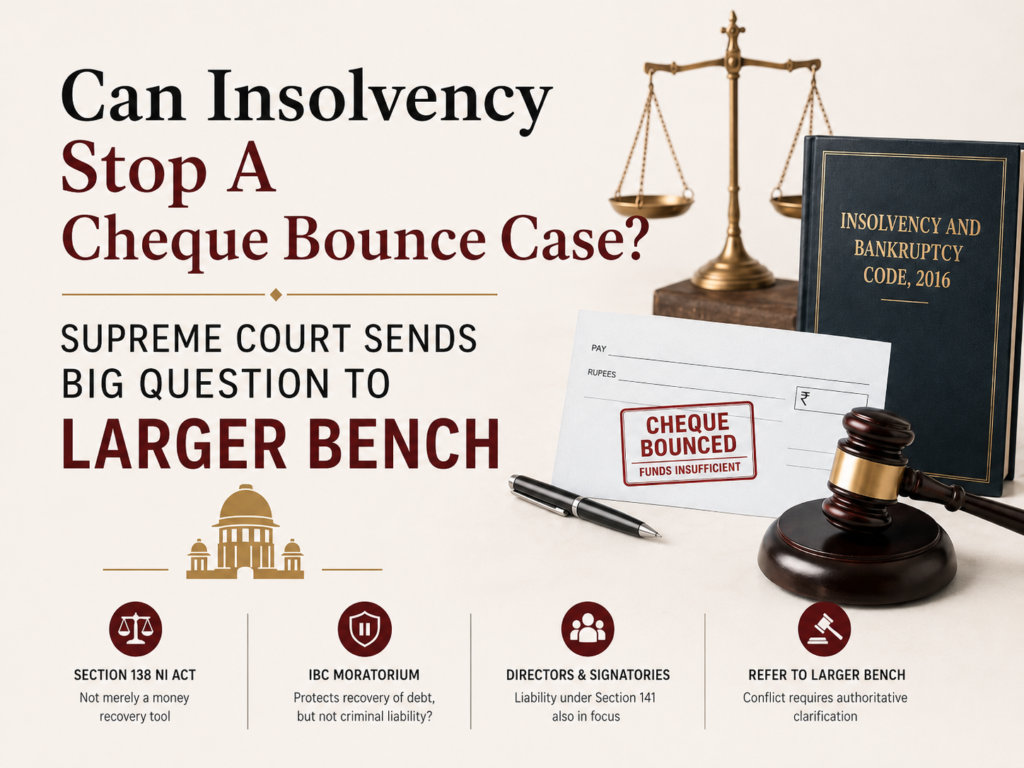

The Supreme Court considered an important question affecting cheque bounce cases, company directors, personal guarantors and insolvency proceedings: Can a person undergoing personal insolvency or bankruptcy under Part III of the Insolvency and Bankruptcy Code, 2016 stop or stay a cheque bounce prosecution under Section 138 of the Negotiable Instruments Act, 1881?
The Court did not finally settle the issue. Instead, after an elaborate examination of Section 138 NI Act, Section 141 NI Act, and the moratorium provisions under Sections 96, 101, 124 and 128 of the IBC, the Bench directed that the matter be placed before the Chief Justice of India for constitution of an appropriate three-Judge Bench. The Court held that an authoritative pronouncement was required on whether Section 138 is quasi-criminal with a tilt towards criminal liability, and whether Part III IBC moratorium applies to the entire Section 138 proceeding or only to its compensatory aspect.
Court’s Decision
The Supreme Court granted leave and considered appeals arising from a Madras High Court order which had refused to quash or stay a pending cheque bounce complaint. The appellant had argued that since he was undergoing personal insolvency/bankruptcy proceedings, the moratorium under Part III of the IBC should stop the Section 138 NI Act proceedings. The High Court had rejected that contention by holding that Section 138 proceedings are criminal in nature and are not merely money recovery proceedings.
The Supreme Court’s important interim analytical conclusion was that Section 138 proceedings cannot be described as simple legal action for recovery of money. The Court observed that while Section 138 has civil elements because it arises from a debt and cheque transaction, its predominant nature is criminal because the dishonour of a cheque is treated as an offence and punishment is imposed to protect faith in commercial transactions. The Court specifically observed that Section 138 “was not intended to be used as a recovery of debt mechanism.”
At the same time, the Court recognised that Section 138 has two layers. Tier I is the criminal aspect, which may result in imprisonment, fine, or both. Tier II is the compensatory aspect, where the court may award compensation. The Court observed that the criminal aspect may proceed, but the recovery of compensation may be affected by the IBC moratorium because compensation has an inherently civil/debt-related character.
Facts of the Case
The appellant was the former Managing Director of a company which was undergoing liquidation. The respondent bank had extended financial/credit facilities, including an Inland Letter of Credit for purchase of coal worth approximately ₹5.03 crore. A cheque was issued to clear the liability, but the cheque was dishonoured on 18.06.2015 with the endorsement “Funds Insufficient.” The bank issued a statutory notice under Section 138 NI Act and then filed a complaint before the Metropolitan Magistrate, Egmore, Chennai.
The appellant later became subject to personal insolvency proceedings. The NCLT admitted an insolvency application against him under Section 95 of the IBC. He then approached the High Court seeking quashing/stay of the Section 138 complaint, arguing that the interim moratorium under Section 96 IBC applied to any legal proceeding “in respect of any debt.” The High Court dismissed the plea, holding that Section 138 is criminal in nature and not merely a money recovery proceeding. Thereafter, further insolvency/bankruptcy developments occurred, including operation of moratorium under Sections 101 and 128 of the IBC.
Issues Before the Court
The Supreme Court framed three core issues:
First, whether Section 138 NI Act proceedings are initiated with the object of recovering money from the debtor.
Second, whether Section 138 proceedings are protected during moratorium under Part III of the IBC, including Sections 96 and 101 during insolvency and Sections 124 and 128 during bankruptcy.
Third, whether directors or persons vicariously liable under Section 141 NI Act can claim the benefit of Part III IBC moratorium when they themselves are undergoing personal insolvency or bankruptcy.
Arguments of the Appellant
The appellant argued that the moratorium under Part III of the IBC is broad because it applies to legal action “in respect of any debt.” According to him, cheque bounce proceedings are directly connected to a debt because Section 138 itself proceeds on the existence of a legally enforceable debt or liability. Therefore, if a debtor is undergoing personal insolvency, the Section 138 complaint should be stayed.
The appellant strongly relied on P. Mohanraj v. Shah Bros. Ispat Pvt. Ltd., where Section 138 proceedings were described as a “civil sheep in a criminal wolf’s clothing.” The appellant argued that since the dominant purpose of Section 138 is compensatory and debt-related, continuation of a cheque bounce case during insolvency would defeat the breathing space given by the IBC. He also argued that if corporate debtors receive moratorium protection, individuals undergoing personal insolvency should also receive similar protection.
Arguments of the Bank
The bank argued that Section 138 NI Act is criminal in nature and cannot be stalled merely because the accused has invoked personal insolvency. According to the bank, the purpose of Section 138 is to maintain trust in cheques and commercial transactions, not merely to recover money.
The bank relied on judgments such as Ajay Kumar Radheshyam Goenka, Anjali Rathi, and Rakesh Bhanot, where the Court emphasised that moratorium protection available to a corporate debtor does not automatically wipe out or stall the criminal liability of directors or signatories. The bank submitted that if personal insolvency were allowed to stop Section 138 prosecutions, accused persons could misuse the IBC to avoid cheque bounce cases.
Analysis of the Law
The Supreme Court began by analysing the true nature of Section 138 NI Act. It noted that dishonour of a cheque arises from a civil transaction, but Section 138 creates a deeming fiction by treating such dishonour as an offence. The Court observed that had Parliament not created this deeming fiction, dishonour of a cheque would ordinarily remain a civil dispute. However, once the statutory fiction is created, the consequences are criminal.
The Court further held that the offence under Section 138 is linked to the dishonour of the cheque, not merely to failure to repay a debt. In simple terms, if a person fails to pay money by cash, bank transfer or promissory note, the matter may remain civil. But if the person issues a cheque and it bounces, the law attaches criminal consequences to that mode of payment. This is because cheques are meant to carry commercial credibility.
The Court also explained the difference between the stage at which the offence is committed and the stage at which prosecution can begin. The cheque dishonour is the triggering event, but prosecution requires statutory notice and failure to pay within the prescribed period. This gives honest drawers a chance to remedy the default before facing prosecution.
Fine vs Compensation
A major part of the judgment deals with the difference between fine and compensation. The Court noted that fine is punitive and is imposed to deter future cheque dishonour. Compensation, however, is remedial and is intended to restore the complainant financially. This distinction became central to the Court’s IBC analysis.
The Court observed that allowing moratorium to stop the criminal punishment aspect, including imprisonment or fine, would damage the deterrent purpose of Section 138. But allowing compensation recovery to continue despite IBC moratorium could unfairly convert cheque bounce cases into a special debt recovery route, giving cheque-based creditors an advantage over other creditors.
The Court therefore indicated that the better approach may be to allow the criminal case to proceed, while temporarily halting recovery of compensation if moratorium applies. It observed that once a criminal court awards compensation under Section 395 BNSS, the recovery of that compensation may be stayed during moratorium, but the prosecution itself may still continue to its logical conclusion.
Court’s Reasoning
The Court reasoned that Section 138 cannot be reduced to a mere recovery tool. Its object is to protect confidence in cheque transactions. The Court said that the principal object of Section 138 is to deter people from issuing cheques without sufficient funds. Therefore, the provision was not intended to operate simply as debt recovery machinery.
At the same time, the Court accepted that compensation under Section 138 overlaps with civil recovery. This is why it proposed a two-tier understanding:
Tier I: Criminal prosecution, conviction, imprisonment and fine.
Tier II: Compensation/recovery component.
The Court indicated that IBC moratorium should not block Tier I, but may apply to Tier II because compensation is connected with debt recovery.
Precedent Analysis
The Court examined P. Mohanraj v. Shah Bros. Ispat Pvt. Ltd., where Section 138 proceedings were described as having civil character and where Section 14 IBC moratorium was held to apply to proceedings against the corporate debtor. However, the present Bench expressed that the predominantly criminal nature and legislative object of Section 138 may not have been fully placed before the three-Judge Bench in P. Mohanraj.
The Court also considered Rakesh Bhanot v. Gurdas Agro Pvt. Ltd., where it was held that personal insolvency moratorium cannot be used to stall criminal prosecution under Section 138. The present Bench noted the tension between this approach and the broader observations in P. Mohanraj regarding personal insolvency moratorium. This conflict was one reason why the matter was referred for larger Bench consideration.
Other important precedents discussed include Ajay Kumar Radheshyam Goenka, Anjali Rathi, Sheetal Gupta, Dashrath Rupsingh Rathod, Jai Balaji Industries, Vinay Devanna Nayak, J.V. Baharuni, Bhavnagar University, and Anuj Jain.
Court’s Ultimate Holding
The Supreme Court did not finally decide the full controversy. Instead, it directed the Registry to place the matter before the Chief Justice of India for constitution of an appropriate three-Judge Bench. The larger Bench may consider:
- Whether Section 138 NI Act and its objective show that the provision is quasi-criminal with a tilt towards the criminal side.
- Whether Part III IBC moratorium should apply to the entire Section 138 proceeding or only to the compensatory aspect.
Implications
This judgment is significant because it affects thousands of cheque bounce cases where accused persons are directors, personal guarantors, borrowers, business owners or individuals facing insolvency. The judgment suggests that an accused cannot simply say “I am under insolvency, so the cheque bounce case must stop.” The criminal prosecution may still continue.
However, the judgment also recognises that if compensation is awarded in a cheque bounce case, its recovery may be treated like a debt and may be temporarily affected by IBC moratorium. This creates a practical distinction between criminal accountability and financial recovery.
For a common person, the rule can be understood this way: if you issue a cheque and it bounces, insolvency may not save you from the criminal case. But if the court orders you to pay compensation, recovery of that compensation may have to wait during insolvency or bankruptcy proceedings, depending on what the larger Bench finally decides.

