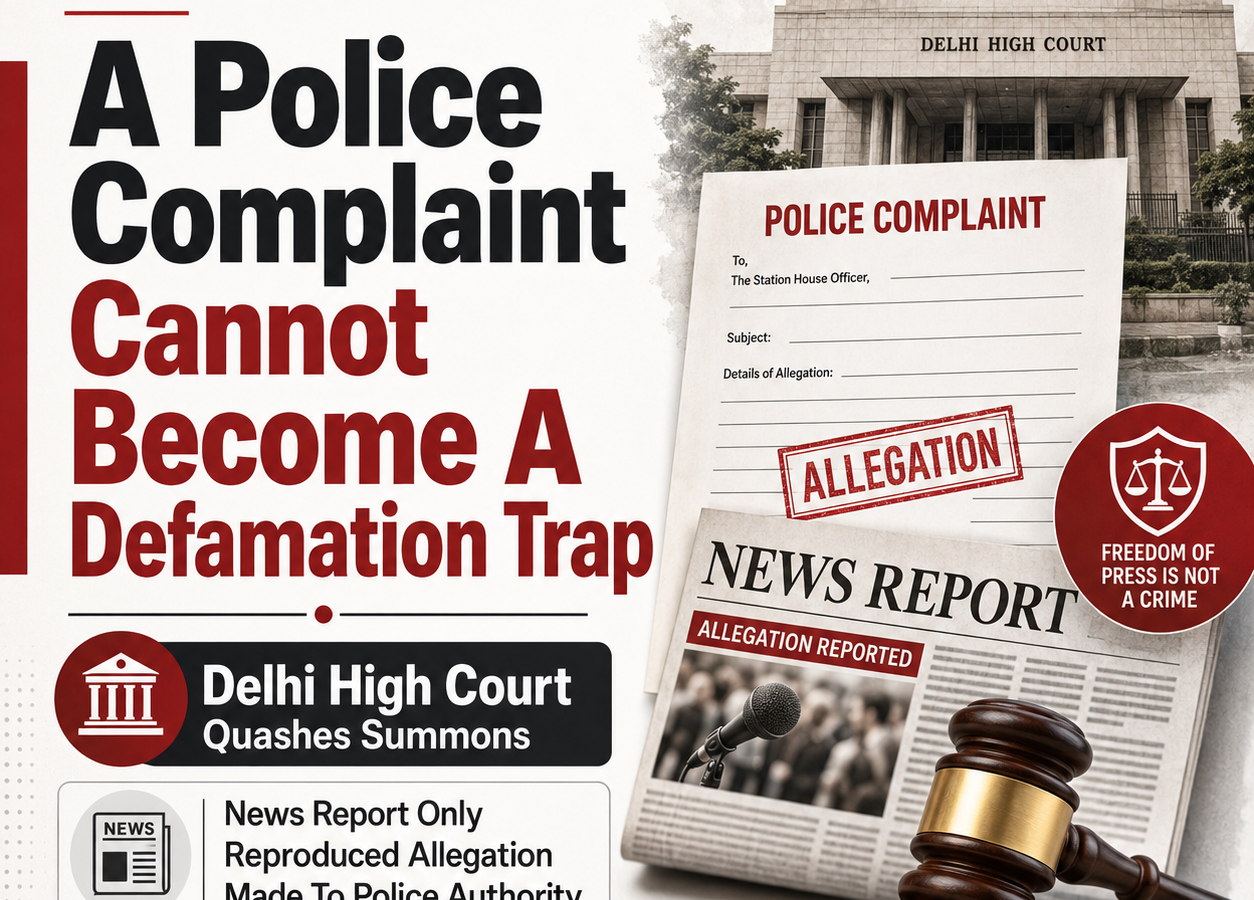
A Police Complaint Cannot Become A Defamation Trap”: Delhi High Court Quashes Summons, Says News Report Only Reproduced Allegation Made To Police Authority

Court’s Decision
The Delhi High Court allowed two connected petitions and set aside the orders by which the Sessions Court had directed issuance of summons against the petitioner in criminal defamation complaints under Sections 499 and 500 IPC.
The Court held that the allegedly defamatory line in the news article was not an independent statement made to the media, but a verbatim reproduction of an allegation made in a police complaint submitted to lawful authorities. Since the police complaint later culminated into an FIR and investigation, the Court held that the essential ingredients of criminal defamation were not made out at the threshold, particularly in view of Exception 8 to Section 499 IPC. The summons and consequential proceedings were therefore quashed.
Facts
The matter arose from an alleged incident at a company board meeting. The petitioner claimed that he was obstructed from entering the boardroom and assaulted, resulting in a fracture to his right index finger. He was taken to hospital, and thereafter lodged a complaint with the police. Based on the complaint, medical material and CCTV footage, an FIR was registered for offences under Sections 325 and 341 IPC.
Subsequently, two board members filed separate criminal defamation complaints alleging that a news report had defamed them. Their grievance was confined to one line in the article stating that the “other present board members were consenting parties to this assault.” They alleged that this statement harmed their reputation.
The Magistrate dismissed the complaints under Section 203 CrPC, holding that the statement was part of the police complaint and protected under Exception 8 to Section 499 IPC. However, the Sessions Court set aside the Magistrate’s order and directed summons to be issued. The petitioner then approached the High Court.
Issues
The main issue before the High Court was whether a person who makes an allegation in a police complaint can be summoned for criminal defamation merely because the contents of that complaint are later reproduced in a news report.
The Court also examined whether the Sessions Court was right in directing issuance of summons when the allegedly defamatory material was part of a police complaint made to a lawful authority.
Petitioner’s Arguments
The petitioner argued that the defamation complaints were a counterblast to the FIR registered on his police complaint.
He submitted that the respondents were not specifically named in his complaint, FIR, or alleged media statements. The grievance was based only on a general reference to “other present board members.”
It was further argued that if allegations made in a police complaint are treated as defamation merely because they appear in a news report, it would discourage citizens from approaching law enforcement authorities and would create retaliatory litigation against complainants.
The petitioner also relied on Exception 8 to Section 499 IPC, arguing that allegations made in good faith to police authorities are protected because the police are legally authorised to receive and investigate such complaints.
Respondents’ Arguments
The respondents argued that the Sessions Court had correctly directed summons because the article had referred to an interview and contained imputations affecting their reputation.
They submitted that at the summoning stage, the Court should only see whether a prima facie case exists, and the benefit of exceptions to Section 499 IPC should be considered during trial.
They further argued that the line regarding “other present board members” was sufficient to identify them as members of the board and that the publication had lowered their reputation.
Analysis Of The Law
The High Court examined the structure of the news articles and divided them into two parts.
The first part contained statements attributed to the petitioner regarding his personal grievances, primarily against his mother and her security officer. The Court noted that the respondents themselves did not claim defamation from this part.
The second part reproduced the contents of the police complaint. The Court noted that the complained-of line was placed in quotation marks and introduced with words indicating that it was from the complaint made to the police. The Court found that the respondents’ grievance was confined only to this one line, which was a verbatim reproduction of the police complaint.
The Court held that once the police complaint had culminated into an FIR and was under investigation, a defamation complaint based merely on reproduction of that allegation could not be allowed to proceed unless the ingredients of defamation were clearly made out.
Exception 8 To Section 499 IPC
The Court discussed Exception 8 to Section 499 IPC, which protects an accusation made in good faith to a person having lawful authority over the subject matter.
The Court observed that making an allegation before a competent authority for redressal or lawful action does not amount to defamation. Since the petitioner had approached the police, a lawful authority, the case squarely attracted Exception 8 at the threshold.
The Court also relied on the Supreme Court’s decision in Iveco Magirus Brandschutztechnik GmbH v. Nirmal Kishore Bhartiya, which held that even at the summoning stage, a Magistrate is not barred from examining whether an exception to Section 499 IPC is prima facie attracted. If the material itself discloses a complete defence under an exception, the Magistrate must apply judicial mind and prevent unnecessary criminal trial.
Precedent Analysis
The Court referred to decisions holding that faithful reporting of FIRs or police complaints, without distortion or embellishment, does not automatically amount to defamation.
In Vijay v. Ravindra Ghisulal Gupta, the Bombay High Court had held that reporting the registration of a crime or reproducing the contents of an FIR, without exaggeration, does not constitute defamation because FIRs are matters of public domain.
The Delhi High Court also referred to Mahadev I. Todale v. Frankfinn Aviation Services Pvt. Ltd., where it was held that reporting police complaints, FIRs and progress of investigation does not give rise to a defamation cause of action while the criminal proceedings remain pending and the allegations are yet to be adjudicated.
The Court further referred to Primero Skill & Training Pvt. Ltd. v. Selima Publications Pvt. Ltd., which reiterated that once FIR contents are in public domain, faithful reporting of those contents cannot by itself give rise to defamation liability.
Court’s Reasoning
The High Court held that the petitioner could not be said to have made or disseminated any false or defamatory imputation against the respondents.
The Court found that the part of the news article attributed to what the petitioner told the journalist concerned his mother and did not pertain to the respondents. The only line complained of was taken from the police complaint.
The Court also noted that this line was not an independent media statement, but a reproduction of an accusation made before the police while invoking criminal law.
The Court reasoned that allowing such defamation proceedings would create a situation where every substantive criminal complaint could be met with a counter-defamation complaint, leading to parallel criminal proceedings arising out of the same incident: one by the victim, and another by the accused or affected persons alleging defamation.
Conclusion
The Delhi High Court held that the impugned orders directing issuance of summons could not be sustained in law.
The Court quashed the summons and all consequential proceedings arising from the criminal defamation complaints.
Key Takeaway
A person who approaches the police with a grievance cannot be dragged into a criminal defamation trial merely because the contents of that complaint are later reproduced in a news report. A complaint made to lawful authorities, if protected under Exception 8 to Section 499 IPC, cannot become the basis for defamation proceedings unless the basic ingredients of the offence are clearly made out.