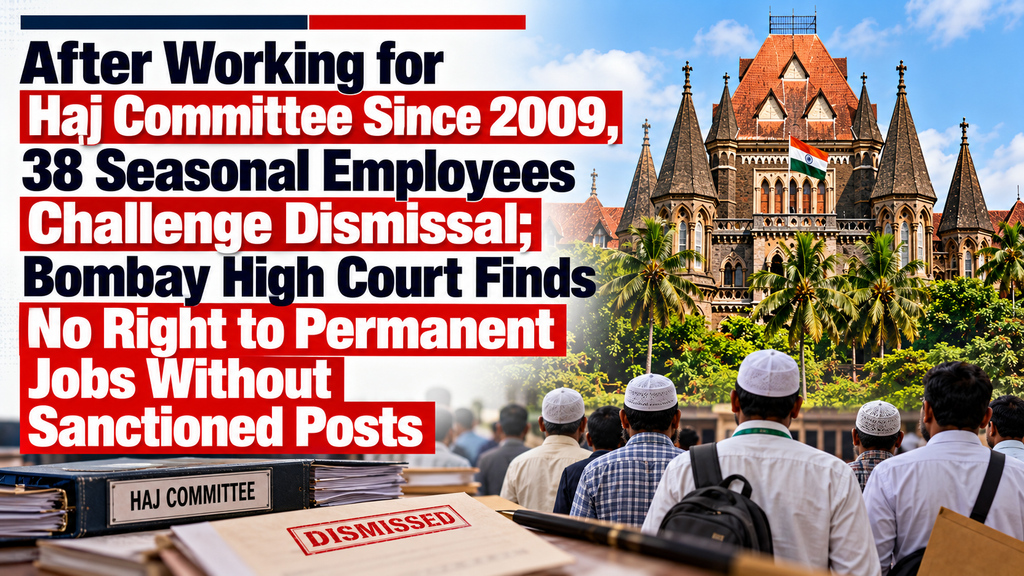
After Working for Haj Committee Since 2009, 38 Seasonal Employees Challenge Dismissal; Bombay High Court Finds No Right to Permanent Jobs Without Sanctioned Posts

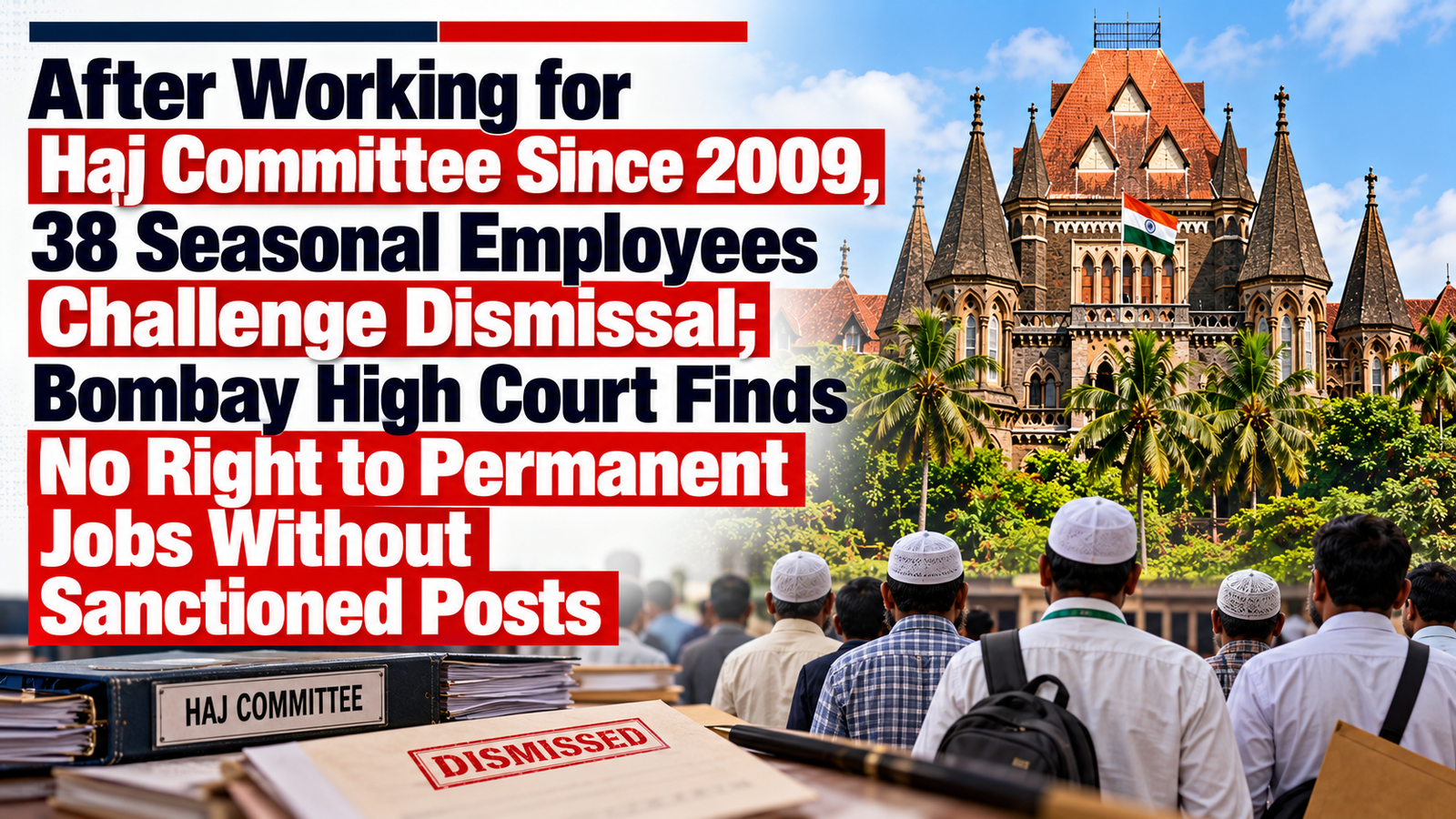
Bombay High Court Dismisses 38 Haj Workers’ Challenge to Seasonal Termination, Holding Years of Re-Engagement Cannot Create a Right to Permanent Employment Without Regular Recruitment
Facts
Thirty-eight seasonal employees of the Haj Committee of India—21 clerks, five peons and twelve sweepers—challenged an order dated 25 November 2023 discontinuing their services. They claimed to have worked during successive Haj seasons, some since 2009, performing tasks involving pilgrimage applications, passports, visa processing and related administration. Although designated as seasonal employees, they asserted that the work was perennial and similar to that performed by regular staff. They sought quashing of the discontinuation, continued employment and protection against replacement by another group of contractual employees.
During the proceedings, an interim order dated 18 November 2024 directed the Committee, if engaging fresh seasonal workers, to consider the petitioners with regard to their seniority rather than replace them with new seasonal workers. A Committee resolution separately proposed re-engagement of 45 terminated staff if the writ petition was withdrawn; the Court criticised this condition as an arm-twisting strategy.
Issues
Whether repeated seasonal engagement over many years creates an enforceable right to regularisation or permanent appointment; whether discontinuation at the end of a seasonal engagement violated the applicable statutory and recruitment rules; and whether the petitioners could demand preference over new contractual recruits as a substantive final relief.
Petitioner’s Arguments
The petitioners contended that their abrupt discontinuation without reasons or a hearing was arbitrary and contrary to natural justice. Haj-related operations had expanded and required year-round work, while their qualifications and duties were comparable to those of permanent employees despite lower wages. They relied on the Haj Committee Act and Rules and on the recruitment provisions under which eligible seasonal clerks could be considered for regular lower division clerk posts. They also objected to proposed hiring of fresh contractual personnel.
Respondent’s Arguments
The Haj Committee maintained that the workers were engaged only for seasonal requirements, not through the prescribed procedure for regular recruitment, and that their appointments ended by efflux of time. No right to continuance or regularisation had accrued. The advertised contractual positions were principally different roles in New Delhi, rather than replacements for Mumbai seasonal workers; the continued engagement of one visa-processing employee reflected a specific temporary requirement.
Analysis of the Law
Section 16(5) of the Haj Committee Act, 2002 enables the Committee to employ staff with previous Central Government sanction, while Section 44 authorises service rules. Rule 16 of the Haj Committee Rules contemplates temporary appointments and possible creation of permanent posts, but does not confer authority to regularise seasonal workers automatically. The Recruitment Rules also distinguish seasonal clerks from lower division clerks: experience across specified Haj seasons may make a candidate eligible for direct recruitment, not convert the seasonal appointment into a permanent one. In the absence of a sanctioned post or regular selection, long intermittent service alone does not establish a legal entitlement.
Precedent Analysis
In State of Maharashtra & Ors. v. Anita, (2016) 8 SCC 293, the Supreme Court held that contractual appointment does not generate a right to permanent public employment; recruitment remains governed by applicable terms and rules. In Teri Oat Estates (P) Ltd. v. Union Territory, Chandigarh, (2004) 2 SCC 130, the Supreme Court emphasised that sympathy or hardship cannot replace the need to establish a legal right. The High Court applied these principles while noting that the petitioners were free to compete for regular posts if created, subject to eligibility.
Court’s Reasoning
The Court found no permanent seasonal-worker post and no rule authorising regularisation of the petitioners’ successive engagements. It rejected the proposed equivalence between seasonal clerks and regular lower division clerks, whose posts were filled through a distinct recruitment process. It accepted that the Mumbai establishment was not inviting replacements for the petitioners and that the New Delhi vacancies served different needs. Although the conditional re-engagement resolution was criticised, that conduct did not supply the missing statutory right. The earlier interim protection concerning future seasonal hiring did not justify a final direction for permanent employment.
Conclusion
The Bombay High Court dismissed Writ Petition No. 2652 of 2024, holding that seasonal workers engaged intermittently cannot claim regularisation or permanent appointment without an available sanctioned post and the prescribed recruitment process. No costs were awarded.
Case: Ansari Safeer Ahmed Musheer A. & Ors. v. Union of India & Anr. (Haj Committee of India)
Court: Bombay High Court, Ordinary Original Civil Jurisdiction
Case Number: Writ Petition No. 2652 of 2024; 2026:BHC-OS:22361-DB
Judge: G. S. Kulkarni and Dr. Neela Gokhale, JJ.
Date: 14 October 2026
Result: Writ petition dismissed; no order as to costs.