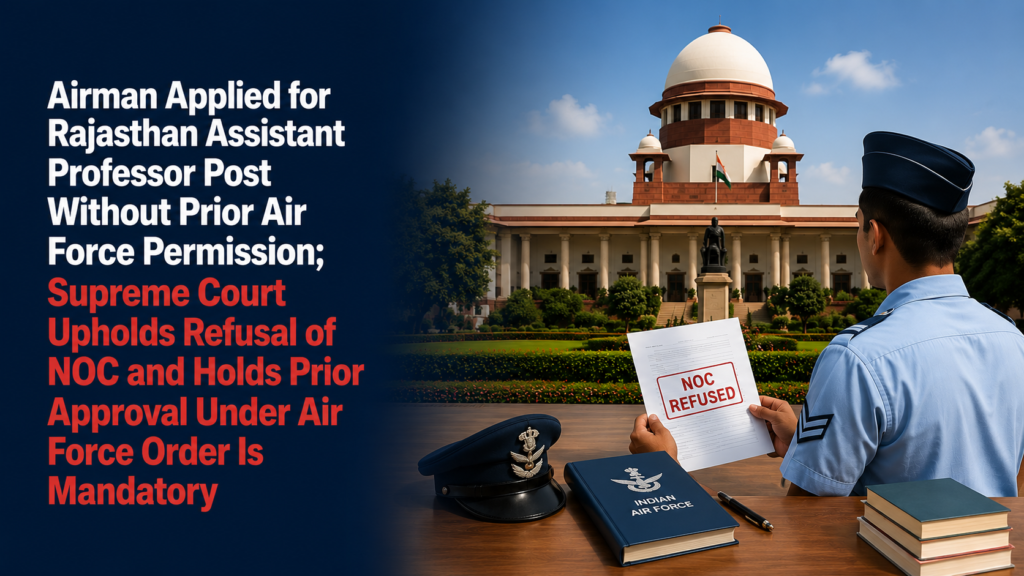
Airman Applied for Rajasthan Assistant Professor Post Without Prior Air Force Permission; Supreme Court Upholds Refusal of NOC and Holds Prior Approval Under Air Force Order Is Mandatory

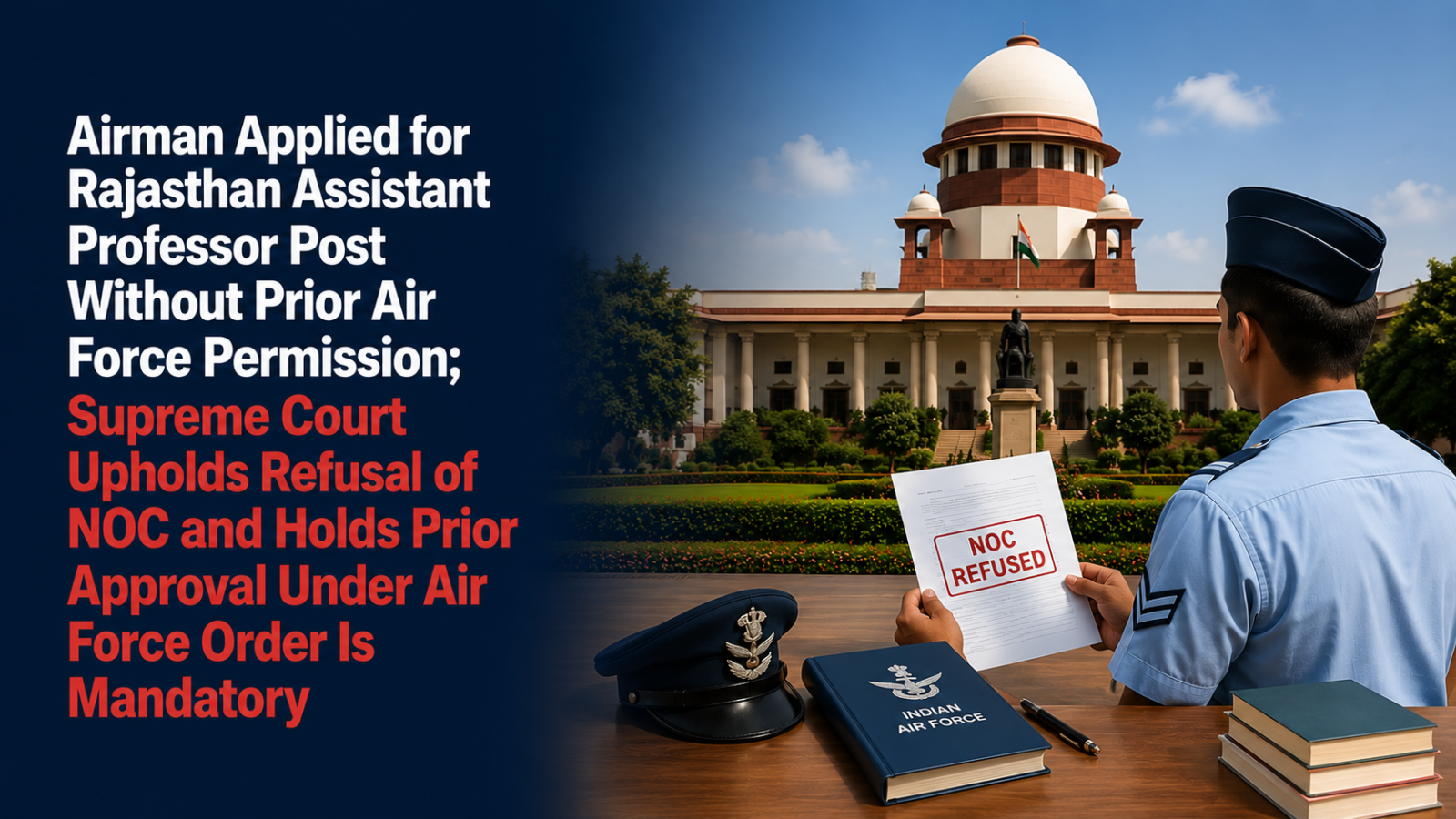
Indian Air Force Corporal Applied for Civil Job Without Prior Approval; Supreme Court Upholds Refusal of NOC Despite His Selection as Assistant Professor.
Facts
The appellant, Nakhat Singh, was serving as a Corporal in the Indian Air Force. After completing more than seven years of service, he wished to join a civil post as an Assistant Professor (Hindi) pursuant to a recruitment advertisement issued by the Rajasthan Public Service Commission in November 2020. He appeared in the written examination, qualified for the interview, and was ultimately selected for appointment on October 1, 2022.
Only after being selected did the appellant apply for a No Objection Certificate (NOC) and premature discharge from the Air Force. However, the Air Officer Commanding declined to recommend his request because he had not obtained prior permission before applying for the civil post, as required under Air Force Order (AFO) No. 33/2017.
The appellant challenged the decision before the Armed Forces Tribunal (AFT), which dismissed his application. His writ petition before the Delhi High Court also failed, leading him to approach the Supreme Court.
Issues
The Supreme Court considered the following issues:
- Whether an Airman must obtain prior permission before applying for a civil post under Air Force Order No. 33/2017.
- Whether the requirement of obtaining prior permission is merely procedural or mandatory.
- Whether denial of a No Objection Certificate (NOC) solely because prior permission was not obtained was legally justified.
- Whether an Airman possesses an unrestricted right to leave Air Force service after securing selection to a civil post.
Appellant’s Arguments
The appellant argued that he had successfully cleared the competitive recruitment process and should not lose the opportunity to serve as an Assistant Professor merely because he had not complied with procedural formalities prescribed under the Air Force Order.
He submitted that the provisions governing prior permission merely regulated the procedure for seeking civil employment and did not affect his substantive right to pursue better career opportunities. According to him, those procedural requirements were directory rather than mandatory and could therefore be relaxed in the interests of justice.
The appellant relied upon earlier Delhi High Court decisions to contend that procedural lapses should not deprive a deserving Airman of appointment to a civil post. He sought quashing of the endorsement refusing to recommend his candidature and prayed for discharge from the Air Force to enable him to join the selected post.
Respondents’ Arguments
The Union of India contended that Air Force Order No. 33/2017 had been framed to balance the career aspirations of Airmen with the operational requirements of the Air Force. It prescribed a mandatory two-stage permission process requiring prior approval before applying for a civil post and a subsequent NOC after selection.
The respondents argued that the appellant failed to establish that he had ever submitted either an online or offline request seeking prior permission. Since prior permission was a mandatory precondition for grant of an NOC, refusal of the NOC was entirely justified.
They further submitted that permission to apply for a civil post and the subsequent grant of an NOC were expressly described under the Air Force Order as privileges and not enforceable rights.
Analysis of the Law
The Supreme Court examined Air Force Order No. 33/2017 in detail. It noted that the Order had been framed because premature discharge of trained Airmen adversely affected the operational preparedness and manpower requirements of the Air Force. The Order therefore attempted to strike a balance between organisational interests and individual career aspirations.
The Court explained that the Order contemplates two separate stages. First, an Airman must obtain prior permission before applying for any civil post. Secondly, after qualifying in the recruitment process, the Airman must obtain a No Objection Certificate before seeking discharge from service.
The Court rejected the appellant’s contention that these requirements were merely procedural. It observed that the Air Force Order itself prescribed the consequence of non-compliance—rejection of the request for an NOC where prior permission had not been obtained. Whenever legislation or subordinate rules specify the consequence of non-compliance, the requirement ordinarily becomes mandatory rather than directory.
The Court further observed that Airmen belong to a disciplined armed force where operational readiness is of paramount importance. Accordingly, compliance with the prescribed approval mechanism could not be ignored simply because an individual had already secured selection to a civil post.
Precedent Analysis
The Court distinguished the Delhi High Court decisions relied upon by the appellant, holding that they turned on different factual circumstances and did not assist him.
Instead, the Court placed significant reliance upon Amit Kumar Roy v. Union of India (2019), wherein the Supreme Court had already held that an Airman does not possess an unrestricted or absolute right to leave Air Force service during the term of engagement. That decision recognised the importance of maintaining operational preparedness and upheld the validity of requiring prior permission before seeking civilian employment.
Applying the same principle, the Court reiterated that an Airman cannot disregard Air Force Orders and later seek relaxation merely because he has already secured appointment elsewhere.
Court’s Reasoning
The Supreme Court first examined whether the appellant had actually attempted to obtain prior permission. Both the Armed Forces Tribunal and the Delhi High Court had found that he failed to produce any documentary proof showing submission of either an online application or an offline application before applying for the civil post.
The Court noted that no acknowledgement, online receipt or contemporaneous complaint regarding technical difficulties had been produced. Even the appellant’s later request for an NOC made no reference to any earlier application seeking prior permission. These concurrent findings of fact, according to the Court, did not warrant interference.
The Court further rejected the argument that compliance with the Air Force Order could be waived. It held that the requirement of prior permission was intrinsically connected with maintaining manpower and operational efficiency within the Air Force. Since Clause 19 specifically provided that failure to obtain prior permission would result in rejection of the request for an NOC, the requirement was mandatory.
The Court emphasised that an Airman cannot first apply for a civil post, complete the recruitment process, secure selection and then present the Air Force with a fait accompli by requesting an NOC after the event. Such an interpretation would defeat the very object of the Air Force Order and undermine military discipline. Accordingly, the refusal to grant an NOC and premature discharge was held to be lawful.
Conclusion
The Supreme Court dismissed the appeal and upheld the concurrent decisions of the Armed Forces Tribunal and the Delhi High Court.
The Court held that obtaining prior permission before applying for a civil post under Air Force Order No. 33/2017 is a mandatory precondition and not a mere procedural formality. Since the appellant failed to establish compliance with that requirement, he was not entitled to an NOC or premature discharge from Air Force service. The Court also reaffirmed that members of the armed forces do not possess an absolute right to leave service at will, as organisational discipline and operational preparedness remain paramount considerations.
Case Details
Case: Nakhat Singh v. Union of India & Others
Court: Supreme Court of India
Case Number: Civil Appeal No. 9050 of 2026
Judge: Justice Ujjal Bhuyan and Justice Atul S. Chandurkar
Date: July 29, 2026
Result: Appeal dismissed. Supreme Court upheld refusal of NOC and premature discharge from the Indian Air Force, holding that obtaining prior permission before applying for a civil post under Air Force Order No. 33/2017 is mandatory