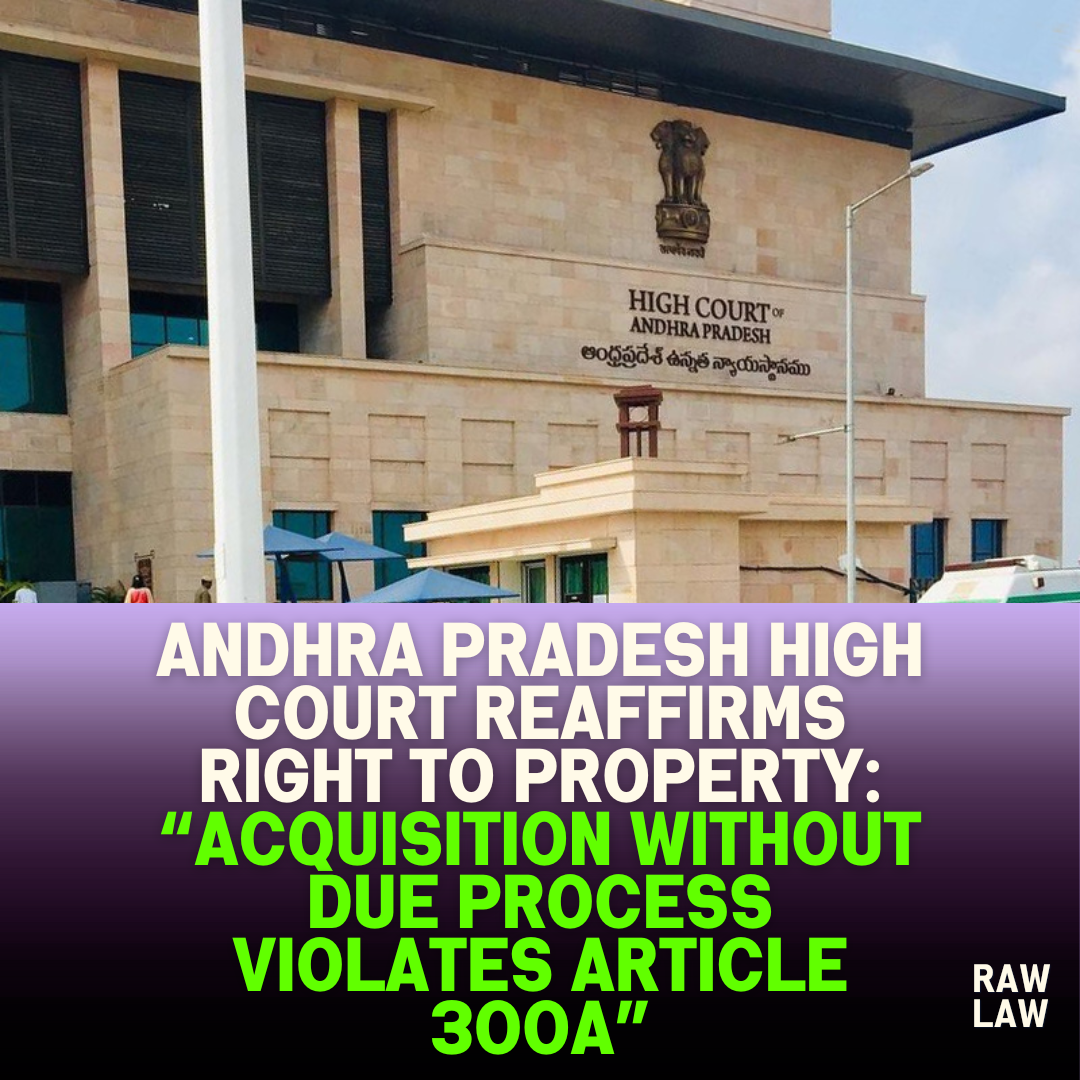
Andhra Pradesh High Court Reaffirms Right to Property: “Acquisition Without Due Process Violates Article 300A”

Court’s Decision
The Andhra Pradesh High Court, comprising Justice Tarlada Rajasekhar Rao, delivered a crucial ruling reaffirming that no person shall be deprived of property except by authority of law, and directed the National Highways Authority and State officials to strictly follow the due process before acquiring private land.
The Court disposed of ten connected writ petitions by landowners from Vizianagaram District, challenging unauthorized interference with their lands under the National Highways Act, 1956.
Justice Rao observed that the right to property under Article 300A of the Constitution remains a fundamental human right, emphasizing that failure to follow legal safeguards—such as notice, hearing, and compensation—renders the acquisition illegal and unconstitutional.
“The process of acquisition cannot be initiated or continued without scrupulous compliance with statutory provisions. Violation of the right to notice or hearing strikes at the root of Article 300A.”
The Court further directed that possession of land cannot be taken unless all statutory formalities—notification, declaration, and compensation—are duly completed.
Facts
Multiple landowners from Vizianagaram District approached the High Court contending that their agricultural lands were being interfered with by highway authorities under the pretext of expanding National Highway corridors, without proper notifications or compensation.
The Union of India, acting through the Ministry of Road Transport and Highways, issued a notification under Section 3A of the National Highways Act, 1956, in 2022 for certain lands in Vizianagaram. However, several petitioners’ properties were not included in this initial notification.
Subsequently, a declaration under Section 3D was published on 3 July 2024, and proceedings under Section 3G(3) were initiated. The petitioners contended that their properties were being entered upon and excavated without proper acquisition, in violation of Article 300A of the Constitution.
The petitioners sought a direction restraining the authorities from acquiring or interfering with their lands without following the mandatory procedures laid down in the Act and the Constitutionl.
Issues
- Whether the authorities could interfere with or acquire private land without issuing notifications and following due process under the National Highways Act, 1956.
- Whether such interference amounts to a violation of the constitutional right to property guaranteed under Article 300A.
- Whether non-compliance with procedural safeguards renders the entire acquisition void.
Petitioners’ Arguments
The petitioners argued that no valid acquisition proceedings were initiated for their lands and that respondent authorities entered the land unlawfully, damaging crops and fencing. They submitted that the initial notification under Section 3A did not include their lands, and yet, officials proceeded with measurement and marking activities.
They contended that such arbitrary action violates Article 300A, which guarantees that no person shall be deprived of property except by authority of law. The petitioners relied on the Supreme Court’s decision in Kolkata Municipal Corporation v. Bimal Kumar Shah (2024) 10 SCC 533, wherein the Apex Court recognized seven foundational rights of property holders that must be respected during acquisition.
The petitioners asserted that the authorities failed to provide notice, hearing, or compensation, thereby breaching both statutory and constitutional mandates. They requested that the Court direct the respondents to refrain from any acquisition until all procedures under Sections 3A, 3D, and 3G are followed.
Respondents’ Arguments
The Central Government Counsel appearing for the Union of India submitted that the petitioners’ lands were not included in the notified area under Section 3A, and hence no acquisition process had been initiated. The counsel assured that no possession or interference would take place until acquisition proceedings, if any, are completed as per law.
The State Government Counsel representing the Collector and local revenue officers also stated that the respondents would follow due process before acquiring any portion of the petitioners’ land. They maintained that no violation had yet occurred, and the proceedings under the Act were being conducted transparently and legally.
The respondents, therefore, urged the Court to dismiss the writ petitions, arguing that they were premature and based on apprehension rather than evidence of actual acquisition.
Analysis of the Law
The Court examined the scheme of the National Highways Act, 1956, which prescribes a three-step acquisition process:
- Section 3A – Notification of intent to acquire;
- Section 3D – Declaration of acquisition;
- Section 3G – Determination and payment of compensation.
The Court held that each step is mandatory, and any deviation vitiates the process. The Act represents a balance between public purpose and individual rights, and hence, compliance with due process is not a mere formality but a substantive safeguard against arbitrary deprivation of property.
The Court referred extensively to Article 300A, holding that the “authority of law” required to deprive a person of property must be just, fair, and reasonable, conforming to both statutory and constitutional standards.
“The right to property, though no longer a fundamental right, continues as a constitutional right and a basic human right. The State cannot circumvent statutory procedure under the guise of urgency or public purpose.”
Precedent Analysis
The judgment drew heavily from the Supreme Court’s landmark ruling in Kolkata Municipal Corporation v. Bimal Kumar Shah (2024) 10 SCC 533, which enumerated the seven core rights forming the “real content” of Article 300A:
- Right to Notice – To be informed before acquisition;
- Right to be Heard – Opportunity to object;
- Right to a Reasoned Decision – Transparency in decision-making;
- Duty to Acquire Only for Public Purpose – Ensuring genuine necessity;
- Right to Fair Compensation – Reflecting true market value;
- Right to an Efficient and Expeditious Process – Avoiding delays;
- Right of Conclusion – Ensuring the process reaches finality.
The High Court emphasized that non-compliance with any of these seven principles would render the acquisition susceptible to constitutional challenge.
The Court also cited precedents where the absence of procedural fairness invalidated acquisitions, reinforcing that notice, hearing, and compensation are indispensable elements of lawful deprivation of property.
Court’s Reasoning
Justice Rao held that the State’s power of eminent domain is not absolute and must be exercised strictly in accordance with law. The judgment reasoned that even in cases of infrastructure or highway development, public purpose cannot override constitutional guarantees.
The Court observed that the culmination of acquisition is not merely payment of compensation but also lawful possession transfer, which must follow notification and adjudication. Until then, the petitioners retain full ownership rights, and any interference is unconstitutional.
“The acquisition process does not conclude with compensation but with lawful possession. If possession is not taken in accordance with law, acquisition remains incomplete.”
The Bench reiterated that administrative expediency cannot justify procedural shortcuts, especially when citizens’ property rights are at stake.
Conclusion
The Court disposed of all ten writ petitions with a categorical direction to the Union of India, National Highways Authority of India, and State authorities to strictly adhere to due process of law under the National Highways Act, 1956 before acquiring any land belonging to the petitioners.
It clarified that no interference or possession should be undertaken until the completion of legal formalities, including publication of notifications, hearing of objections, and payment of compensation.
The Court made no order as to costs and directed that all pending miscellaneous petitions be closed.
Implications
- Reinforces that Article 300A protects property as a constitutional and human right.
- Establishes that acquisition without notice or hearing is void ab initio.
- Affirms that even infrastructure projects must follow lawful procedure.
- Strengthens landowners’ rights across India, particularly in highway and infrastructure acquisitions.
- Reiterates that State’s power of eminent domain is limited by procedural fairness.