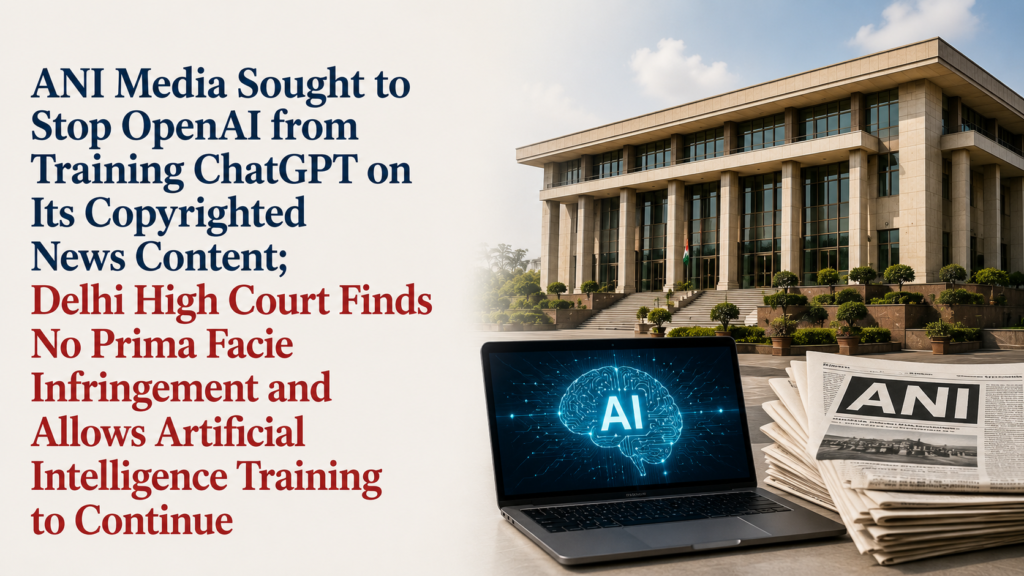
ANI Media Sought to Stop OpenAI from Training ChatGPT on Its Copyrighted News Content; Delhi High Court Finds No Prima Facie Infringement and Allows Artificial Intelligence Training to Continue

Delhi High Court Rejects ANI’s Bid to Stop ChatGPT Training on Copyrighted News Content, Holds Public Interest Favours Continued AI Development
Facts
ANI Media Pvt. Ltd. instituted a commercial copyright suit against OpenAI before the Delhi High Court alleging unauthorized use of ANI’s copyrighted news articles and other literary works for training the Large Language Models (LLMs) underlying ChatGPT.
ANI asserted two distinct causes of action:
- Training Claim – OpenAI allegedly copied, stored and used ANI’s copyrighted works to train ChatGPT without obtaining a licence.
- Output (Reproduction) Claim – ChatGPT allegedly reproduced ANI’s copyrighted articles, summaries and interviews while responding to user prompts, thereby communicating ANI’s works to the public without authorization.
ANI sought an interim injunction restraining OpenAI from:
- storing its copyrighted works;
- using those works for AI training;
- generating infringing outputs;
- continuing to exploit ANI’s content without licence.
OpenAI opposed the application.
Several organizations intervened.
Intervenors supporting ANI included:
- Digital News Publishers Association (DNPA);
- Federation of Indian Publishers;
- Indian Music Industry.
Intervenors supporting OpenAI included:
- Broadband India Forum;
- Flux AI Labs;
- IGAP Project LLP.
The Court also appointed two Amici Curiae owing to the novel legal questions concerning artificial intelligence and copyright law.
Justice Amit Bansal framed four principal issues concerning:
- jurisdiction;
- copyright infringement through AI training;
- copyright infringement through AI-generated outputs; and
- fair dealing under Section 52 of the Copyright Act.
The judgment was delivered at the stage of deciding ANI’s application for interim injunction.
Issues
The Delhi High Court considered:
- Whether Indian courts had jurisdiction despite OpenAI’s servers being located outside India.
- Whether storing ANI’s copyrighted works for training ChatGPT amounted to copyright infringement.
- Whether ChatGPT’s responses reproduced ANI’s copyrighted literary works.
- Whether OpenAI’s use of ANI’s works qualified as fair dealing under Section 52(1)(a) of the Copyright Act.
- Whether ANI had established a prima facie case for grant of interim injunction.
- Whether balance of convenience and public interest justified restraining OpenAI from training or operating ChatGPT pending trial.
ANI’s Arguments
ANI argued that OpenAI had unlawfully copied and stored its original literary works while training ChatGPT.
According to ANI:
- copyright subsists even in publicly accessible material;
- public availability does not amount to a free licence;
- OpenAI commercially benefited from ANI’s journalism without permission.
ANI further submitted that:
- ChatGPT memorizes copyrighted material;
- it “regurgitates” copyrighted articles;
- many outputs substantially reproduced ANI’s expression.
ANI argued that:
- copyright protects expression, not merely verbatim copying;
- ChatGPT reproduced translations prepared by ANI;
- OpenAI itself had entered licensing agreements with international publishers such as the Associated Press and Financial Times, thereby acknowledging the need for licences.
ANI therefore contended that both AI training and AI-generated responses infringed Sections 14 and 51 of the Copyright Act.
OpenAI’s Arguments
OpenAI denied infringement.
It submitted that:
- ChatGPT does not permanently store copyrighted articles;
- LLMs learn statistical relationships rather than retaining expressive content;
- the model predicts language rather than reproducing original works.
OpenAI argued that:
- copyright protects expression, not facts;
- news consists primarily of facts that remain free for public use;
- ChatGPT ordinarily produces new responses rather than copies.
OpenAI further submitted that:
- instances of verbatim reproduction (“regurgitation”) are rare;
- safeguards have been developed to reduce such occurrences;
- AI training serves broader research and technological purposes.
It also argued that AI training constitutes fair dealing under Section 52 of the Copyright Act.
Analysis of the Law
Territorial Jurisdiction
OpenAI argued that training occurred on servers located outside India.
The Court rejected this preliminary objection.
The Court held that:
- ANI’s principal place of business is situated in Delhi;
- OpenAI actively offers paid services within India;
- ChatGPT’s outputs are generated and accessed by users in Delhi.
The Court therefore held that Indian courts possess territorial jurisdiction under:
- Section 62 of the Copyright Act; and
- Section 20 CPC.
The Court further observed that merely locating servers abroad cannot immunize alleged copyright infringement affecting Indian copyright owners.
Copyright in ANI’s Works
The Court accepted, prima facie, that ANI owns copyright over its original literary works.
It observed that:
- publicly available news articles remain protected by copyright;
- publication on the internet does not extinguish copyright.
However, the Court emphasized that copyright extends only to the expression of facts—not to the underlying facts themselves.
This distinction became central to deciding both the output claim and the training claim.
Output (Reproduction) Claim
The Court examined whether ChatGPT reproduced ANI’s copyrighted works.
After considering examples produced by ANI, the Court found no convincing prima facie evidence that ChatGPT systematically reproduced substantial portions of ANI’s literary works.
The Court observed that:
- responses generated by ChatGPT generally differed from the original articles;
- they often summarized information using different wording;
- different prompts generated different outputs.
The Court accepted that isolated instances of memorization may theoretically occur.
However, the evidence before the Court did not establish systematic reproduction of ANI’s copyrighted expression.
Accordingly, the Court held that ANI had failed to establish a prima facie case of infringement through ChatGPT outputs.
Training Claim
The Court recognized that AI training necessarily requires temporary copying and processing of copyrighted material.
The principal question therefore became whether such use constituted copyright infringement or fell within the statutory defence of fair dealing.
The Court noted that AI training is fundamentally different from publishing or distributing copyrighted works.
Training transforms massive quantities of data into mathematical relationships enabling prediction of language rather than creating substitute copies of the original works.
The Court accepted, prima facie, that AI training is transformative in nature.
Fair Dealing Under Section 52
The Court undertook an extensive interpretation of Section 52(1)(a).
It analysed:
- legislative history;
- Indian precedents;
- comparative jurisprudence;
- technological functioning of LLMs.
The Court held that fair dealing requires examination of:
Purpose Test
The Court found that AI training serves:
- research;
- technological advancement;
- development of new computational capabilities.
Commercial use alone does not automatically defeat fair dealing.
Fairness Test
The Court considered:
- extent of use;
- market substitution;
- economic harm;
- public interest.
The Court found that ANI had not demonstrated that ChatGPT functions as a substitute for ANI’s news service.
Nor had ANI established prima facie evidence that OpenAI’s training displaced ANI’s commercial market.
Instead, AI systems provide fundamentally different services from news agencies.
Accordingly, the Court held that OpenAI had established a strong prima facie defence of fair dealing.
Public Interest
The Court devoted significant attention to public interest.
It observed that:
- AI represents one of the most significant technological developments of the present era;
- India is actively promoting domestic AI development;
- restrictive copyright interpretations could hinder innovation.
The Court emphasized that copyright law must balance:
- protection of authors;
- technological progress;
- public access to knowledge.
The Court concluded that preventing AI training at the interim stage could adversely affect innovation and research without sufficient evidence of copyright infringement.
Precedent Analysis
Eastern Book Company v. D.B. Modak
The Court reaffirmed that Indian copyright law protects original expression involving skill and judgment rather than mere labour.
The judgment relied upon this principle while examining ANI’s news articles and distinguishing facts from protected expression.
R.G. Anand v. Deluxe Films
The Court reiterated that copyright protects only the form and expression of ideas.
Substantial similarity—not mere similarity of facts—is required to establish infringement.
This principle guided the Court’s evaluation of ChatGPT outputs.
Neetu Singh v. Telegram
The Court relied upon this judgment while holding that foreign servers do not deprive Indian copyright owners of remedies before Indian courts.
Blueberry Books v. Google India
The Court referred to this decision while considering territorial jurisdiction and extra-territorial aspects of online copyright disputes.
Indian Performing Rights Society v. Sanjay Dalia
The judgment relied upon Section 62 principles governing copyright jurisdiction in favour of copyright owners.
Court’s Reasoning
The Court observed that AI presents entirely new copyright questions that could not have been contemplated when the Copyright Act was enacted in 1957.
Nevertheless, existing statutory principles must be applied.
At the interim stage, the Court concluded:
- ANI failed to establish systematic reproduction of its copyrighted works by ChatGPT;
- AI training appears prima facie transformative;
- OpenAI demonstrated a substantial fair dealing defence;
- the balance of convenience favoured continuation of AI development;
- restraining ChatGPT would have serious public interest implications.
The Court emphasized that these findings were prima facie and that the issues would ultimately be determined after a full trial.
Conclusion
The Delhi High Court dismissed ANI’s application for interim injunction.
The Court held that:
- Indian courts possess jurisdiction over the dispute;
- ANI established ownership of copyright in its original literary works;
- however, no prima facie case of output infringement was made out;
- AI training was prima facie protected as fair dealing under Section 52;
- balance of convenience and public interest overwhelmingly favoured OpenAI.
Accordingly, OpenAI was permitted to continue operating and training ChatGPT pending final adjudication of the suit.
The Court clarified that all observations were confined to the interim stage and would not prejudice the final trial.
Key Takeaways
- Indian courts can exercise jurisdiction over AI copyright disputes even where AI servers are located abroad.
- Public availability of copyrighted works does not extinguish copyright protection.
- Copyright protects the expression of news, not the underlying facts.
- ChatGPT outputs must substantially reproduce protected expression before infringement can be established.
- AI training was held, prima facie, to constitute transformative use capable of qualifying as fair dealing under Section 52.
- Commercial use alone does not defeat a fair dealing defence.
- Public interest in AI innovation is a relevant consideration while granting interim injunctions.
- The judgment represents India’s first comprehensive judicial examination of AI training and copyright law.
Case Details
Case: ANI Media Pvt. Ltd. v. OpenAI OpCo LLC
Court: Delhi High Court
Case Number: CS(COMM) 1028/2024
Judge: Justice Amit Bansal
Reserved On: 27 March 2026
Date of Decision: 24 July 2026
Result: Interim injunction refused. The Court held that OpenAI had a strong prima facie defence of fair dealing in relation to AI training, found no prima facie case of substantial reproduction through ChatGPT outputs, and directed that the suit proceed to trial.