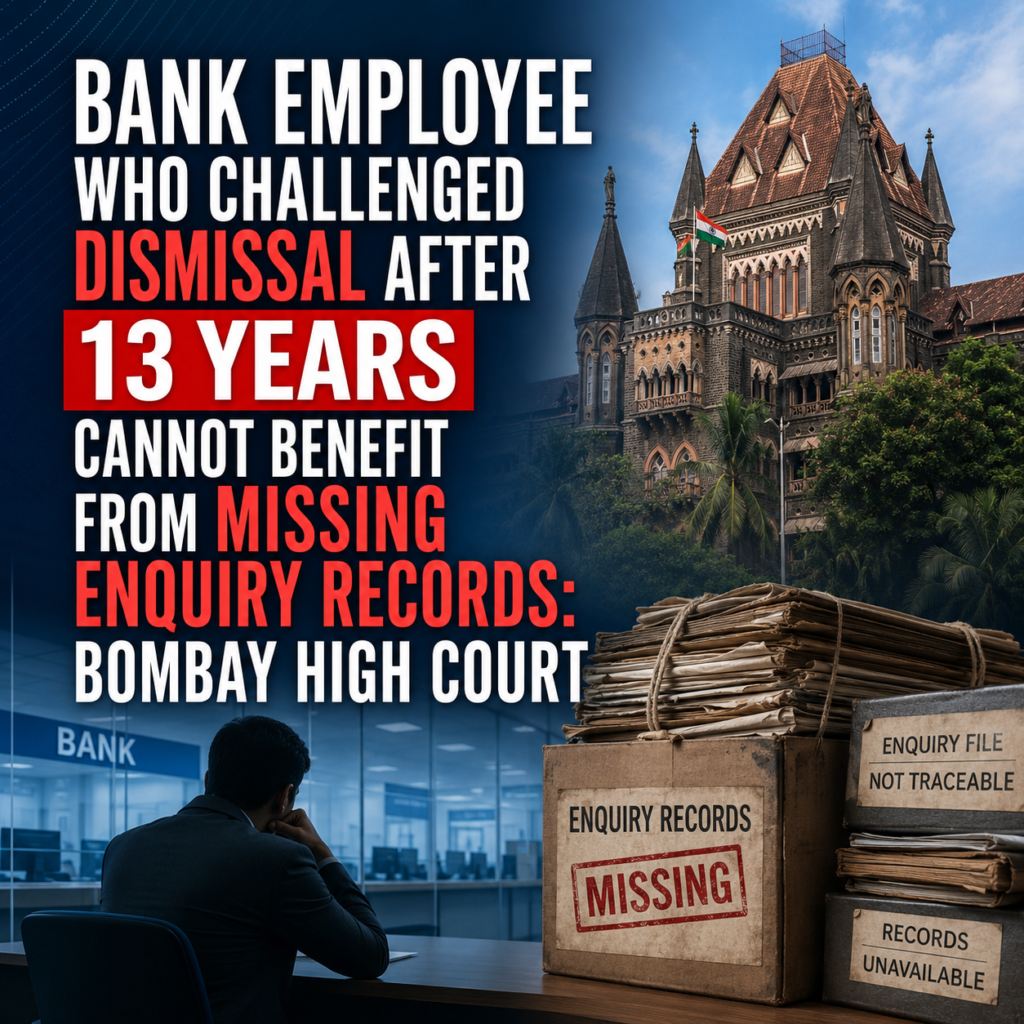
Bank Employee Who Challenged Dismissal After 13 Years Cannot Benefit From Missing Enquiry Records: Bombay High Court

Bombay High Court Restores Dismissal of Bank Employee Who Raised Dispute 13 Years Later
Facts
Sharad Rajaram Khadtare was appointed as a clerk with Bank of India in January 1979 and was posted at the Bank’s Chakan Branch in 1997.
He was suspended in February 1997 following allegations that he had fraudulently withdrawn and misappropriated money from the accounts of several customers.
The disciplinary charges concerned alleged fraudulent withdrawals of:
- ₹1,46,000 from the account of Kaluram Tupe;
- ₹99,200 from the account of Pratidnya Transport;
- ₹1,07,000 from the account of S.N. Chavan; and
- ₹57,500 from the account of S.K. Karpe and Sons.
A departmental chargesheet was issued in October 1999. During the domestic enquiry, 11 management witnesses were examined and made available for cross-examination. The employee was represented by a defence representative.
The Enquiry Officer found the charges proved. After issuing a show-cause notice, considering the employee’s replies and granting him a personal hearing, the Bank dismissed him from service on 18 October 2000.
His departmental appeal was rejected in September 2001.
A separate criminal case arising from related allegations ended in his acquittal in June 2013.
Only after the acquittal, nearly 13 years after his dismissal, the employee demanded reinstatement and initiated industrial-dispute proceedings.
The Central Government referred the dispute to the Industrial Tribunal in June 2014. However, the employee filed his statement of claim only in April 2018, nearly four years after the reference.
By that time, the Bank had destroyed much of the old enquiry record in accordance with its record-retention practice. Neither party could produce the depositions and complete documentary evidence recorded during the domestic enquiry.
The Industrial Tribunal held that the enquiry had been conducted fairly and in accordance with natural justice. However, because the complete enquiry evidence was unavailable, it declared the Enquiry Officer’s findings perverse.
The Tribunal subsequently held the dismissal illegal and directed the Bank to pay full back wages from the date of dismissal until the employee’s superannuation, along with continuity of service and consequential benefits.
Bank of India challenged both awards before the Bombay High Court.
Issues
- Whether the Industrial Tribunal could declare the Enquiry Officer’s findings perverse merely because the Bank was unable to produce the complete enquiry record after more than two decades.
- Whether an employee who challenged his dismissal after 13 years could benefit from the employer’s destruction of old records.
- Whether the delay in raising the industrial dispute caused serious prejudice to the Bank’s ability to defend the dismissal.
- Whether the burden of producing available copies of the enquiry record should have been placed upon the employee.
- Whether the employee’s acquittal in the criminal case affected the findings recorded in the separate departmental enquiry.
- Whether the Industrial Tribunal was justified in awarding full back wages, continuity of service and consequential benefits.
Petitioner’s Arguments
Bank of India argued that the Industrial Tribunal had committed a serious error by declaring the Enquiry Officer’s findings perverse solely because the full enquiry record was no longer available.
The Bank submitted that:
- the employee had waited 13 years before challenging his dismissal;
- there had been no correspondence or demand for reinstatement during that period;
- the Bank had destroyed the old records in the ordinary course of its record-management practice;
- it could not reasonably be expected to preserve every disciplinary record indefinitely; and
- the employee’s own delay had caused the evidentiary difficulty.
The Bank maintained that the Enquiry Officer had considered the testimony of 11 witnesses and prepared a detailed 24-page report discussing the evidence.
It argued that the Tribunal had not identified any actual perversity in that report. Instead, it treated the absence of the original evidence as sufficient to invalidate the findings.
The Bank contended that the employee must have received copies of the depositions and relied-upon documents during the fair enquiry. Therefore, if he intended to challenge the dismissal after several years, he was required to preserve and produce those documents.
The Bank further argued that the employee had committed grave misconduct involving misappropriation of customers’ money and that banking employees are held to a high standard of honesty and integrity.
It submitted that the employee’s acquittal in the criminal case was irrelevant because the criminal trial and departmental enquiry were separate proceedings governed by different standards of proof.
The Bank sought setting aside of the Tribunal’s preliminary and final awards.
Respondent’s Arguments
The employee argued that no fixed limitation period is prescribed under the Industrial Disputes Act for raising an industrial dispute or for making a reference.
He submitted that he had waited for the criminal case to conclude and demanded reinstatement soon after his acquittal in June 2013.
According to him, his acquittal was honourable and related to substantially the same allegations and evidence that formed the basis of the disciplinary action.
The employee argued that the Bank had selectively failed to produce the depositions and other crucial material from the enquiry while producing certain other documents.
He submitted that the original enquiry record was under the Bank’s control and that he could not be expected to produce documents which were not in his possession.
According to him, the Industrial Tribunal could not assess whether the findings were supported by evidence when the underlying depositions and documents were unavailable.
He therefore supported the Tribunal’s conclusion that the Enquiry Officer’s findings were perverse.
Alternatively, he requested that, even if the Court found the delay attributable to him, the relief should be modified rather than completely denied. He sought at least pensionary benefits or reasonable compensation, considering his advanced age.
Analysis of the Law
The High Court examined the principles governing delay and laches, domestic enquiries, perversity of findings and the distinction between criminal and departmental proceedings.
Delay in Raising an Industrial Dispute
Although the Industrial Disputes Act does not prescribe a rigid limitation period for making a reference, the dispute must still be an existing and live industrial dispute.
A stale claim raised after an unexplained and excessive delay may be refused where the delay:
- obscures the facts;
- results in loss of evidence;
- makes witnesses unavailable;
- prejudices the employer’s defence; or
- enables the claimant to gain an unfair advantage.
The absence of a statutory limitation period does not permit an employee to remain inactive indefinitely and then seek full relief without regard to the prejudice caused.
Burden of Producing Enquiry Records
Where an employee participates in a fair domestic enquiry, the employee ordinarily receives copies of the chargesheet, depositions, relied-upon documents, findings and punishment order.
If the employee delays challenging the disciplinary action for many years, he cannot automatically place the entire burden of producing every old document upon the employer.
A claimant responsible for the delay may be required to produce at least the copies that were supplied to him during the enquiry.
An adverse inference may arise where the employee fails to preserve or produce available documents while attempting to benefit from the employer’s inability to produce the originals.
Perversity of Enquiry Findings
A finding is perverse where it is:
- unsupported by any evidence;
- based on irrelevant material;
- contrary to the evidence;
- irrational; or
- one which no reasonable person could have reached.
The mere absence of the complete original enquiry record before the Tribunal does not, by itself, establish that the Enquiry Officer’s findings were perverse.
The Tribunal must examine the enquiry report and identify whether the findings disclose a complete absence of evidence or a legally unsustainable approach.
Standard of Proof in Departmental Proceedings
Charges in a departmental enquiry are decided on the standard of preponderance of probabilities.
This is substantially different from a criminal prosecution, where guilt must be proved beyond reasonable doubt.
Accordingly, an acquittal in a criminal case does not automatically nullify a finding of misconduct in a domestic enquiry.
Integrity Expected From Bank Employees
Employees working in banks and other financial institutions occupy positions of trust.
Misappropriation of customers’ money constitutes grave misconduct and may justify dismissal because the employment relationship depends upon honesty, reliability and integrity.
Precedent Analysis
Chairman, State Bank of India v. M.J. James
The Supreme Court explained the distinction between limitation, delay, laches and acquiescence.
It held that courts must consider whether delay has prejudiced the opposing party by causing loss of records, disappearance of witnesses, changes in position or difficulty in conducting a fair adjudication.
The Bombay High Court relied on this decision to hold that the employee’s 13-year delay had materially prejudiced the Bank.
The delay had resulted in:
- destruction of enquiry records;
- inability to trace customers and bank employees who had testified; and
- loss of the Bank’s opportunity to prove the charges afresh before the Tribunal.
Damoh Panna Sagar Rural Regional Bank v. Munna Lal Jain
The Supreme Court held that bank employees are required to maintain a high degree of honesty and integrity.
Misconduct involving financial dealings, customer funds or breach of trust must be viewed seriously because public confidence in banking institutions depends upon the integrity of their employees.
The High Court relied on this principle while considering the seriousness of the allegations against the respondent.
General Principle on Criminal Acquittal and Departmental Enquiry
The Court applied the settled principle that criminal proceedings and disciplinary proceedings have different purposes and standards of proof.
A criminal acquittal does not automatically erase or invalidate departmental findings, particularly where the disciplinary action is based upon evidence independently recorded in the domestic enquiry.
Court’s Reasoning
The Court noted that the Industrial Tribunal had expressly held that the domestic enquiry was fair, proper and compliant with natural justice.
Once that conclusion was reached, it followed that the employee had been given an adequate opportunity to defend himself and had access to the material relied upon during the enquiry.
The Enquiry Officer had examined the testimony of 11 witnesses and prepared a detailed report running into 24 pages.
The Tribunal did not analyse that report to identify any unsupported, irrational or legally defective finding.
Instead, it declared the findings perverse only because the complete depositions and documents were unavailable before it.
The High Court held that this approach was fundamentally erroneous.
The records had been destroyed because the employee remained silent for 13 years after his dismissal. The Bank was not expected to preserve disciplinary records forever in anticipation that a former employee might revive the dispute decades later.
The Court observed that the employee had further delayed the matter by taking nearly four years to file his statement of claim after the reference was made.
By the time the Tribunal ruled upon the preliminary issues, approximately 24 years had passed since the dismissal.
This delay made it impossible for the Bank to trace many witnesses, particularly customers who had testified during the domestic enquiry.
The employee could not be allowed to create the evidentiary disadvantage through his own inaction and then rely upon that disadvantage to invalidate the disciplinary proceedings.
The Court held that, since the enquiry was fair and the employee had participated in it, the Tribunal ought to have required him to produce the copies supplied to him or drawn an adverse inference against him for failing to do so.
The Court also examined the Enquiry Officer’s report and found that it contained an elaborate discussion of the evidence. This was not a case where the findings were based on no evidence.
The Tribunal had effectively rewarded the employee’s delay by granting full back wages and all consequential benefits.
The Court found such relief wholly unjustified, particularly considering the seriousness of the misconduct involving alleged fraudulent withdrawals from customers’ accounts.
The employee’s criminal acquittal did not alter the position because his dismissal followed an independent domestic enquiry governed by a lower standard of proof.
Conclusion
The Bombay High Court allowed Bank of India’s writ petition and set aside both awards passed by the Industrial Tribunal.
The Court held that:
- the employee’s 13-year delay in challenging his dismissal had caused serious prejudice to the Bank;
- the Bank could not be penalised for destroying old enquiry records in the ordinary course;
- the employee could not take advantage of the evidentiary difficulty created by his own delay;
- the Tribunal was wrong in declaring the Enquiry Officer’s findings perverse merely because the entire enquiry record was unavailable;
- the detailed enquiry report showed that the findings were not based on a complete absence of evidence;
- the employee’s criminal acquittal did not invalidate the departmental enquiry; and
- the direction granting full back wages, continuity of service and consequential benefits was unsustainable.
The High Court restored the disciplinary outcome by holding that the Enquiry Officer’s findings were not perverse and by setting aside the Industrial Tribunal’s order declaring the dismissal illegal.
Case Details
Case: Bank of India v. Sharad Rajaram Khadtare
Court: Bombay High Court
Case Number: Writ Petition No. 15893 of 2025
Judge: Justice Sandeep V. Marne
Date: 22 June 2026
Result: Industrial Tribunal’s awards set aside; dismissal from service sustained