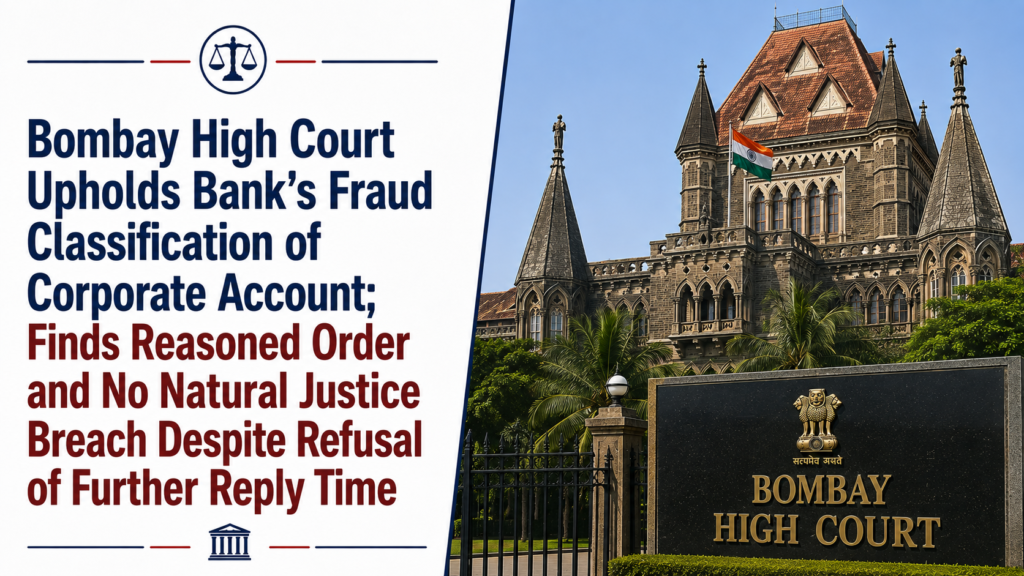
Bombay High Court Upholds Bank’s Fraud Classification of Corporate Account; Finds Reasoned Order and No Natural Justice Breach Despite Refusal of Further Reply Time

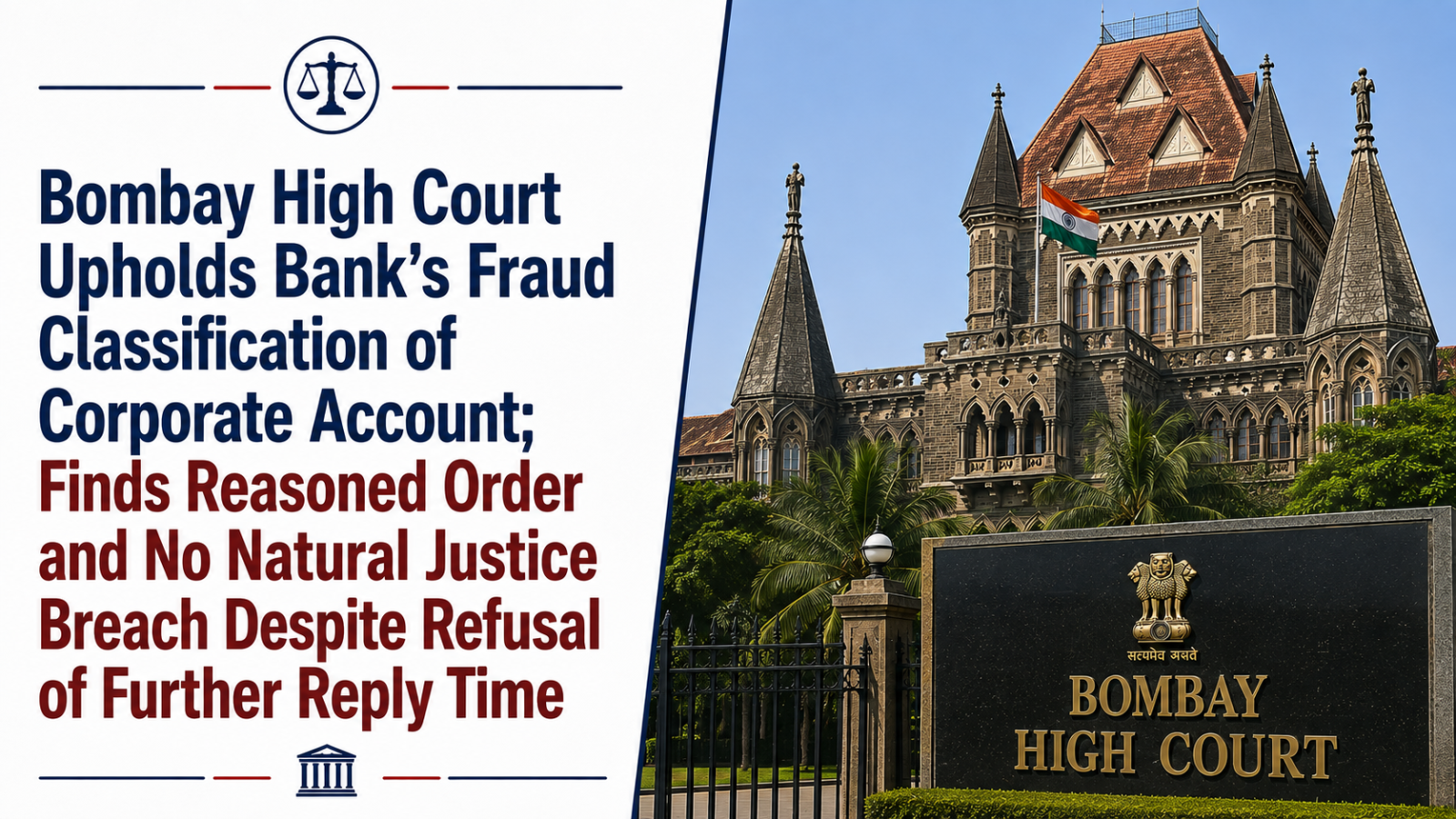
Bombay High Court Dismisses Former Directors’ Challenge to Fraud Tag; Finds Adequate Opportunity to Respond
Facts
The petitioners, Anil Khemani and another, were erstwhile directors of Respondent No. 2 company. They challenged a Show Cause Notice dated 6 September 2025 and an Order dated 16 October 2025 passed by Axis Bank declaring the account of Respondent No. 2 as fraud. The High Court noted at the outset that the impugned order did not declare the petitioners themselves as fraud, but only classified the company account as fraud. The Court nevertheless heard the petition on merits.
Axis Bank had taken over credit facilities aggregating to Rs. 23.01 crore from SBI in June 2020. The company later opened an undisclosed account with Nashik Merchant Co-operative Bank Ltd. (NMCB) without informing Axis Bank. The company eventually defaulted, its account was classified as NPA, and it entered the Corporate Insolvency Resolution Process in March 2024.
During the CIRP, a Transaction Audit was conducted. The audit indicated, among other things, that more than Rs. 6 crore had been routed through the undisclosed NMCB account, including transfers to Petitioner No. 1 and his partnership firm, and that there were other related-party transactions, loans and unexplained transfers.
A Show Cause Notice was issued along with the final Transaction Audit Report and 21 days were granted for response. Petitioner No. 1 sought a four-week extension citing family issues and medical emergency, which the Bank refused. On 16 October 2025, the Fraud Identification Council classified the company account as fraud.
Issues
- Whether the fraud classification order dated 16 October 2025 was unreasoned.
- Whether refusal to grant further time to respond to the Show Cause Notice violated the principles of natural justice.
- Whether the petitioners had been given sufficient prior opportunity to understand and answer the allegations against the company.
- Whether the Bank’s reliance upon the Transaction Audit Report was legally sustainable.
Petitioners’ Arguments
The petitioners contended that the impugned order was unreasoned and mechanically based on the Transaction Audit Report.
They argued that the Show Cause Notice was issued while the company was in CIRP and that they therefore lacked access to the company’s records, books and documents.
They further submitted that the Bank had itself acted belatedly in initiating the fraud classification process for transactions allegedly occurring between 2021 and 2024, yet arbitrarily refused their request for additional time to respond.
The petitioners also alleged that documents relied upon for the fraud classification had not been furnished and that refusal of the extension request violated natural justice.
Respondent’s Arguments
Axis Bank argued that the petitioners had known the allegations almost a year before issuance of the formal Show Cause Notice.
The same issues—opening of the undisclosed NMCB account, diversion of funds and discrepancies in the company’s accounts—had already been discussed in the draft Transaction Audit Report and during CoC meetings attended by Petitioner No. 1.
The Bank also pointed out that the petitioners had been given access to the company’s office to provide documents but did not attend, and despite repeated assurances, Petitioner No. 1 failed to provide Tally data and other supporting records.
It therefore submitted that the refusal to grant further time was justified and that the impugned order contained sufficient reasons based upon unrebutted Transaction Audit findings.
Analysis of the Law
The High Court relied upon State Bank of India v. Rajesh Agarwal, (2023) 6 SCC 1, in which the Supreme Court held that an order declaring an account as fraud must be reasoned.
However, the Court clarified that such reasons need not be written at the same level of detail as a judicial judgment. Brief reasons are sufficient so long as they demonstrate fairness and application of mind.
The Court therefore examined whether the Fraud Identification Council’s order, read with its schedules and the Transaction Audit findings incorporated therein, sufficiently disclosed the basis of classification.
Precedent Analysis
The principal precedent was:
State Bank of India v. Rajesh Agarwal, (2023) 6 SCC 1 — the Supreme Court held that borrowers must receive notice and an opportunity to respond before fraud classification, and the final decision must contain reasons.
The Bombay High Court applied that principle but held that the reasons in the present matter were adequate because the fraud order expressly referred to the adverse Transaction Audit findings and set out the relevant misconduct in its schedules.
Court’s Reasoning
The Court rejected the contention that the fraud order was unreasoned. It noted that Schedule III referred to the adverse observations in the Transaction Audit Report, while Schedule I, Part B set out key findings including diversion of funds through the undisclosed NMCB account, related-party transactions, unjustified transfers and interest-free loans and advances.
On natural justice, the Court found that the petitioners had been aware of the allegations from at least September 2024. They had been given access to the company’s office, had been invited to provide documents and Tally data, and the allegations had been discussed with Petitioner No. 1 in CoC meetings. Despite multiple opportunities and undertakings, the required information was not supplied.
The Court further noted that the final Transaction Audit Report was supplied along with the Show Cause Notice and the petitioners received the prescribed 21-day period to respond. Their request for additional time was based only on unspecified family issues and medical emergency. In those circumstances, the Bank was justified in refusing further extension.
Accordingly, the Court found no violation of natural justice.
Conclusion
The Bombay High Court dismissed the writ petition and upheld the fraud classification order passed by Axis Bank.
It held that the order contained sufficient reasons, that the petitioners had been given repeated opportunities to respond to the Transaction Audit allegations, and that refusal of additional time did not amount to violation of natural justice.
Case Details
Case: Anil Khemani and Another v. Axis Bank Ltd. and Another
Court: Bombay High Court, Ordinary Original Civil Jurisdiction
Case Number: Writ Petition No. 886 of 2026
Judges: Hon’ble Mr. Justice B. P. Colabawalla and Hon’ble Mr. Justice Firdosh P. Pooniwalla
Date: 06 August 2026
Result: Writ Petition dismissed; fraud classification of Respondent No. 2 company’s account upheld; no order as to costs