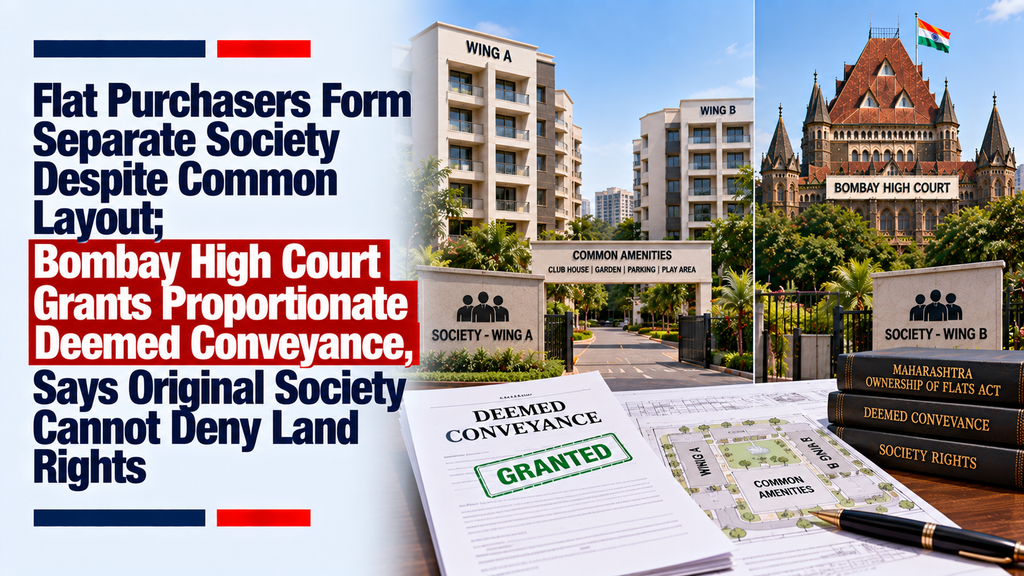
Flat Purchasers Form Separate Society Despite Common Layout; Bombay High Court Grants Proportionate Deemed Conveyance, Says Original Society Cannot Deny Land Rights

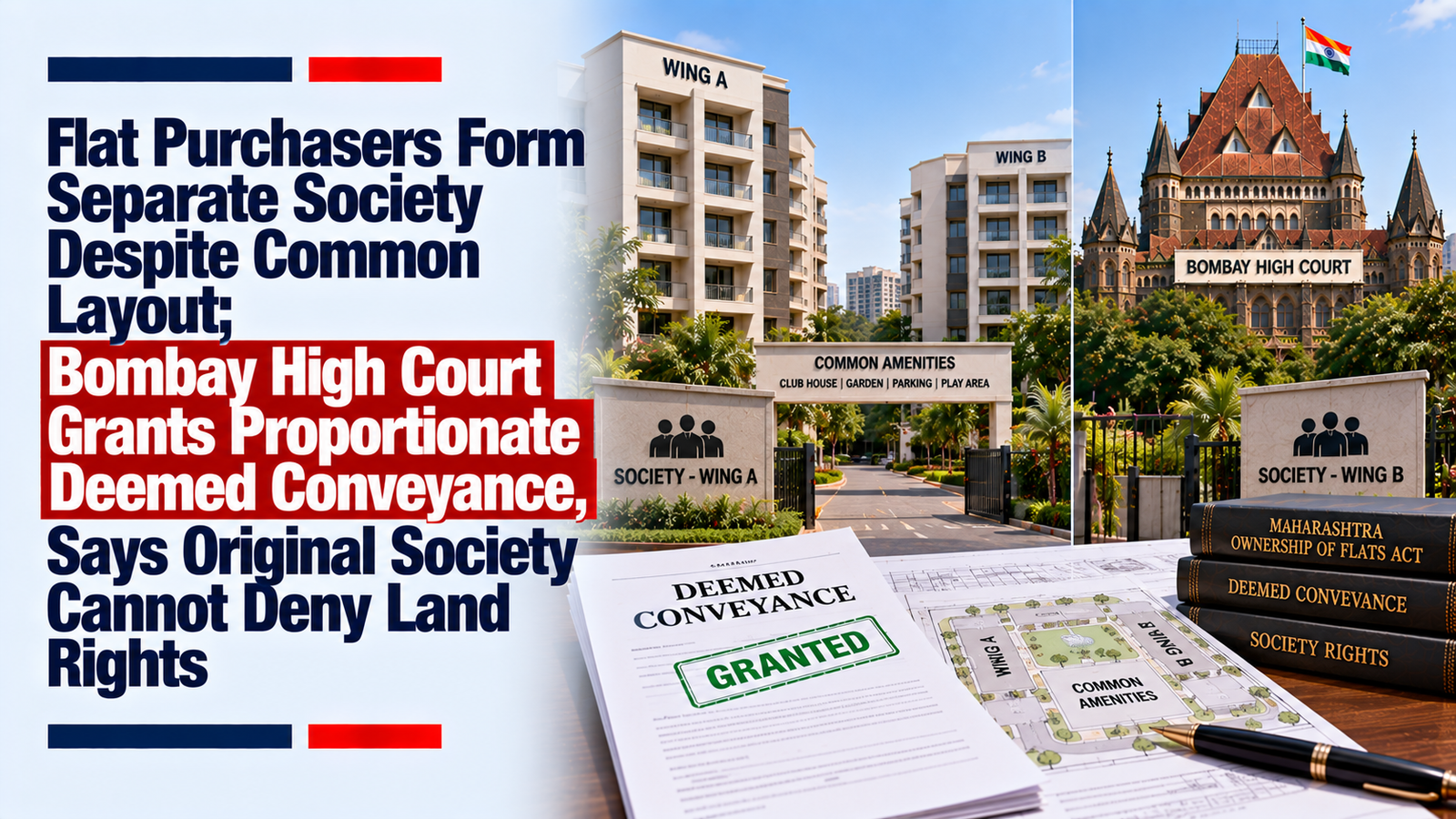
Original Society Accepts Separate Housing Society but Opposes Its Land Rights; Bombay High Court Says Registration Carries Right to Seek Conveyance
Facts
The petitioner, Beau Monde Plot No. 1 Co-operative Housing Society, challenged the District Deputy Registrar’s order dated 6 March 2025, which had rejected its application for deemed conveyance of its building and proportionate share in the layout land.
The dispute concerned three adjoining plots. Five buildings each had been constructed on Plot Nos. 2 and 3. Purchasers of those ten buildings formed Respondent No. 3 Society, and a conveyance of Plot Nos. 2 and 3 was executed in its favour on 31 March 1971.
For Plot No. 1, a Package Deal Agreement dated 25 September 1970 contemplated acquisition of the plot by Respondent No. 3 while simultaneously permitting the developer to construct a building and sell its flats. The purchasers were originally expected to become members of Respondent No. 3 Society.
Instead, purchasers in the Plot No. 1 building ultimately formed their own independent society on 4 December 2008. Respondent No. 3 never challenged that registration. The petitioner thereafter applied for deemed conveyance on 3 July 2024.
Issues
The principal questions were whether the independently registered petitioner-society could obtain deemed conveyance despite the original contractual arrangement requiring its flat purchasers to join Respondent No. 3 Society, and whether conveyance should be confined to the physical area of Plot No. 1 or extend proportionately into the larger common layout.
A further issue arose because the entire development had been sanctioned through a common layout plan, resulting in FSI generated from all three plots being utilised across the buildings.
Petitioner’s Arguments
The petitioner argued that its society had been validly registered since 2008 and its registration had never been challenged.
It contended that the development constituted a common layout and that under the Government Resolution dated 22 June 2018, it was entitled to conveyance of its proportionate share in the layout land.
It also relied on Respondent No. 3’s conduct. In particular, Respondent No. 3 had written to the petitioner in April 2022 inviting it to participate in joint redevelopment, thereby acknowledging its separate legal existence.
Respondent’s Arguments
Respondent No. 3 argued that the original contractual arrangement specifically required purchasers in Building No. 1 to become members of its society.
It maintained that the building had been constructed for Respondent No. 3 and that it alone was entitled to obtain conveyance of Plot No. 1.
It also challenged the jurisdiction of the Competent Authority and contended that the petitioner’s claim for 2,139.14 sq. metres was untenable because Plot No. 1 itself measured only 1,219 sq. metres.
Analysis of the Law
The High Court considered the consequences of Respondent No. 3 having allowed the petitioner-society’s separate registration to remain unchallenged.
The Court held that if Respondent No. 3 believed that only one society could exist for the entire development, it ought to have challenged the petitioner’s registration under the available statutory remedies, including an appeal under Section 152 of the Maharashtra Co-operative Societies Act, 1960, or proceedings for deregistration under Section 21A where legally permissible.
The Court made an important observation:
Once the formation of a separate organisation of flat purchasers for a building is accepted, its corresponding right to seek conveyance of the building and the land necessary for it cannot ordinarily be denied.
The Court found it anomalous to recognise a separate housing society for a building while insisting that ownership of that building and the necessary land must remain vested in another society.
Respondent Society’s Conduct Was Crucial
The Court placed considerable emphasis on Respondent No. 3’s conduct.
Not only had it failed to challenge the petitioner’s registration since 2008, it had subsequently recognised the petitioner as a separate society during redevelopment discussions in 2022.
The letter reproduced on page 12 of the judgment invited Beau Monde Society to decide whether it would participate in joint redevelopment. The High Court treated this conduct as further acknowledgement of the petitioner’s valid and independent existence.
Having accepted that separate existence, Respondent No. 3 could not simultaneously deny the petitioner’s entitlement to ownership of its building and the land required for its sustenance.
Crucial Finding: Common Layout Destroyed Individual Plot Identity
This is the most significant aspect of the judgment.
A common plan for all three plots was sanctioned on 14 December 1971. The Court held that once the three plots were subjected to a common housing scheme, their individual identity for purposes of FSI and built-up area distribution was effectively lost.
The petitioner’s building therefore could not be treated as having consumed FSI exclusively from the 1,219 sq. metre Plot No. 1. Its construction had also consumed development potential generated from Plot Nos. 2 and 3.
Accordingly, conveyance could not simply be restricted to the physical boundaries of Plot No. 1.
The petitioner was entitled to proportionate land forming part of the entire common layout.
How the Court Calculated the Entitlement
The petitioner’s architect calculated its share based on the sanctioned built-up area.
The petitioner’s building accounted for 24.45% of the total built-up area. The architect consequently calculated its entitlement as:
- 1,970.45 sq. metres of land;
- 123.59 sq. metres FSI advantage attributable to the 44-foot road; and
- 45.10 sq. metres FSI advantage attributable to S.V. Road.
The Court found this exercise fair and reasonable and accepted the calculation. Thus, the overall land/FSI entitlement worked out to 2,139.14 sq. metres, even though Plot No. 1 physically measured only 1,219 sq. metres.
Precedent Analysis
The petitioner relied upon Veer Tower Co-operative Housing Society Ltd., Upvan Co-operative Housing Society Ltd. and Blue Heavens Co-operative Housing Society Ltd.
However, the High Court considered it unnecessary to undertake an elaborate examination of those authorities because the case turned on its peculiar factual circumstances—particularly the common layout, common utilisation of FSI and Respondent No. 3’s acquiescence in the petitioner’s separate registration.
This is therefore an important factual limitation on the ratio: the judgment should not be read as automatically entitling every separately registered building society to a proportionate share in adjoining land.
Court’s Reasoning
The Court identified two matters that Respondent No. 3 had accepted:
- a common sanctioned layout for Plot Nos. 1, 2 and 3, permitting the petitioner’s building to consume FSI generated from Plot Nos. 2 and 3; and
- the formation and registration of the petitioner as a separate co-operative housing society.
Having acquiesced in both, Respondent No. 3 had to accept their legal consequences—namely, the petitioner’s right to secure conveyance of its proportionate share in the common layout.
The Court further held that Respondent No. 3 had itself assumed obligations akin to those of a promoter because it permitted the developer to consume FSI from Plot Nos. 2 and 3 for construction of the building on Plot No. 1. It therefore could not avoid its obligation under Section 11 to convey the necessary right, title and interest.
Conclusion
The Bombay High Court allowed the writ petition and set aside the District Deputy Registrar’s order rejecting deemed conveyance.
The matter was remanded to the Competent Authority specifically for issuance of a deemed conveyance certificate covering:
1,970.45 sq. metres of land + FSI advantage of 123.59 sq. metres + 45.10 sq. metres.
The Competent Authority was directed to issue the certificate as expeditiously as possible, preferably within four months.
Case Details
Case: Beau Monde Plot No. 1 Co-operative Housing Society v. District Deputy Registrar & Ors.
Court: Bombay High Court, Civil Appellate Jurisdiction
Case No.: Writ Petition No. 9139 of 2026
Citation: 2026:BHC-AS:38444
Judge: Justice Sandeep V. Marne
Reserved: 3 September 2026
Pronounced: 21 September 2026
Result: Petition allowed; rejection of deemed conveyance set aside and Competent Authority directed to issue proportionate deemed conveyance in favour of the petitioner-society.