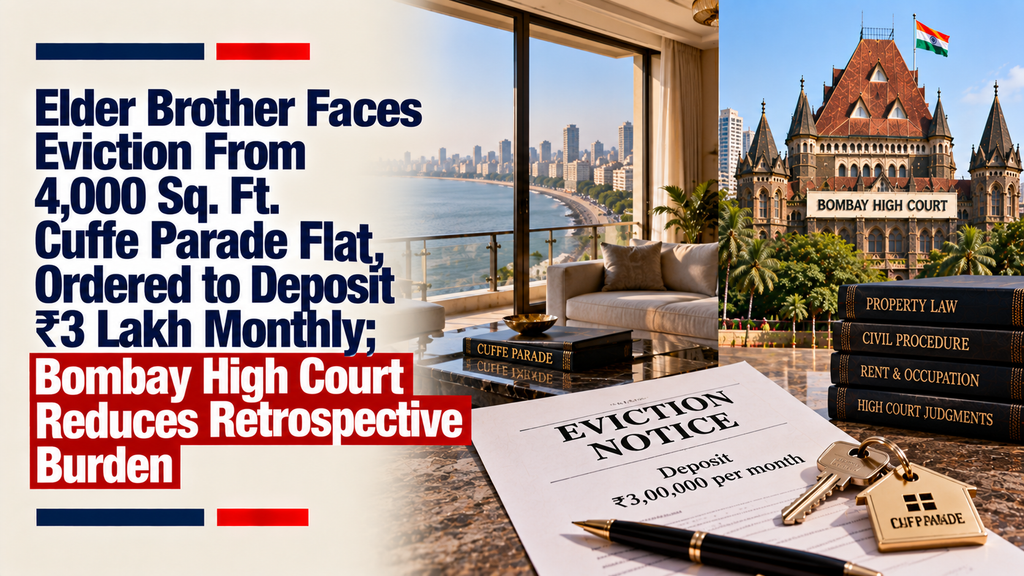
Elder Brother Faces Eviction From 4,000 Sq. Ft. Cuffe Parade Flat, Ordered to Deposit ₹3 Lakh Monthly; Bombay High Court Reduces Retrospective Burden

Brother Occupies Younger Brother’s Cuffe Parade Flat Since 1982 as Alleged Gratuitous Licensee; Bombay High Court Modifies ₹3 Lakh Monthly Deposit Condition
Facts
The dispute is between brothers over Flat No. 2D, Pallonji Mansion, Cuffe Parade, Mumbai, measuring approximately 4,000 sq. ft. The respondent/plaintiff, Mahesh Keswani, claimed that he had permitted his elder brother, Suresh Keswani, to occupy the flat in around 1982–83 purely as a gratuitous licensee, without rent, compensation or licence fee.
The plaintiff terminated the gratuitous licence by letter dated 10 August 2011 and demanded possession. The elder brother disputed the plaintiff’s title and claimed that although the flat stood in the younger brother’s name, the entire purchase consideration had actually been paid by him.
The Trial Court ultimately held that the defendants were gratuitous licensees and passed an eviction decree. It also directed mesne profits at ₹500 per sq. ft. per month, subject to quantification under Order XX Rule 12C CPC.
Pending appeal, the Appellate Bench of the Small Causes Court stayed eviction, but imposed a condition requiring deposit of ₹3 lakh per month from October 2011 to April 2026, within three months, and ₹3 lakh every month thereafter.
The defendants approached the Bombay High Court, arguing that this retrospective monetary condition was excessive and onerous.
Issues
The principal question was:
Whether, while staying an eviction decree against a gratuitous licensee, the Appellate Court could require ₹3 lakh per month as interim compensation retrospectively from the date of the suit, particularly when a separate civil suit concerning title to the property remained pending.
A connected issue was whether the principles governing market-rate compensation against tenants and contractual licensees could mechanically be applied to a gratuitous licence arising out of a family arrangement.
Petitioners’ Arguments
The petitioners contended that the elder brother was actually the owner of the premises and had himself financed its purchase.
They relied upon a receipt said to evidence payment towards purchase of the flat and emphasised that their separate suit seeking declaration of ownership remained pending.
They argued that the respondent was only around 22 years old when the property was purchased and allegedly lacked the financial capacity to purchase such property. Therefore, according to them, imposing ₹3 lakh per month retrospectively from 2011—before the title dispute had been finally resolved—was disproportionately onerous.
Respondent’s Arguments
The respondent relied upon the fact that the share certificate and ownership documents stood in his name.
He further pointed to earlier representations allegedly made by the elder brother to the State Government while seeking de-requisition of other flats, in which the elder brother had represented that he owned no other premises and was residing in the flat belonging to the respondent.
The respondent also claimed that the market rent of the property exceeded ₹6 lakh per month and therefore ₹3 lakh per month was already substantially below the prevailing rental value.
Analysis of the Law
The High Court examined Order XLI Rule 5 CPC, which makes it clear that merely filing an appeal does not automatically stay execution of a decree.
For stay, the Court must consider substantial loss, absence of unreasonable delay and appropriate security for performance of the decree if ultimately binding upon the appellant.
The Court recognised that dispossession during pendency of the statutory appeal could cause substantial prejudice. However, a stay is an equitable and discretionary relief, and a person obtaining it can be placed on reasonable terms to protect the decree-holder.
Crucial Distinction: Tenant vs. Gratuitous Licensee
The Court drew an important distinction from the conventional landlord-tenant cases.
It noted that Atma Ram Properties concerned a tenant and that Safset Agencies involved a leave-and-licence agreement.
This case was different. It arose from a family dispute where a younger brother alleged that his elder brother was merely his gratuitous licensee, while the elder brother independently claimed ownership of the very same property.
Accordingly, the market-rent principles applicable in conventional tenancy or contractual licence disputes could not be applied strictly or mechanically to this family gratuitous-licence dispute.
Precedent Analysis
The Court considered Atma Ram Properties (P) Ltd. v. Federal Motors (P) Ltd., where the Supreme Court held that an appellate court staying an eviction decree can require the occupant to compensate the successful landlord reasonably while the latter is deprived of the fruits of the decree.
The governing principle is that a party seeking equitable stay must “do equity”. Conditions can therefore be imposed to ensure that the party ultimately succeeding in the litigation is adequately protected.
The Court also considered State of Maharashtra v. Super Max International, which recognises the power to impose higher interim compensation while staying eviction but cautions that the amount cannot be excessive, fanciful or punitive.
Court’s Reasoning
The High Court did not interfere with the quantum of ₹3 lakh per month.
The plaintiff had produced an architect’s report estimating market rent at ₹6,65,200 per month from November 2024, whereas the petitioners had placed no competing valuation before the Appellate Court. Against that material, ₹3 lakh per month was not considered excessive.
However, the Court found the requirement to immediately deposit ₹3 lakh per month all the way back from the date of the suit in 2011 excessively onerous in the peculiar circumstances.
This was particularly so because the parties were brothers and a substantive civil suit in which the elder brother claimed ownership of the flat was still pending.
The High Court therefore struck a balance: ₹3 lakh per month would presently become payable from the date of the eviction decree—26 November 2024—not from October 2011.
Important Clarification on Title
The High Court expressly observed that the Small Causes Court does not adjudicate title while deciding the eviction proceeding of this nature.
The eviction decree proceeded on the fact that the suit property stood in the plaintiff’s name and on the finding that the defendant was a gratuitous licensee. The elder brother’s substantive claim of ownership remained for determination in the separate title proceedings.
Thus, the judgment should not be read as finally deciding which brother owns the flat.
Conclusion
The Bombay High Court modified, rather than completely set aside, the conditions imposed for stay of eviction.
The petitioners were directed to:
- deposit ₹3 lakh per month from 26 November 2024, the date of the eviction decree, within two months;
- continue depositing ₹3 lakh per month until disposal of the appeal;
- refrain from creating third-party rights in the property; and
- undertake that, if they ultimately lose the appeal, they will deposit ₹3 lakh per month for the earlier period from the date of the suit until the eviction decree, within eight weeks.
The Court specifically clarified that all its observations were prima facie and would have no bearing on the pending title suits.
Case Details
Case: Suresh Atalrai Keswani & Anr. v. Mahesh Atalrai Keswani
Court: Bombay High Court, Civil Appellate Jurisdiction
Case No.: Writ Petition No. 10799 of 2026
Judge: Justice Arun R. Pedneker
Reserved: 2 September 2026
Pronounced: 21 September 2026
Citation: 2026:BHC-AS:38443
Result: Petition disposed of by modifying the stay conditions; ₹3 lakh monthly compensation retained, but immediate liability shifted from 2011 to the date of the eviction decree, 26 November 2024.