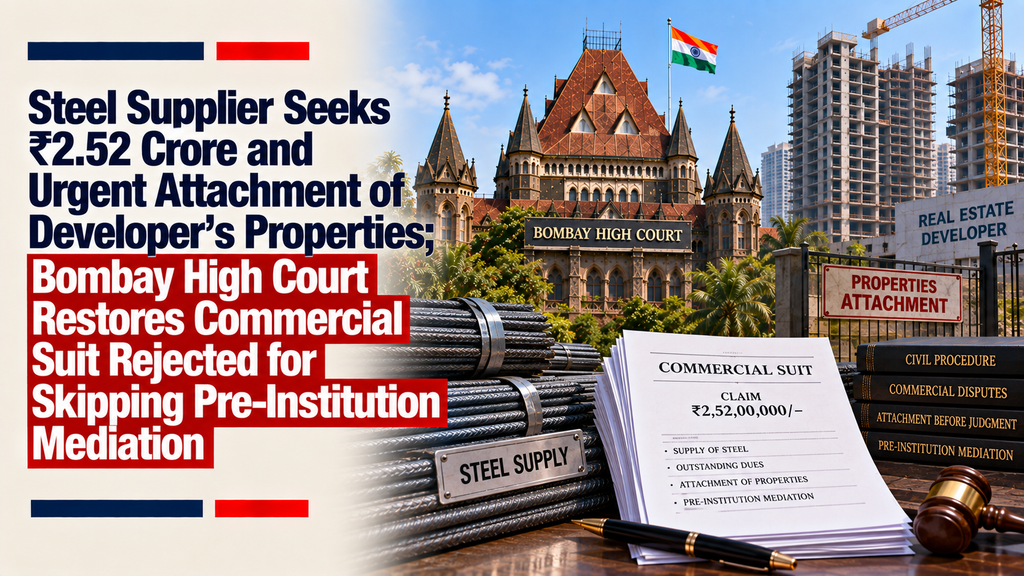
Steel Supplier Seeks ₹2.52 Crore and Urgent Attachment of Developer’s Properties; Bombay High Court Restores Commercial Suit Rejected for Skipping Pre-Institution Mediation

Plaintiff Seeks Urgent Protection Against Disposal of Developer’s Assets; Bombay High Court Says Section 12A Cannot Defeat Substantive Rights
Facts
MITC Rolling Mills Pvt. Ltd., a manufacturer of TMT steel and other iron and steel products at Dindori, Nashik, supplied FE-500 steel to Renuka Realtors pursuant to a purchase order dated 18 January 2019. Payment was contractually required within 30 days of the invoices. According to MITC, despite delivery and repeated assurances, ₹1,64,60,528 remained unpaid.
MITC claimed interest at 24% per annum, quantified at ₹87,78,300 up to 15 November 2021, taking the total suit claim to ₹2,52,38,828, besides further interest.
The supplier instituted Commercial Suit No. 6 of 2021 on 26 November 2021. It did not first undertake pre-institution mediation under Section 12A of the Commercial Courts Act because it claimed urgent protection was necessary: according to MITC, the defendants were in the process of disposing of assets and creating liabilities which could defeat recovery.
MITC therefore filed an independent interim application seeking an injunction and attachment before judgment, including restraint against dealing with three identified development properties/projects.
The Commercial Court nevertheless rejected the plaint under Order VII Rule 11 CPC, holding that pre-institution mediation under Section 12A was mandatory and that there was no prima facie evidence supporting the alleged disposal of properties.
MITC appealed to the Bombay High Court. The appeal arose under Section 13(1-A) of the Commercial Courts Act.
Issues
The principal issue was whether a commercial plaint could be rejected for failure to undergo mandatory pre-institution mediation when the suit was accompanied by a substantive application seeking urgent interim injunction and attachment before judgment.
The Court also examined the proper test for determining whether a plea of urgency is genuine or merely a device to circumvent Section 12A.
Appellant’s Arguments
MITC argued that its plea of urgency was neither formal nor cosmetic. It had identified specific properties which it apprehended the respondents would deal with and had filed a detailed application seeking injunction and attachment before judgment.
Accordingly, the suit fell within the statutory category of suits “contemplating urgent interim relief”, for which Section 12A itself permits immediate access to Court without first exhausting pre-institution mediation.
MITC further contended that the properties identified in its interim application had subsequently been dealt with and were no longer available to secure the suit claim, demonstrating the practical importance of its request for immediate protection.
Respondents’ Arguments
The respondents maintained that Section 12A was mandatory and relied upon Patil Automation Pvt. Ltd. v. Rakheja Engineers Pvt. Ltd.
They argued that MITC had merely attempted to bypass mandatory mediation by dressing up an ordinary money-recovery action as an urgent case.
According to the respondents, selling flats and dealing with projects was part of the ordinary business of a developer and did not by itself demonstrate an intention to defeat a future decree.
Analysis of the Law
Section 12A provides that a commercial suit which does not contemplate urgent interim relief cannot be instituted unless the plaintiff first exhausts pre-institution mediation.
The Division Bench stressed the distinction between:
- commercial suits not contemplating urgent interim relief, where Section 12A mediation is mandatory; and
- suits genuinely contemplating urgent interim relief, where immediate access to Court remains available.
The High Court found that MITC had filed a comprehensive interim application requiring consideration of prima facie case, balance of convenience and irreparable injury. The defendants themselves had opposed that application extensively on merits.
The Trial Court’s approach was therefore held to be “wholly untenable.”
Court’s Reasoning
The High Court held that the proper inquiry at the Section 12A stage was whether the asserted urgency was false, bogus, camouflage or merely a device to escape pre-institution mediation.
MITC’s case was not based on a bare sentence inserted in the plaint. It had filed an independent application for temporary injunction and attachment before judgment, identified the properties sought to be protected and pleaded the circumstances creating apprehension that its monetary claim could be defeated.
The High Court specifically held that there is no bar under Section 12A against a plaintiff approaching the Commercial Court with an independent application seeking urgent interim relief. The Court must examine whether that application is genuine or merely a ploy to circumvent mediation.
The Division Bench warned that summarily forcing such a plaintiff into mediation could result in the subject matter disappearing or leave the successful plaintiff with nothing more than an inexecutable “paper decree.”
Important Proposition
The judgment does not dilute the mandatory character of Section 12A.
Rather, it holds that where a suit actually contemplates urgent interim relief, the Commercial Court cannot simply reject the plaint for absence of mediation without meaningfully examining whether the urgency is genuine or merely camouflage.
The merits of granting the injunction remain a separate question.
Precedent Analysis
Patil Automation Pvt. Ltd. v. Rakheja Engineers Pvt. Ltd.
The Supreme Court held that Section 12A is mandatory and that suits instituted in violation of it are liable to rejection under Order VII Rule 11.
However, the Bombay High Court emphasised that Patil Automation itself concerned suits which did not contemplate urgent interim relief. The Supreme Court expressly recognised that suits contemplating urgent relief constitute a distinct category for which the legislature preserved immediate access to Court.
Yamini Manohar v. T.K.D. Keerthi
The judgment was applied for the proposition that the Court must examine the nature and subject matter of the suit, the interim relief sought and the plaintiff’s case to determine whether urgency is genuine.
A plaintiff cannot merely use an artificial prayer for interim relief as a “disguise or mask” to bypass Section 12A. But equally, a genuine urgent application cannot be ignored merely because the main suit seeks monetary recovery.
Dhanbad Fuels Pvt. Ltd. v. Union of India
MITC also relied on Dhanbad Fuels concerning the consequences of non-compliance with Section 12A and the prospective operation of the rule declared in Patil Automation. The suit here had been instituted on 26 November 2021, before the 20 August 2022 date referred to in Patil Automation.
The Division Bench ultimately considered the more fundamental feature to be that this was not a simpliciter commercial suit without mediation; it was instituted along with an application expressly seeking urgent interim relief.
Conclusion
The Bombay High Court held that the Commercial Court had erred by rejecting MITC’s plaint without properly adjudicating the nature and genuineness of the urgent interim relief sought.
The Court accordingly:
- allowed the appeal;
- quashed the order dated 10 November 2022 rejecting the plaint;
- restored Commercial Suit No. 6 of 2021 to the Commercial Court at Nashik;
- directed that the suit and interim application be adjudicated on merits;
- kept all parties’ contentions open; and
- held MITC entitled to refund of court fees under Section 15 of the Maharashtra Court Fees Act, 1959.
Importantly, the High Court did not grant attachment or injunction itself. It restored the proceedings so that the Commercial Court could decide the interim application and suit on their merits.
Case Details
Case: MITC Rolling Mills Pvt. Ltd. v. M/s Renuka Realtors & Ors.
Court: Bombay High Court, Civil Appellate Jurisdiction
Case: Commercial First Appeal No. 8 of 2023 in Commercial Suit No. 6 of 2021
Citation: 2026:BHC-AS:38457-DB
Coram: Justice G. S. Kulkarni and Justice Dr. Neela K. Gokhale
Reserved: 13 August 2026
Pronounced: 21 September 2026
Result: Appeal allowed; rejection of plaint set aside; ₹2.52 crore commercial recovery suit and urgent interim application restored for adjudication on merits.