BMC Seeks Permission to Cut 1,237 Mangroves for Madh-Versova Bridge; Bombay High Court Allows Project, Orders In-Situ Restoration and 10-Year Monitoring

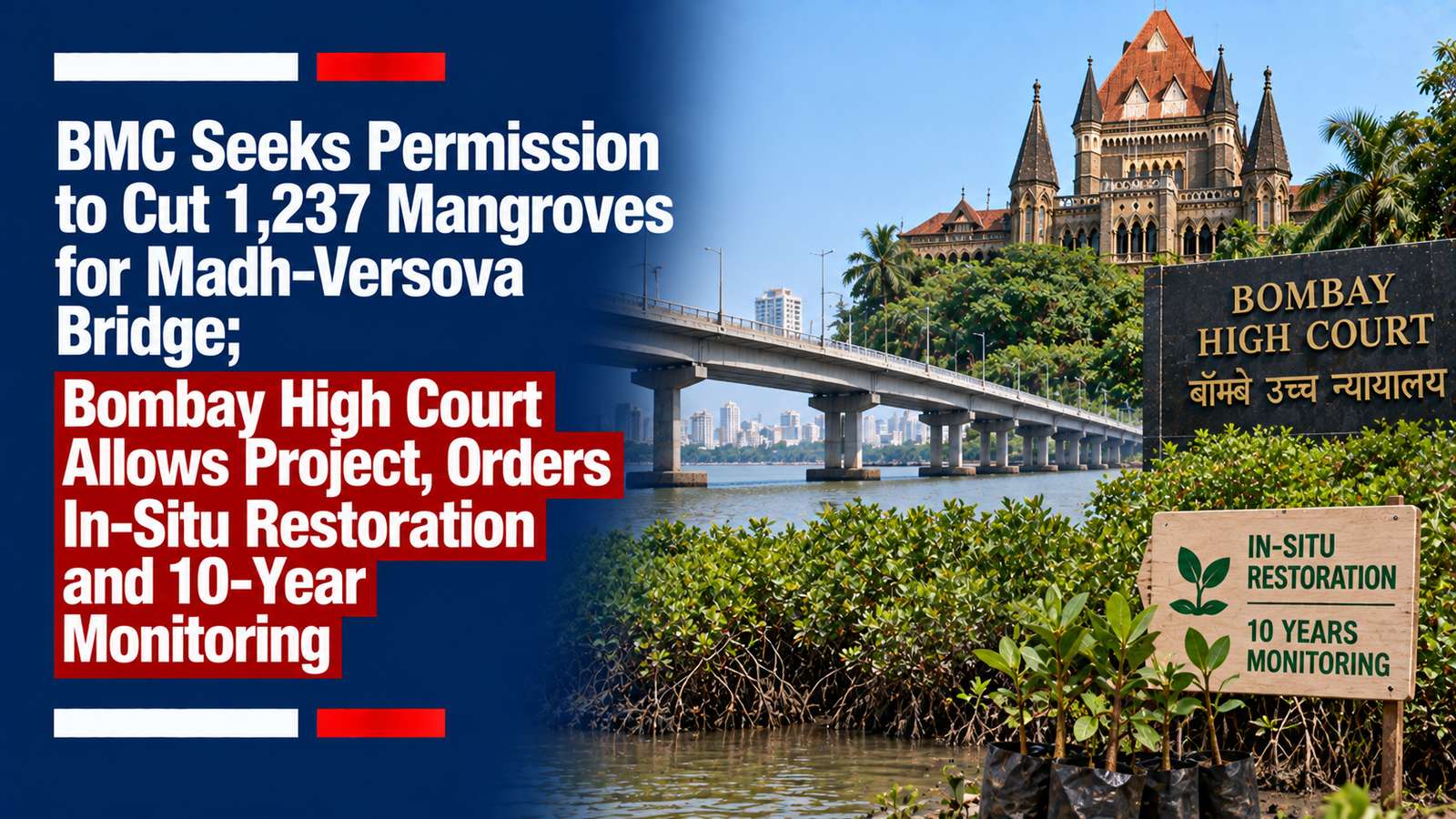
Bombay High Court Allows BMC to Cut 1,237 Mangroves for 2-Km Madh-Versova Bridge, Mandates Restoration and Compensatory Plantation
Facts
The Brihanmumbai Municipal Corporation (BMC) approached the Bombay High Court under Article 226 seeking permission to cut 1,237 mangroves spread over 2.7515 hectares for construction of a proposed 2,064-metre bridge across Malad Creek connecting Madh Island and Versova. Prior permission of the High Court was necessary because of the protective directions governing mangroves issued in Bombay Environmental Action Group v. State of Maharashtra.
Parts of the project fall within different Coastal Regulation Zone classifications, including CRZ-IA mangroves and the 50-metre mangrove buffer zone. BMC asserted that the bridge was a permissible activity under the CRZ Notification, 2019.
An initial Environmental Impact Assessment estimated that approximately 2.80 hectares and 560 mangrove trees would be affected. After MCZMA required a separate proposal and further assessment, the alignment was reconsidered. MCZMA recorded that the alignment was also designed so as not to obstruct movement of local fishermen’s boats.
BMC placed before the Court a restoration plan under which, although approximately 2.7515 hectares may be affected during construction, about 2.5 hectares would be restored in situ, leaving only approximately 0.20 hectare (2,005 sq. metres) permanently lost to the footprint of the bridge piers and pylons.
Issues
The central question was whether the protection accorded to mangroves should prevent the proposed intervention or whether the project could be permitted as an exception on the ground of larger public interest, subject to environmental safeguards, restoration and compensatory measures.
Petitioner’s Arguments
BMC argued that the four-lane cable-stayed bridge was a crucial missing link in Mumbai’s transport infrastructure and would connect Madh Island directly with Versova and the Coastal Road/Development Plan Road network.
According to BMC, completion of the project would reduce the present journey by approximately 18–20 kilometres, cutting travel time from around 1.5 hours to approximately five minutes, while diverting substantial traffic from S.V. Road and Link Road.
BMC further claimed that the project would result in a 93% reduction in CO₂ emissions in the relevant travel scenario. It also argued that the bridge would provide an important emergency route for the Air Force and Navy, which have establishments in the Madh-Marve area.
On environmental mitigation, BMC undertook that against the impact on 1,237 mangroves, approximately 39,000 mangroves would be planted over nine hectares of degraded mangrove forest land. It had already deposited approximately ₹1.42 crore towards plantation, protection and maintenance for ten years.
BMC additionally undertook to furnish yearly comprehensive status audit reports for ten years to ensure continuing monitoring of the restoration measures.
Respondents’ Arguments
The environmental NGO, Bombay Environmental Action Group, opposed the petition, arguing that destruction and degradation of mangroves would adversely affect the environment and aquatic/maritime life.
It contended that the authorities had failed to adequately evaluate the diverse environmental consequences of the project and that compensatory mangrove plantation was insufficient. Sustainable development, it argued, required genuine environmental protection rather than permitting destruction merely because the project was characterised as public infrastructure.
The Mangrove Cell also stated that permission should not be granted unless BMC deposited the requisite ₹12.50 crore financial outlay connected with the mangrove restoration plan.
Analysis of the Law
The Court began by recognising the ecological importance of mangroves, describing them as fragile but highly productive ecosystems that function as natural buffers against coastal erosion, tidal surges and flooding and protect life, property and coastal infrastructure.
Under Bombay Environmental Action Group, mangroves cannot ordinarily be destroyed for private, commercial or other purposes unless the intervention is demonstrably required in public interest.
At the same time, the Court emphasised that judicial review does not ordinarily extend to substituting the Court’s assessment for executive policy choices concerning the necessity, nature or mode of implementation of infrastructure projects, particularly where statutory expert bodies have objectively examined the environmental implications and imposed safeguards.
The Court therefore approached the case through the doctrine of sustainable development: public purpose alone was insufficient; the project had also to demonstrate adequate environmental assessment, mitigation and restoration.
Precedent Analysis
The Court relied principally upon Bombay Environmental Action Group v. State of Maharashtra, which created the protective framework governing mangroves while recognising an exception where intervention is necessary for public good.
It referred to Maharashtra Maritime Board v. Union of India and the Supreme Court decisions in N.D. Jayal v. Union of India, Vellore Citizens Welfare Forum v. Union of India and M.C. Mehta v. Union of India to reiterate that sustainable development requires a balance between environmental protection and legitimate developmental activity.
The Court stressed that sustainable development does not mean development at the cost of the environment. Rather, development must preserve ecological balance and protect the interests of future generations.
It also distinguished Maharashtra State Electricity Transmission Company Ltd. v. State of Maharashtra, observing that the present case involved an undertaking for in-situ rehabilitation of mangroves, rather than compensatory measures merely at a distant location.
Court’s Reasoning
The Court found that the project had a genuine and substantial public-infrastructure purpose. It would establish direct road connectivity between Madh Island and Versova, constitute a missing link in the road network, reduce travel distance and time, divert traffic from congested roads and consequently reduce the environmental burden caused by prolonged vehicular movement.
The Court also took note of BMC’s uncontroverted assertion that CO₂ emissions in the relevant travel scenario would fall from 38,356 kg to 2,615 kg, besides the bridge serving as an alternative route for the Air Force and Navy during emergencies.
However, the Court expressly cautioned that public purpose alone could not conclude the environmental enquiry. Sustainable development required examination of the ecological consequences and safeguards.
What ultimately weighed with the Court was the combination of factors: the project’s public utility, environmental assessment, statutory permissions, revised alignment, restoration of approximately 2.5 hectares in situ, permanent loss restricted to approximately 0.20 hectare, and extensive compensatory plantation.
Against the impact on 1,237 mangroves, approximately 39,000 mangroves over nine hectares were proposed to be planted, with ₹1.42 crore deposited for plantation and ten-year maintenance.
The Court also noted that the alignment did not pass through a Protected Area or Eco-Sensitive Zone, while MCZMA had confirmed that the project was permissible under the CRZ Notification, 2019.
Crucially, the Court held that permission was not being granted merely because the project was governmental or public. It was the combined effect of public utility, environmental assessment, statutory clearances and restoration/compensatory measures that justified allowing the project.
The Court further made BMC’s environmental undertaking enforceable and warned that breach could expose the Corporation to civil as well as criminal consequences.
Conclusion
The Bombay High Court allowed BMC’s writ petition and granted permission to cut 1,237 mangroves over 2.7515 hectares for construction of the Madh Island–Versova bridge.
The permission is not unconditional. BMC must strictly comply with the statutory clearances, environmental conditions, mangrove restoration measures and its undertaking concerning in-situ restoration, compensatory plantation and periodic monitoring for ten years.
The judgment therefore treats the project as falling within the public-interest exception recognised under the Court’s earlier mangrove-protection jurisprudence, while making environmental safeguards integral to the permission.
Case Details
Case: Brihanmumbai Municipal Corporation v. Union of India & Ors.
Court: Bombay High Court, Ordinary Original Civil Jurisdiction
Case No.: Writ Petition (L) No. 17795 of 2026
Coram: Chief Justice Mahesh Chandra Tripathi and Justice Advait M. Sethna
Reserved: 9 September 2026
Pronounced: 17 September 2026
Citation: 2026:BHC-OS:20464-DB
Result: Petition allowed; BMC permitted to cut 1,237 mangroves for the Madh-Versova bridge, subject to strict environmental safeguards, restoration and its undertaking.