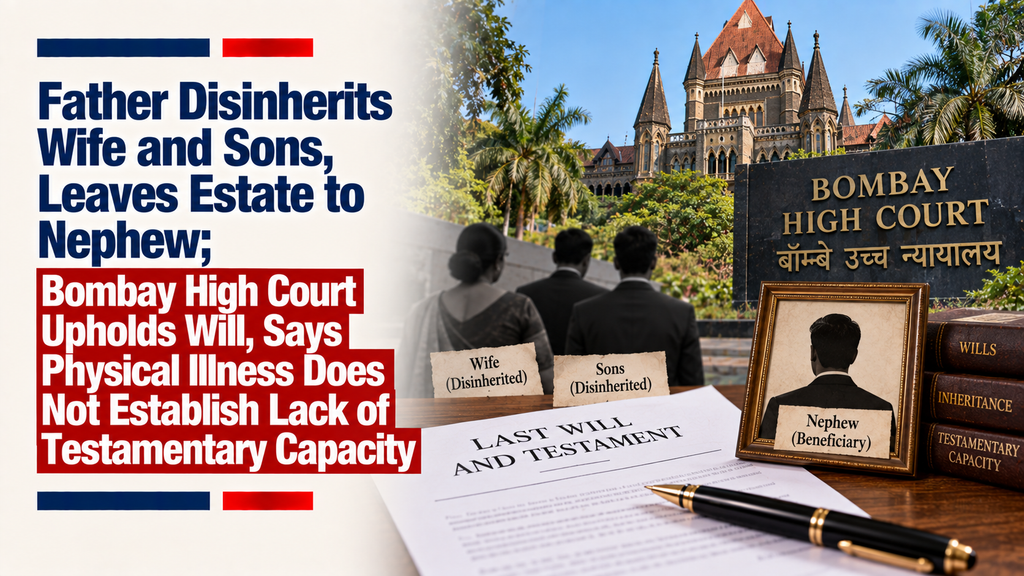
Father Disinherits Wife and Sons, Leaves Estate to Nephew; Bombay High Court Upholds Will, Says Physical Illness Does Not Establish Lack of Testamentary Capacity

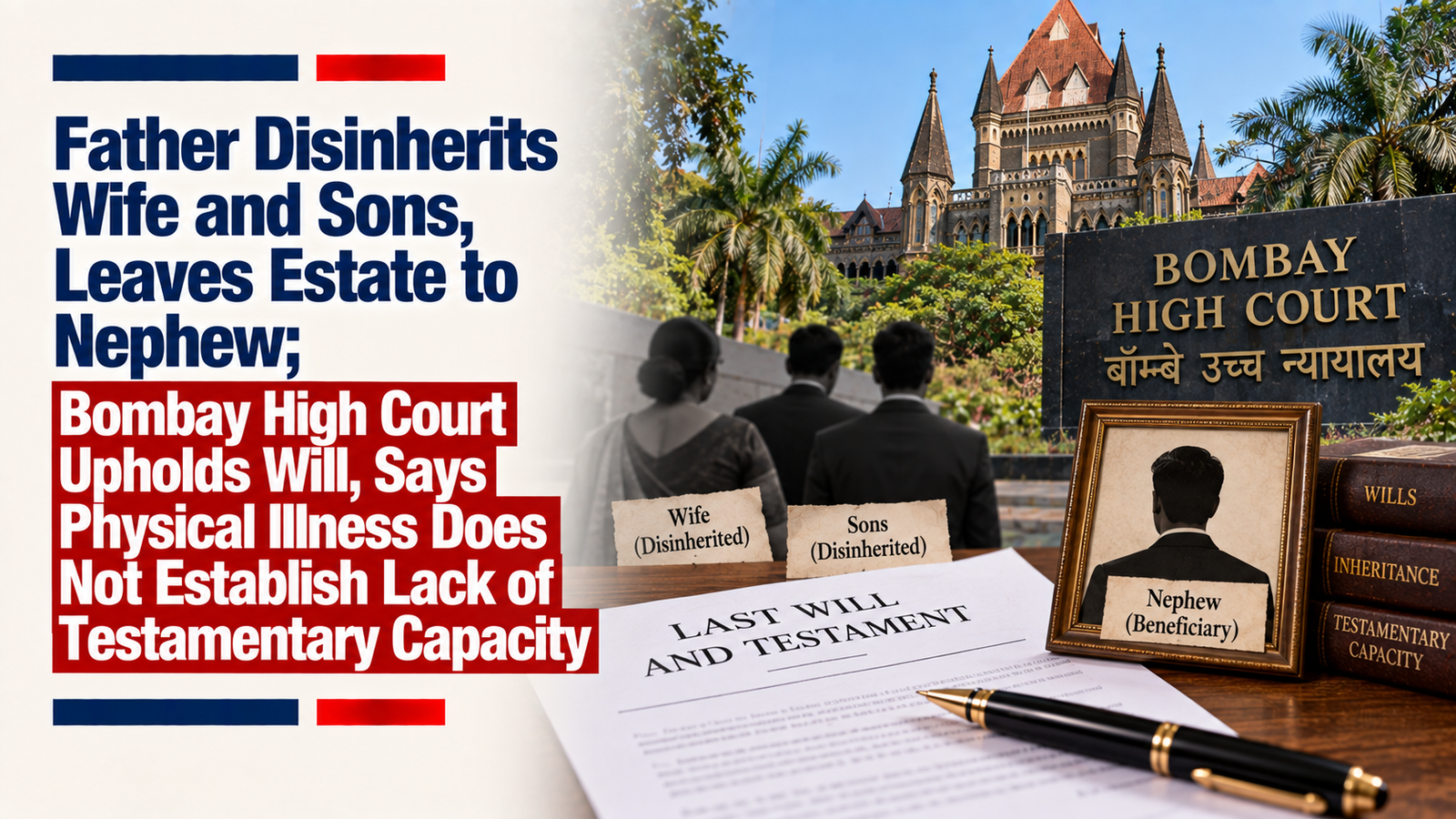
Nephew Made Sole Executor and Principal Beneficiary of Uncle’s Will; Bombay High Court Rejects Sons’ Forgery Challenge, Grants Probate
Facts
The dispute arose from the last Will and Testament dated 30 November 2004 of Gulab Hukumatrai Gurbani, who died on 16 April 2005. His nephew, Rajkumar Assudomal Gurbani, sought probate before the Bombay High Court. The Will appointed Rajkumar as the sole executor and principal beneficiary, including a bequest of the deceased’s share in an immovable property at Jaipur and the residue of his estate.
The deceased was survived by his wife, Savitri Gulab Gurbani, and two sons, Vijay Gulab Gurbani and Ram Gulab Gurbani. Both sons filed caveats opposing probate, resulting in the testamentary petition being converted into a contested Testamentary Suit.
The principal controversy was whether the Will had genuinely been executed by the deceased. The sons alleged that the signatures were forged and relied upon a handwriting expert. They also questioned the deceased’s physical and mental capacity because he was suffering from prostate cancer and was substantially physically incapacitated.
The plaintiff examined himself and the two attesting witnesses: Dr. Sumitlal M. Shaha, who had been the deceased’s physician for approximately 35 years, and Uddhav Baldev Gurbani, a family acquaintance of approximately 50 years.
Issues
The Court considered whether:
- the plaintiff was entitled to probate;
- the Will dated 30 November 2004 had been duly executed;
- the defendants could prove that the deceased had not signed the Will; and
- what consequential order should follow.
Plaintiff’s Arguments
The plaintiff argued that the deceased had been residing substantially with the plaintiff and his family and that his relationship with his wife and sons had become strained.
According to the plaintiff, the two attesting witnesses gave consistent evidence establishing that the deceased read the Will aloud, understood its contents and confirmed that he was executing it voluntarily. The deceased thereafter signed the Will, followed by both attesting witnesses signing in his presence and in each other’s presence. This, according to the plaintiff, satisfied Section 63(c) of the Indian Succession Act, 1925.
The plaintiff further argued that although the deceased suffered from prostate cancer, the disease affected his physical mobility and not his mental faculties. His long-standing physician specifically testified that he was of sound disposing mind, memory and understanding when the Will was executed.
The exclusion of the wife and sons was also said to be explainable: the Will itself recorded reasons for disinheriting them, while the plaintiff and his family had allegedly cared for the deceased during his illness.
Defendants’ Arguments
The sons contended that the Will was forged and fabricated and that the signatures appearing on it were not their father’s. They relied principally upon the report of their handwriting expert.
They also argued that the deceased was suffering from advanced prostate cancer, was paralysed from the waist down and was in such a compromised physical condition that serious doubt arose regarding his ability to comprehend and voluntarily execute the Will. They alleged that his condition had been exploited and that the Will had been obtained through coercion.
The defendants highlighted what they considered suspicious circumstances: the nephew was effectively the principal beneficiary; the deceased’s wife and sons were excluded; the plaintiff was allegedly involved in preparation and execution of the Will; questions arose about registration; and a letter dated 27 January 2005 allegedly referred to a subsequent Will.
They further questioned whether the attesting witnesses had independently satisfied themselves regarding the deceased’s mental condition and emphasised his chemotherapy and deteriorating physical health.
Analysis of the Law
The Court reiterated the settled requirements for proving a Will. The propounder must establish that:
- the testator duly executed the Will;
- the testator was of sound and disposing mind;
- the testator understood the nature and effect of the dispositions;
- execution was voluntary; and
- where suspicious circumstances exist, the propounder must satisfactorily remove those suspicions.
An important distinction emerged between physical incapacity and testamentary incapacity. The plaintiff emphasised that the law does not require a testator to be in perfect physical health; the relevant question is whether the person possessed the mental capacity to understand the testamentary act.
The Court also dealt with the procedural significance of pleadings. The defendants had not pleaded unsoundness of mind, coercion or lack of testamentary capacity in their caveat/affidavit supporting the caveat. The plaintiff therefore argued that these grounds could not subsequently be introduced merely through evidence.
Precedent Analysis
The plaintiff relied upon Sridevi v. Jayaraja Shetty, (2005) 2 SCC 784, for the fundamental requirements governing proof of a Will, including due execution, sound disposing mind, understanding of the disposition and voluntary execution.
Purushottam Vishandas Raheja v. Asha Shrichand Raheja and Kattinokkula Murali Krishna v. Veeramalla Koteswara Rao, (2010) 1 SCC 466, were relied upon on the proposition that objections to probate must be properly pleaded and evidence cannot travel beyond the case pleaded in the caveat.
On exclusion of natural heirs, the plaintiff relied upon Ramabai Padmakar Patil v. Rukminibai Vekhande and Pentakota Satyanarayana v. Pentakota Seetharatnam, contending that the very purpose of testamentary succession is to permit a testator to depart from the ordinary course of intestate succession.
Leela Rajagopal v. Kamala Menon Cocharan was cited for the proposition that a beneficiary’s participation in the process leading to execution of a Will does not, by itself, constitute a suspicious circumstance.
Court’s Reasoning
The Court found the evidence of the two attesting witnesses particularly significant because they had known the deceased for decades. Their evidence established that the deceased read the Will, confirmed that he understood it and was executing it voluntarily, signed it in their presence, and thereafter the witnesses attested it.
Their evidence on these material aspects remained substantially intact during cross-examination.
The Court consequently held that the statutory requirements of Section 63(c) of the Indian Succession Act read with Section 68 of the Indian Evidence Act, 1872 stood satisfied.
Importantly, the Court rejected the suggestion that an attesting witness must know who drafted or typed the Will, investigate the wisdom of its dispositions, or be present during its subsequent registration. Those matters were not requirements for proving due execution.
The challenge to testamentary capacity also failed. Apart from the pleading problem, the evidence of the deceased’s long-standing physician supported the conclusion that his physical illness had not deprived him of the mental capacity necessary to execute the Will.
The handwriting expert’s evidence ultimately failed to establish forgery. The Court found serious deficiencies in its evidentiary foundation, including that the comparison signatures had merely been represented to the expert as admitted signatures and had not independently been established as such. The analysis was also based on scanned copies of photocopies, with digitally enlarged images.
The Court therefore found that the defendants failed to discharge the burden of proving that the signatures on the Will were not those of the deceased.
Ultimately, the Court was satisfied that the plaintiff had proved due execution and attestation and had adequately answered the circumstances characterised by the defendants as suspicious.
Conclusion
The Bombay High Court decreed Testamentary Suit No. 74 of 2006 and directed the Prothonotary and Senior Master to issue probate of the deceased’s Will dated 30 November 2004 in favour of the plaintiff, subject to requisite formalities. The grant was directed to be issued expeditiously.
Despite the plaintiff seeking exemplary costs, the Court ultimately made no order as to costs.
Case Details
Case: Rajkumar Assudomal Gurbani v. Vijay Gulab Gurbani & Anr.
Court: Bombay High Court, Testamentary and Intestate Jurisdiction
Case No.: Testamentary Suit No. 74 of 2006
Judge: Justice Arif S. Doctor
Reserved on: 18 August 2026
Pronounced on: 17 September 2026
Citation: 2026:BHC-OS:20439
Result: Suit decreed; probate of the Will dated 30 November 2004 directed to be issued in favour of the plaintiff.