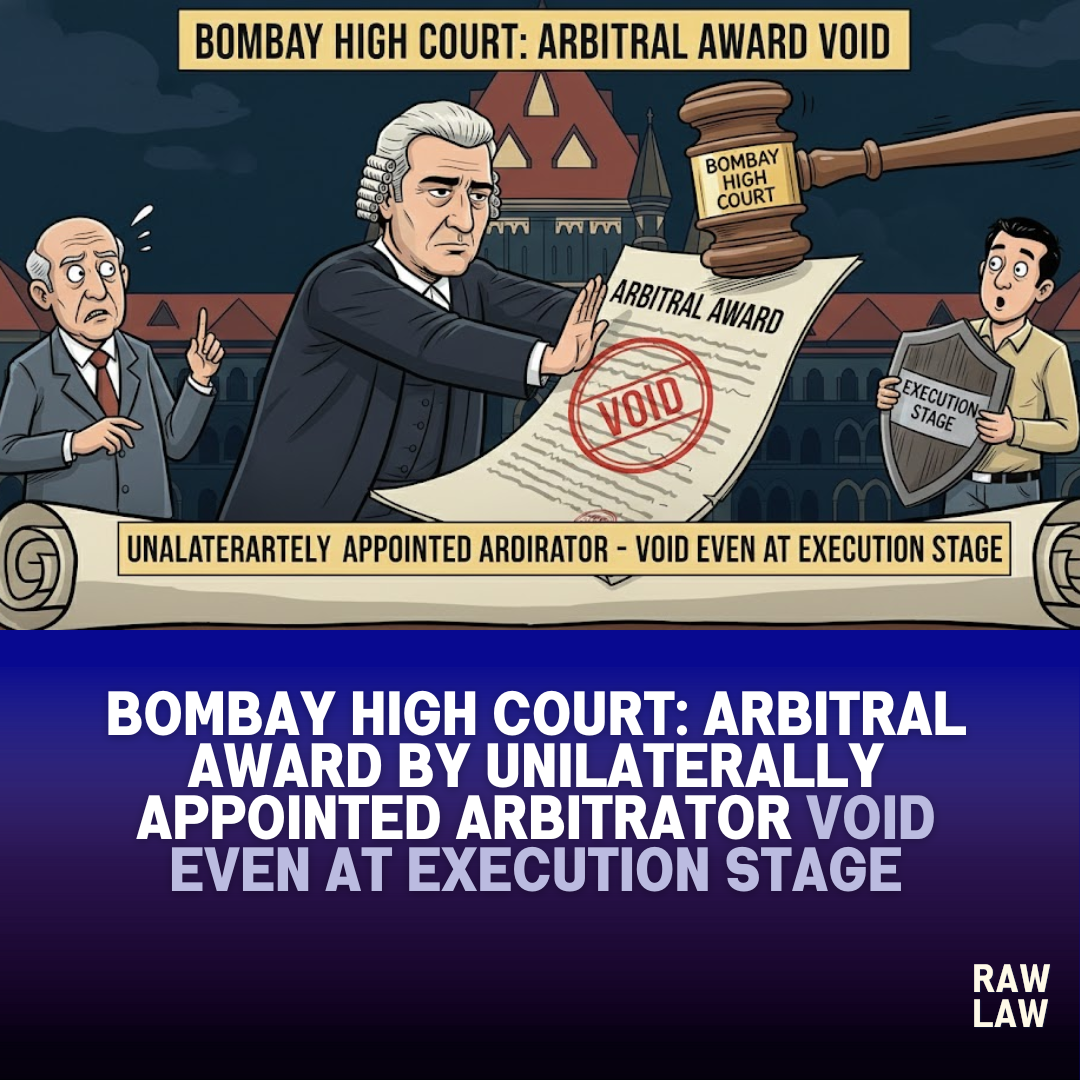
Bombay High Court: Arbitral award by unilaterally appointed arbitrator void even at execution stage

HEADNOTE
L&T Finance Ltd. v. Sangeeta Bhansali & Anr.
Court: Bombay High Court
Jurisdiction: Ordinary Original Civil Jurisdiction
Bench: Justice Rajesh S. Patil
Date of Judgment: January 17, 2026
Citation: 2026:BHC-OS:1344
Laws / Sections Involved: Arbitration and Conciliation Act, 1996 – Sections 11, 12(5), 13, 16, 34; Seventh Schedule; Commercial Courts Act, 2015
Keywords: Unilateral appointment of arbitrator, void arbitral award, execution proceedings, Section 12(5) Arbitration Act, non est award
Summary
The Bombay High Court set aside an arbitral award at the execution stage, holding that an award passed by a unilaterally appointed sole arbitrator is void ab initio and unenforceable in law. Applying the Supreme Court’s recent ruling in Bhadra International (India) Pvt. Ltd. v. Airport Authority of India (2026), the Court ruled that arbitrator ineligibility under Section 12(5) of the Arbitration and Conciliation Act goes to the root of jurisdiction and can be raised even during execution. Since the lender had unilaterally appointed the arbitrator and the award was never challenged under Section 34, the Court nonetheless held the award to be non est. The commercial execution application was dismissed, with liberty granted to initiate fresh arbitration proceedings, excluding the time spent earlier for limitation purposes.
Court’s decision
The Bombay High Court dismissed the Commercial Execution Application filed by L&T Finance Ltd. and set aside the arbitral award dated August 7, 2019. The Court held that an award passed by a sole arbitrator appointed unilaterally by one party is a nullity in law and cannot be enforced, even if it was not challenged under Section 34 of the Arbitration Act. Relying on binding Supreme Court precedent, the Court ruled that lack of jurisdiction strikes at the very foundation of the award.
Facts
The dispute arose out of loan agreements between L&T Finance Ltd. and the borrowers. Upon default, the lender invoked the arbitration clause and unilaterally appointed a sole arbitrator. The arbitrator rejected challenges under Sections 12, 13, and 16 of the Arbitration Act and ultimately passed an award directing the borrowers to pay over ₹1.01 crore with interest and costs. The borrowers did not file a Section 34 petition. When the lender initiated execution proceedings, the borrowers again raised the issue of unilateral appointment, contending that the award was void ab initio.
Issues
The primary issue before the Court was whether an arbitral award passed by a unilaterally appointed arbitrator, who was ineligible under Section 12(5) read with the Seventh Schedule of the Arbitration Act, could be enforced through execution proceedings despite the absence of a challenge under Section 34.
Applicant’s arguments
The decree holder argued that the arbitral award had attained finality since it was not challenged under Section 34. It was contended that the executing court could not go behind the decree and that objections relating to appointment of the arbitrator stood waived. The applicant relied on certain High Court judgments suggesting that execution courts have limited powers to examine the validity of an arbitral award.
Respondents’ arguments
The judgment debtors argued that unilateral appointment rendered the arbitrator de jure ineligible, making the award non est in law. Relying on recent Supreme Court authority, they contended that lack of jurisdiction can be raised at any stage, including execution. Since the arbitrator lacked inherent jurisdiction, the award was argued to be void and incapable of enforcement.
Analysis of the law
The Court analysed Section 12(5) of the Arbitration Act and the doctrine of equal treatment of parties. It held that party autonomy in appointing arbitrators is subject to mandatory statutory restrictions. An arbitrator who is rendered ineligible by law cannot assume jurisdiction, and any award passed in such circumstances is without legal foundation.
Precedent analysis
The Court relied heavily on the Supreme Court’s decision in Bhadra International (India) Pvt. Ltd. v. Airport Authority of India (2026), which held that awards by unilaterally appointed arbitrators are void ab initio and that challenges to such awards can be raised even at the execution stage. The Court also referred to Perkins Eastman Architects DPC v. HSCC (India) Ltd. and Bharat Broadband Network Ltd. v. United Telecoms Ltd., reaffirming that unilateral appointment violates Section 12(5) of the Act.
Court’s reasoning
Justice Rajesh S. Patil held that an arbitral tribunal derives jurisdiction only from a valid appointment in accordance with the Act. Since the arbitrator in the present case was unilaterally appointed, he was de jure ineligible, and the award passed was coram non judice. The Court emphasised that no act of the parties, including failure to challenge under Section 34, can cure inherent lack of jurisdiction.
Conclusion
The Bombay High Court set aside the arbitral award dated August 7, 2019 and dismissed the commercial execution application. The Court granted liberty to the parties to initiate fresh arbitration proceedings in accordance with law, directing that the period spent in earlier proceedings be excluded for limitation purposes.
Implications
This judgment significantly strengthens the enforceability safeguards under arbitration law by confirming that jurisdictional defects in arbitrator appointment render awards void, regardless of procedural finality. It has major implications for financial institutions and lenders that continue to rely on unilateral appointment clauses, reinforcing the need for neutral and compliant arbitral processes.
Case law references
• Bhadra International (India) Pvt. Ltd. v. Airport Authority of India (Supreme Court, 2026)
Holding: Awards by unilaterally appointed arbitrators are void and unenforceable; objection can be raised even in execution.
Application: Applied directly to set aside the arbitral award.
• Perkins Eastman Architects DPC v. HSCC (India) Ltd. (2020) 20 SCC 760
Holding: A party interested in the outcome cannot unilaterally appoint an arbitrator.
Application: Relied upon to hold the appointment invalid.
• Bharat Broadband Network Ltd. v. United Telecoms Ltd. (2019) 5 SCC 755
Holding: Ineligible arbitrator lacks jurisdiction; award is non est.
Application: Used to reject enforcement of the award.
FAQs
Q1. Can an arbitral award be challenged at the execution stage?
Yes. If the arbitrator lacked jurisdiction due to statutory ineligibility, the award can be challenged even during execution.
Q2. Does failure to file a Section 34 petition cure the defect?
No. Jurisdictional defects cannot be cured by waiver or procedural default.
Q3. What is the effect of unilateral appointment of an arbitrator?
Such appointment renders the arbitrator ineligible under Section 12(5), making the award void ab initio.