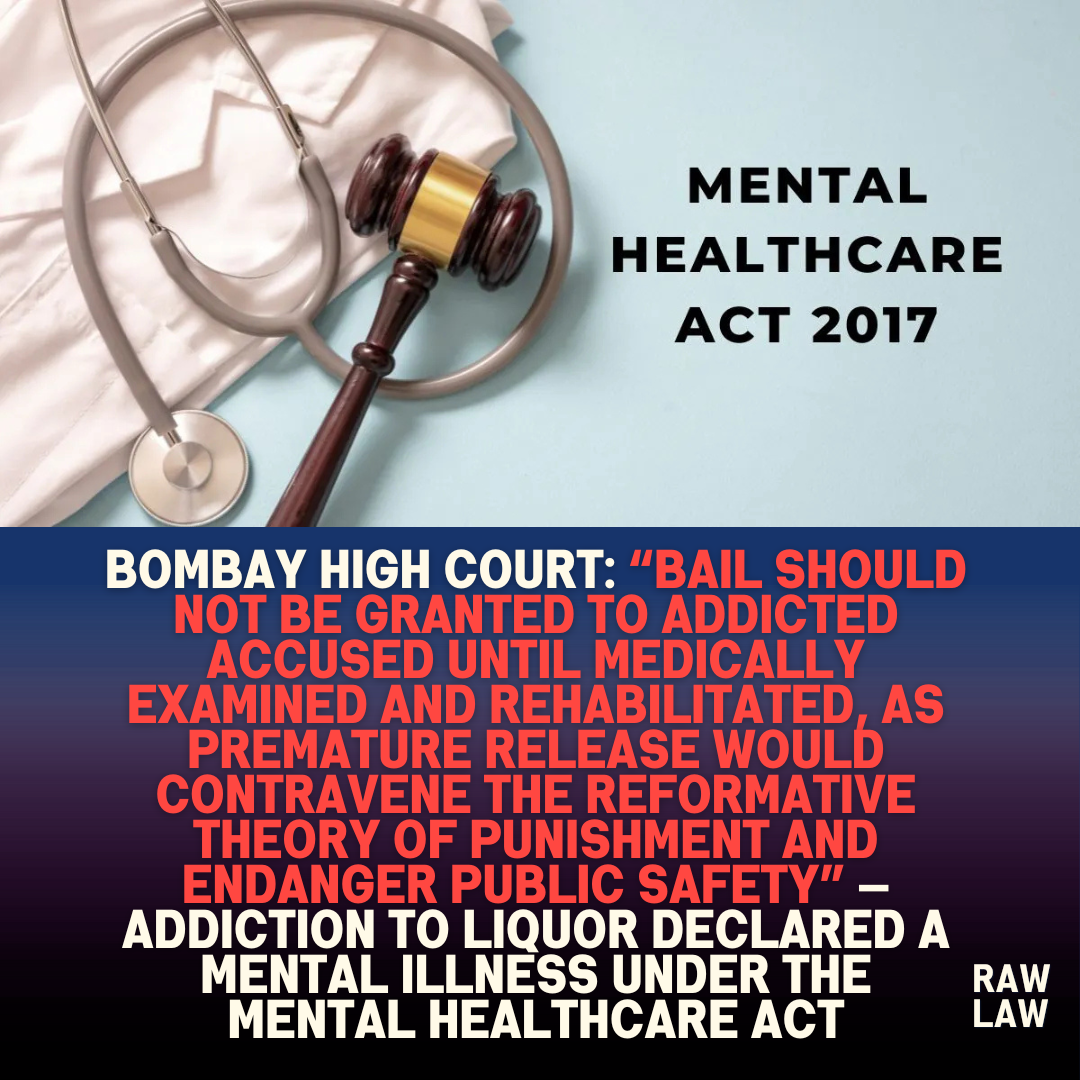
Bombay High Court: “Bail Should Not Be Granted to Addicted Accused Until Medically Examined and Rehabilitated, as Premature Release Would Contravene the Reformative Theory of Punishment and Endanger Public Safety” — Addiction to Liquor Declared a Mental Illness Under the Mental Healthcare Act

Court’s Decision
The Bombay High Court refused to entertain the regular bail application filed under Section 483 of the Bharatiya Nagarik Suraksha Sanhita, 2023, in a case involving allegations of murder, cruelty, and assault under Sections 302, 304, 498A, and 323 of the IPC. When the Court indicated its disinclination to grant bail, the applicant sought leave to withdraw the application.
However, the Court took the opportunity to lay down significant directions for systemic reform. It held that addiction to liquor or drugs amounts to a “mental illness” under Section 2(1)(s) of the Mental Healthcare Act, 2017, and that such persons must undergo psychiatric evaluation and treatment before being considered for bail. The Court further directed all police officers, jail authorities, and trial courts in Maharashtra to ensure medical examination and rehabilitation of accused persons addicted to liquor or drugs.
Facts
The prosecution alleged that the applicant, a CRPF personnel dismissed for misconduct, was addicted to liquor and frequently harassed his wife, Kranti. On 7 May 2024, under the influence of alcohol, he assaulted her with fists and kicks in the presence of their children, targeting her chest near the spleen where she already had a medical ailment. She succumbed to the injuries three days later.
The FIR was registered at Bhagya Nagar Police Station, Nanded, and the applicant was arrested. The two children were eyewitnesses to the assault. In response, the applicant filed a bail application before the High Court.
The case thus raised concerns not only about the applicant’s criminal liability but also about the impact of alcohol addiction on violent crimes within families.
Issues
- Whether addiction to liquor constitutes a mental illness under the Mental Healthcare Act, 2017.
- Whether such addiction influences bail decisions, given the risk of recidivism and threat to society.
- What directions should be issued to police, jail authorities, and courts to ensure compliance with statutory obligations for the treatment of addicted accused persons.
Petitioner’s Arguments
The applicant sought release on bail, arguing that he had no intention to kill his wife and that the incident was a result of a domestic quarrel. He contended that continued incarceration was unnecessary as investigation was complete and a charge sheet had been filed. It was also submitted that bail should not be denied solely on the basis of his addiction to alcohol.
Respondent’s Arguments
The State opposed bail, highlighting that the applicant had a violent history of assaulting his wife under the influence of alcohol. It was argued that his addiction was not just a personal problem but a social menace, making him a danger to his family and society if released. The prosecution stressed that granting bail would expose his children and other vulnerable persons to further risk.
Analysis of the Law
The Court examined the concept of “irresistible impulse” in criminal law, referring to the American case of State v. Plummer (1977), which recognized that long-term addiction to drugs or alcohol could mimic a mental defect, rendering a person unable to control violent impulses.
The Court observed that under Section 2(1)(s) of the Mental Healthcare Act, 2017, “mental illness” expressly includes conditions associated with the abuse of alcohol and drugs. Thus, individuals addicted to liquor or drugs must be considered mentally ill and referred for psychiatric treatment and rehabilitation.
The Court also discussed the interplay of Sections 480 and 483 of the BNSS, 2023, emphasizing that bail cannot be mechanically granted to such accused because their release could endanger family members and society at large. The law must therefore operate not only as a punitive measure but also as an instrument of social reform through compulsory medical treatment.
Precedent Analysis
- State v. Plummer (1977, US) – Distinguished between short-term voluntary intoxication (not a defense) and long-term addiction effects, which could mimic mental illness.
- Sundarjas Kanyalal Bhathija v. Collector, Thane (SC 1991) – Stressed that superior courts must ensure law is predictable and effective to guide behavior. Relied upon to justify issuing statewide directions.
- References to WHO reports – Addiction recognized as a mental health disorder requiring treatment.
Court’s Reasoning
The Court reasoned that while voluntary intoxication is not a defense in law, long-term addiction changes the legal landscape by creating mental illness that can affect volition. The applicant, addicted to liquor, was likely to pose a continuous threat if released on bail.
The Court observed that press reports and social realities demonstrate how bootleggers and drug peddlers fuel addiction, leading to violent crimes within families, especially against women and children. Therefore, instead of only punishing addicts, the justice system must ensure psychiatric treatment and rehabilitation.
The Court held that bail should not be granted to such accused until they are medically examined and rehabilitated, as premature release would contravene the reformative theory of punishment and endanger public safety.
Conclusion
The bail application was withdrawn, but the Court issued wide-ranging directions:
- Police, courts, and jail authorities must ensure psychiatric examination of all accused prima facie addicted to liquor or drugs.
- If found mentally ill, such accused must be treated in government rehabilitation centers until recovery.
- The Registrar General was directed to circulate this order to all district courts, police commissioners, jail authorities, and health officials in Maharashtra.
- The State Legal Services Authority was instructed to conduct awareness programs to change societal perception towards addicts, encouraging treatment instead of stigma.
The Court thus transformed a bail proceeding into a systemic reform judgment addressing the menace of addiction and its intersection with criminal law.
Implications
- Addiction to liquor or drugs is now judicially recognized as mental illness under Indian law, requiring mandatory treatment.
- Bail jurisprudence will factor in addiction, making release difficult until rehabilitation.
- Police, jail, and courts are bound to follow the Mental Healthcare Act for addicted accused, ensuring medical and psychological treatment.
- The judgment strengthens the reformative and preventive approach to criminal law in India.