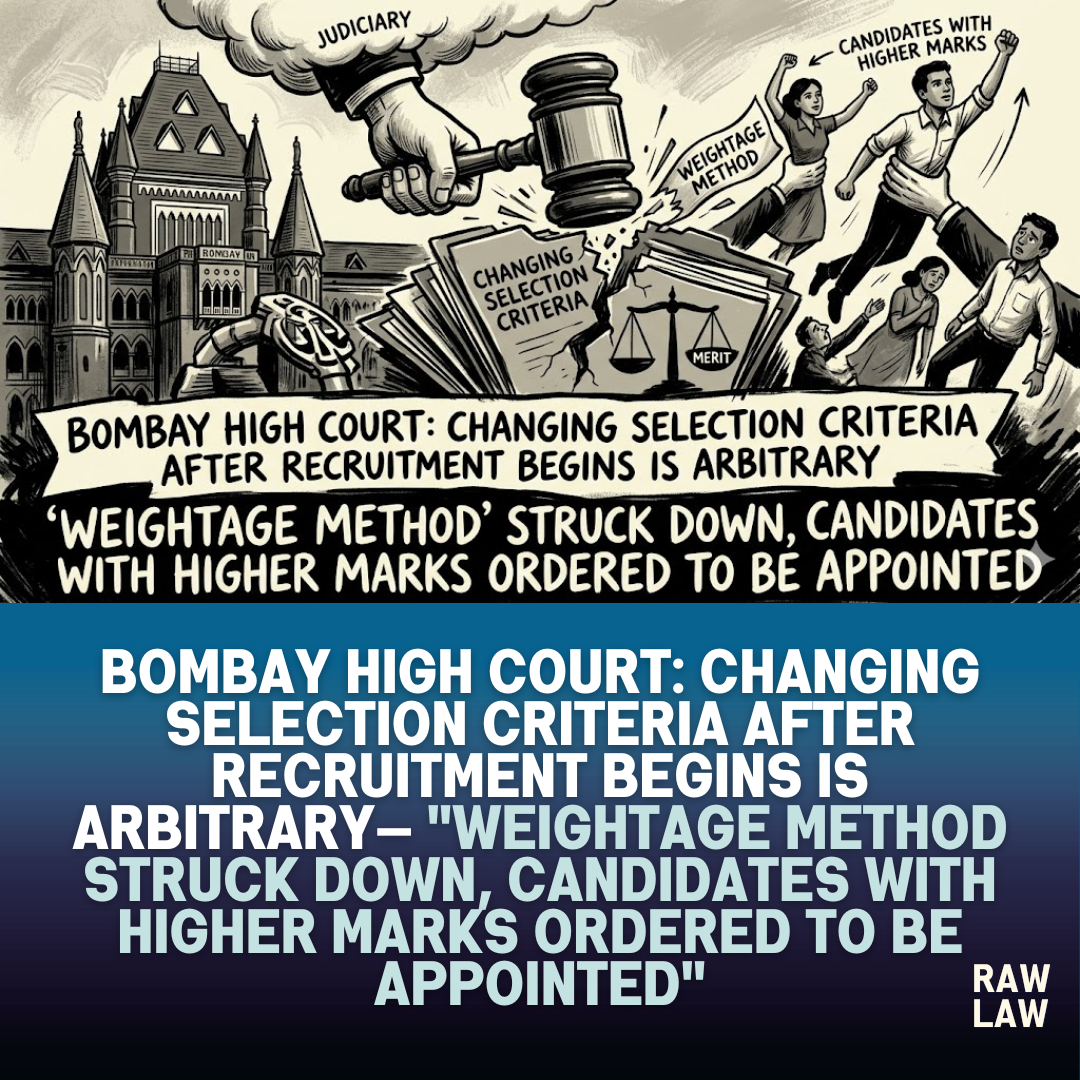
Bombay High Court: Changing selection criteria after recruitment begins is arbitrary— “Weightage method struck down, candidates with higher marks ordered to be appointed”

Court’s decision
The Bombay High Court (Aurangabad Bench) allowed the writ petition and held that altering the selection methodology after the recruitment process had commenced was arbitrary and violative of Articles 14 and 16 of the Constitution. The Court quashed the application of a 50%–50% weightage formula introduced at the stage of preparing the select list and directed that the petitioners be selected and appointed based on their higher aggregate marks.
Facts
The dispute arose from a recruitment process initiated by a state power generation company through Advertisement No.01/2023 for the post of Junior Officer (Security). The advertisement prescribed a selection process consisting of an online test (120 marks) followed by a physical efficiency test and psychometric test (40 marks), totaling 160 marks.
The petitioners participated in the recruitment process and secured higher total marks than certain selected candidates. However, after completion of the examinations, the recruiting authority introduced a weightage formula giving 50% weight to the online test and 50% to the physical and psychometric tests.
This recalibration altered the merit ranking, resulting in the petitioners being placed on the waitlist despite having higher total scores. Candidates with lower aggregate marks were selected due to higher performance in the physical test under the new weightage system.
Aggrieved by this post facto change in evaluation criteria, the petitioners approached the High Court seeking quashing of the selection list and direction for appointment.
Issues
The Court considered whether the recruiting authority could introduce a weightage system after candidates had completed the selection process.
Another key issue was whether the advertisement permitted such modification in evaluation methodology and whether such discretion could be exercised without violating constitutional guarantees of fairness and equality.
The Court also examined whether such a change amounted to altering the “rules of the game” midway through the recruitment process.
Petitioner’s arguments
The petitioners argued that the recruitment process must strictly adhere to the terms of the advertisement, which clearly specified allocation of marks—120 for the online test and 40 for the physical and psychometric tests. They contended that the introduction of a weightage system after completion of the examination fundamentally altered the selection criteria.
They relied on established Supreme Court jurisprudence to argue that rules governing selection cannot be changed midway. According to them, the weightage system resulted in arbitrary selection, as candidates with lower total marks were preferred over more meritorious candidates.
The petitioners further submitted that such post hoc changes violate the principle of legitimate expectation, as candidates participate in recruitment processes based on declared criteria.
Respondent’s arguments
The respondents contended that there was no change in the selection process, but only a refinement in the method of evaluating merit. They argued that the recruitment process operates in two stages—conduct of examinations and assessment of merit—and the weightage formula was applied only at the stage of merit evaluation.
They relied on clauses in the advertisement that reserved discretion to modify the selection process and argued that such flexibility was necessary to select the most suitable candidates.
According to them, the weightage method did not alter the nature of the tests but merely standardized evaluation, and therefore did not constitute a change in rules.
Analysis of the law
The Court examined the legal framework governing public recruitment, particularly the constitutional mandate of equality under Articles 14 and 16. It reiterated that recruitment processes must be fair, transparent, and free from arbitrariness.
The Court emphasized that once a recruitment process begins, the criteria governing selection must remain fixed. Any change that affects the outcome of selection after candidates have participated in the process undermines fairness and violates constitutional guarantees.
The doctrine against changing the “rules of the game” midway was identified as a core principle ensuring integrity in public employment. The Court also highlighted the concept of legitimate expectation, noting that candidates are entitled to rely on the criteria specified in the advertisement.
Precedent analysis
The Court relied extensively on Supreme Court precedents.
In Tej Prakash Pathak v. Rajasthan High Court, it was held that recruitment begins with advertisement and any change in criteria thereafter violates Article 14. The Court applied this principle to hold that post-examination introduction of weightage was impermissible.
In K. Manjushree v. State of Andhra Pradesh, the Supreme Court ruled that introducing minimum marks after completion of selection amounts to changing rules after the game is played. The High Court drew parallels to the present case.
In Ramjit Singh Kardam v. Sanjeev Kumar, the Supreme Court held that keeping candidates unaware of selection criteria changes until results are declared is arbitrary.
The Court distinguished cases relied upon by the respondents, noting that those involved pre-notified changes or materially different facts.
Court’s reasoning
The Court found that the advertisement did not contain any provision permitting application of a 50% weightage formula. The prescribed marking scheme clearly allocated 120 marks to the online test and 40 marks to the physical test.
By introducing weightage after the tests were completed, the respondents effectively altered the evaluation framework, leading to a different outcome in the merit list. The Court held that such discretion cannot be exercised arbitrarily, especially by a state authority.
It rejected the argument that clauses in the advertisement permitted such modification, observing that allowing post hoc changes would enable authorities to manipulate results by varying weightage arbitrarily.
The Court noted that if such weightage had been disclosed in the advertisement, candidates could have prepared accordingly. The absence of such disclosure rendered the process unfair.
Ultimately, the Court held that the application of weightage amounted to changing the rules after the game had been played, which is impermissible in law.
Conclusion
The High Court declared the application of the weightage formula illegal and arbitrary. It directed that the selection be based strictly on total marks as prescribed in the advertisement.
Since the petitioners had secured higher aggregate marks, the Court ordered their selection and appointment. The writ petition was allowed and the impugned selection process was set aside to that extent.
Implications
This judgment reinforces a critical principle in public employment law: recruitment authorities cannot alter evaluation criteria after the process has begun. It strengthens judicial scrutiny over recruitment processes and prevents arbitrary exercise of discretion.
The ruling has significant implications for government and public sector recruitment bodies, emphasizing the need for clarity and transparency in advertisements. Any ambiguity or post hoc modification risks invalidation.
For candidates, the judgment upholds the principle of legitimate expectation and ensures protection against unfair selection practices. It also serves as a strong precedent against manipulation of merit lists through undisclosed evaluation methods.
Case law references
- Tej Prakash Pathak v. Rajasthan High Court (2024)
Held that recruitment criteria cannot be altered after the process begins; applied to strike down post-exam weightage. - K. Manjushree v. State of Andhra Pradesh (2008)
Established that introducing new selection criteria after completion of process is illegal. - Ramjit Singh Kardam v. Sanjeev Kumar (2020)
Held that undisclosed changes in selection criteria are arbitrary and violative of fairness. - Chief Manager, Punjab National Bank v. Anit Kumar Das (2021)
Distinguished as factually different and not applicable.
FAQs
1. Can recruitment criteria be changed after the selection process starts?
No. Courts consistently hold that selection criteria cannot be altered after the recruitment process begins, as it violates fairness and equality under Articles 14 and 16.
2. What is meant by “changing the rules of the game”?
It refers to altering eligibility or evaluation criteria after candidates have participated in the process, which is considered arbitrary and illegal.
3. Can authorities apply weightage to marks if not mentioned in the advertisement?
No. Any weightage or evaluation method must be clearly specified in the advertisement. Applying it later is unlawful.