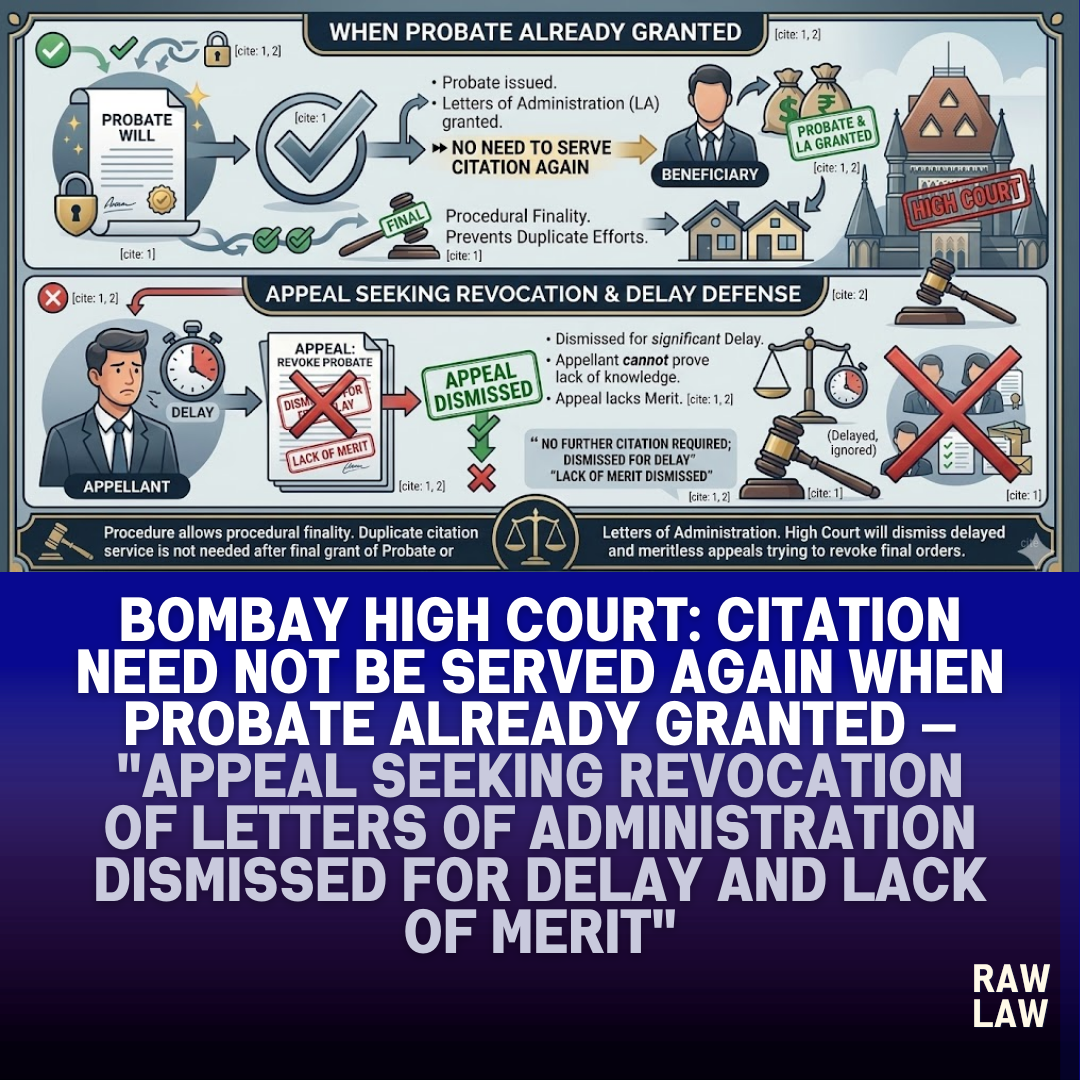
Bombay High Court: Citation need not be served again when probate already granted — “Appeal seeking revocation of letters of administration dismissed for delay and lack of merit”

1. Court’s decision
A Division Bench of the Bombay High Court dismissed an appeal challenging the dismissal of a petition seeking revocation of probate and subsequent letters of administration issued in relation to a will.
The Court upheld the earlier order of the Single Judge rejecting the revocation petition. It ruled that service of citation to the next of kin was not mandatory in the circumstances because the original probate proceedings had already considered objections and granted probate of the will.
The Court also concluded that the challenge to the probate proceedings had been filed after a long and unexplained delay and therefore could not be entertained.
2. Facts
The dispute concerned the estate of a deceased individual who had executed a will in 1974 appointing executors and distributing his estate primarily between his widow and one of his sons.
After his death in 1974, a petition was filed seeking probate of the will. Some heirs initially filed caveats opposing the probate but later withdrew their objections.
Following withdrawal of the caveats, probate of the will was granted in 1978.
Later, after the death of the surviving executrix who had been administering the estate, another petition was filed seeking Letters of Administration De-Bonis-Non, which allow administration of the remaining unadministered portion of an estate.
The Court granted such letters of administration in 2009.
3. Issues
The Court examined several issues arising from the appeal.
First, whether citation to the next of kin was mandatory before granting letters of administration in respect of the unadministered estate.
Second, whether dispensing with citation in the 2009 proceedings rendered the grant of letters of administration invalid.
Third, whether the petition seeking revocation of probate and letters of administration had been filed after an unexplained delay that justified dismissal of the challenge.
4. Petitioner’s arguments
The appellants argued that the grant of letters of administration in 2009 was invalid because citation had not been served on them despite being legal heirs.
They relied on provisions of the Indian Succession Act, 1925 and the Bombay High Court Original Side Rules to contend that notice of such applications must be served on heirs and next of kin.
According to the appellants, failure to serve citation rendered the grant of letters of administration defective and therefore liable to be revoked.
They also argued that the delay in challenging the proceedings was explained because they had allegedly become aware of the grant only much later.
5. Respondent’s arguments
The respondent argued that citation had already been effectively addressed in the earlier probate proceedings where heirs had the opportunity to oppose the will.
It was further contended that the appellants had withdrawn their caveats and had even consented to the probate earlier.
Therefore, when the executrix later died and letters of administration were sought only for completing administration of the estate, fresh citation was not necessary.
The respondent also pointed out that public notices had been issued and property transfers had taken place years earlier, demonstrating that the appellants were aware of the proceedings.
6. Analysis of the law
The Court examined the scheme of Sections 258 and 259 of the Indian Succession Act, 1925.
Section 258 provides that when an executor who obtained probate dies leaving part of the estate unadministered, another representative may be appointed to complete administration.
Section 259 states that the court should be guided by the same rules applicable to original probate grants when granting such letters of administration.
The Court clarified that the phrase “guided by” indicates flexibility and does not necessarily make all procedural requirements strictly mandatory in every case.
7. Precedent analysis
The Court examined earlier judgments dealing with probate procedure and service of citation.
It distinguished a previous decision where citation had been held mandatory because that case involved the original grant of probate.
In contrast, the present case concerned a later stage where probate had already been granted and the court was only appointing a representative to complete administration of the estate.
Therefore, the earlier case law relied upon by the appellants did not apply to the present circumstances.
8. Court’s reasoning
The Court noted that probate of the will had already been granted decades earlier after considering objections from heirs.
Some heirs had filed caveats but later withdrew them and consented to the probate proceedings.
Therefore, the court concluded that the essential issues concerning validity of the will had already been adjudicated.
When the executrix later died before fully administering the estate, the grant of letters of administration was merely a procedural step to continue administration of the estate rather than a fresh determination of testamentary rights.
In these circumstances, dispensing with service of citation was justified.
9. Conclusion
The Court held that the appellants had failed to demonstrate any legal error in the order granting letters of administration or in the order dismissing the revocation petition.
It further concluded that the challenge had been filed after significant delay and that the explanation offered for the delay was not credible.
Accordingly, the appeal was dismissed and the earlier orders were upheld.
10. Implications
The judgment clarifies an important procedural aspect of probate law.
Where probate has already been granted and the executor later dies leaving the estate partially unadministered, courts may dispense with fresh citation when granting letters of administration to complete the administration of the estate.
The ruling also underscores that revocation petitions filed after long delays without convincing explanation are unlikely to succeed, especially when earlier proceedings have already settled the validity of the will.
Case Law References
- Pooja Deepak Patil v. Savita Vasantrao Patil (2018)
Held that citation to heirs is mandatory in original probate proceedings where consent has not been filed. - Dr. Dishah Dhunjishah Gagrat v. Viloo Byramji Plumber (2010)
Discussed procedural requirements relating to service of citation and probate proceedings.
FAQs
1. What are Letters of Administration De-Bonis-Non?
They are issued when an executor who obtained probate dies before fully administering the estate. A new representative is appointed to complete administration of the remaining estate.
2. Is citation to heirs always required in probate proceedings?
Citation is generally required for original probate proceedings, but courts may dispense with fresh citation when granting letters of administration for an already probated will.
3. Can probate be challenged after many years?
Courts are reluctant to entertain revocation petitions filed after long delays unless convincing reasons for the delay are shown.