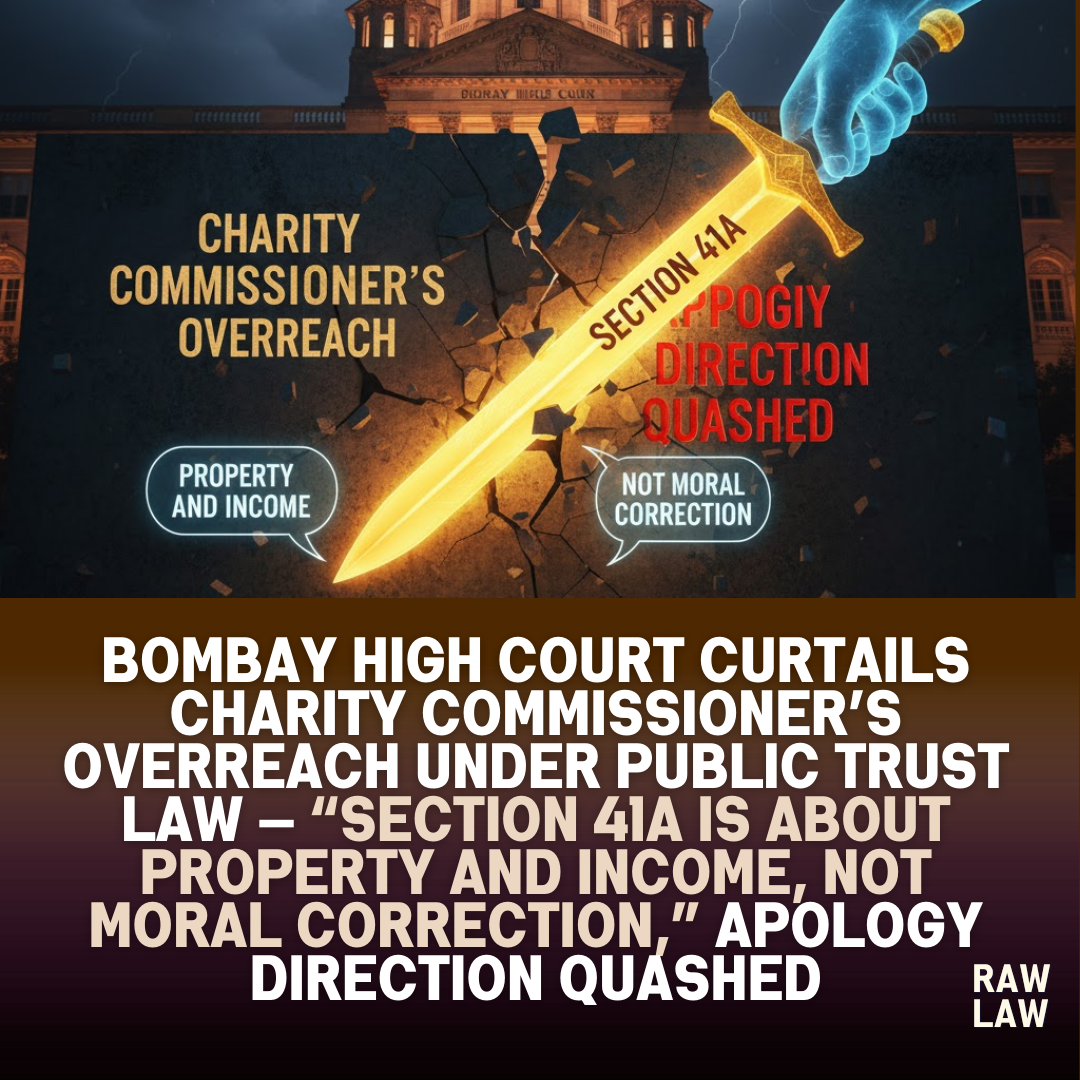
Bombay High Court curtails Charity Commissioner’s overreach under public trust law — “Section 41A is about property and income, not moral correction,” apology direction quashed

Court’s decision
The Bombay High Court, exercising its Civil Appellate Jurisdiction, has allowed a writ petition filed by a public educational trust and quashed an order of the Charity Commissioner directing the trust to issue a public apology to students and parents in newspapers. The Court held that Section 41A of the Maharashtra Public Trusts Act, 1950 confers only limited supervisory powers linked to administration of trust property, income, and statutory compliance, and does not authorise directions of a moral or punitive character unrelated to trust property or finances. Holding that the Charity Commissioner acted without jurisdiction, the Court set aside the impugned order in its entirety.
Facts
The petitioner is a public trust registered under the Maharashtra Public Trusts Act, 1950, running an English medium school in Nashik. The school was initially affiliated with the State board and later sought affiliation with the Central Board of Secondary Education after obtaining a no-objection certificate. Following inspection, the CBSE rejected the application for affiliation, and the appeal against rejection was also unsuccessful.
After the rejection, the school management convened meetings with parents and informed them of the decision. Subsequently, certain parents approached the Charity Commissioner alleging that the trust had misrepresented that the school was CBSE-affiliated, causing prejudice to students and parents. Acting on this complaint, the authority passed an order directing the trust to issue a public apology in two widely circulated newspapers and further directed initiation of an enquiry against the trust management.
Aggrieved by these directions, the trust approached the High Court challenging the jurisdiction of the authority to pass such an order under Section 41A of the Act.
Issues
The central issue before the High Court was whether the Charity Commissioner could exercise powers under Section 41A of the Maharashtra Public Trusts Act to issue directions that are unconnected with the management of trust property, trust income, or statutory financial administration. The Court also examined whether allegations of misrepresentation regarding school affiliation fall within the concept of “proper administration of the trust” as contemplated by Section 41A read with Chapter V-A of the Act.
Petitioner’s arguments
The petitioner contended that Section 41A must be interpreted in light of its placement in the Act, particularly Chapter V-A comprising Sections 35, 36, 36A and 36B, which exclusively deal with trust property, trust funds, investment, alienation, and financial supervision. It was argued that the expression “proper administration” in Section 41A cannot be expanded to cover every grievance against a trust or its management.
The petitioner submitted that the complaint before the authority did not allege misuse of trust funds, illegal alienation of property, improper investment, or breach of statutory duties relating to property or income. The direction to issue a public apology, it was argued, had no nexus with protection of trust assets or application of income and amounted to an impermissible exercise of moral or disciplinary power, which the statute does not confer.
Respondent’s arguments
The respondents did not seriously contest the legal position and left it to the Court to pass an appropriate order. The State authority sought to sustain the order by invoking the broad language of Section 41A, contending that it empowers the Charity Commissioner to ensure proper administration of public trusts and to issue directions in that regard.
Analysis of the law
The High Court undertook a detailed statutory analysis of the Maharashtra Public Trusts Act. It emphasised that Chapter V-A forms a self-contained code governing trust property, trust income, investment of funds, alienation of assets, borrowing, and maintenance of property registers. Each provision in the chapter reinforces fiduciary discipline and financial accountability.
Interpreting Section 41A in this statutory context, the Court held that the power to issue directions is expressly “subject to the provisions of the Act” and derives its content and limits from Chapter V-A. The phrase “proper administration” cannot be read in an unguided or moral sense; it refers to administration of property, funds, and statutory financial duties. Any broader interpretation would convert Section 41A into an open-ended source of authority, which the legislature deliberately avoided.
Precedent analysis
While the judgment primarily turned on statutory construction, the Court reaffirmed settled principles of administrative law that regulatory powers must be exercised within clearly defined statutory bounds. Supervisory provisions cannot be expanded by implication to cover areas consciously left outside legislative control. The Court reiterated that jurisdictional limits are determined by statutory scheme, not by the perceived seriousness of allegations.
Court’s reasoning
Applying these principles, the Court found that the grievance against the trust related to alleged misrepresentation regarding CBSE affiliation and the resulting impact on students and parents. However serious, such allegations did not concern misuse of trust property, misapplication of income, improper accounting, or danger to trust assets.
The direction to issue a public apology neither protected trust property nor ensured statutory compliance under Sections 35 to 36B. The Court held that Section 41A is a provision of supervision, not moral correction. By directing publication of an apology and ordering an enquiry unconnected with trust finances or property, the authority crossed the jurisdictional boundary drawn by the Act. The impugned order therefore suffered from a patent lack of jurisdiction.
Conclusion
The writ petition was allowed. The Bombay High Court quashed and set aside the order dated 28 June 2010 passed by the Charity Commissioner directing the trust to issue a public apology and ordering further enquiry. Rule was made absolute with no order as to costs.
Implications
This judgment decisively limits the scope of Section 41A of the Maharashtra Public Trusts Act. It clarifies that the Charity Commissioner’s powers are confined to supervision of trust property, income, and statutory financial administration, and cannot be extended to issue punitive, moral, or reputational directions. The ruling provides important protection to public trusts against jurisdictional overreach and reinforces the principle that regulatory authorities must act strictly within the contours of legislative design.
Case law references
- Present judgment (Bombay High Court, Civil Appellate Jurisdiction): Held that Section 41A does not authorise directions unrelated to trust property, income, or statutory financial administration; apology direction quashed as without jurisdiction.
FAQs
Q1. What is the scope of Section 41A of the Maharashtra Public Trusts Act?
Section 41A empowers the Charity Commissioner to issue directions only to ensure proper administration of trust property, trust income, and statutory financial duties.
Q2. Can the Charity Commissioner direct a trust to issue a public apology?
No. The Bombay High Court has held that such moral or punitive directions fall outside the jurisdiction under Section 41A.
Q3. Does “proper administration” include all activities of a public trust?
No. Proper administration is limited to management of trust property and income, not every grievance against a trust or its management.