Bombay High Court Directs NBEMS to Register DNB Student; Holds Candidate Cannot Lose Admission Due to Authorities’ Technical Seat Allocation Error

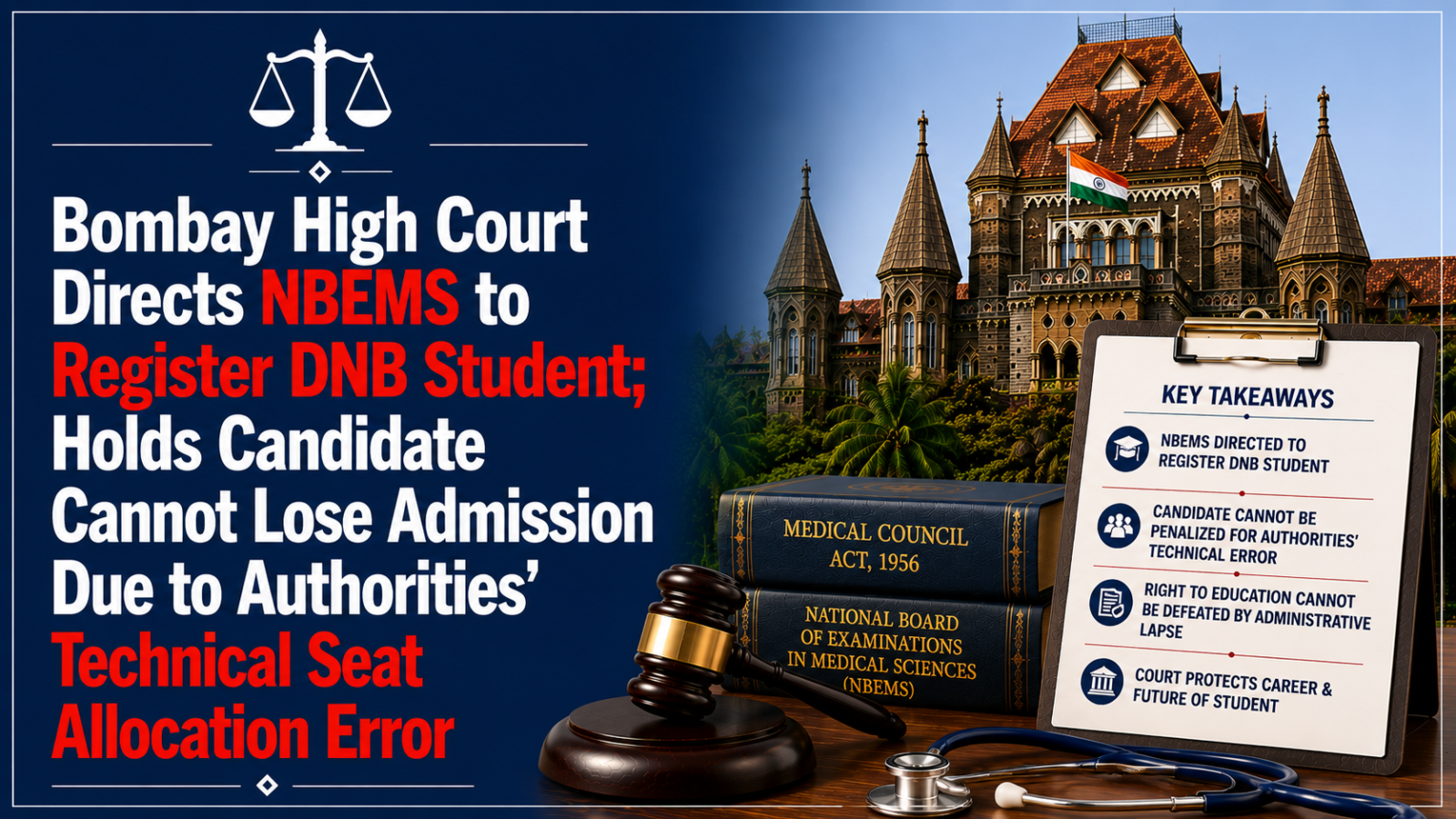
Bombay High Court Holds Medical Student Cannot Be Denied Registration Due to Seat Allocation Discrepancy
Facts
The petitioner, Dr. Mital Lahanu Sonawane, a Group ‘A’ Medical Officer in Government service, became eligible for admission to postgraduate medical courses under the in-service quota after completing the requisite period of service. She participated in NEET-PG 2025 and, during the third round of counselling, was allotted a DNB Ophthalmology seat at Respondent No. 5 College. Although she was subsequently allotted an MS Ophthalmology seat elsewhere, she elected to retain the DNB seat, paid the prescribed fees and completed the admission formalities.
After being relieved from Government service, the petitioner attempted to register herself on the NBEMS Online Portal for Joining and Registration (OPJR) but was unable to do so because of a portal error. Upon enquiry, she discovered that the DNB seat allotted to her had simultaneously been reflected in the All India counselling process owing to a failure by the college to communicate its conversion of the seat to the State CET Cell. Both the Joint Director of Health Services and the College requested NBEMS to regularise her admission and enable registration. The petitioner therefore approached the Bombay High Court seeking a direction to NBEMS to register her as a DNB student.
Issues
- Whether the petitioner could be denied registration for the DNB Ophthalmology course due to a technical error in the seat allocation process.
- Whether the administrative discrepancy in counselling justified issuance of a writ directing NBEMS to regularise the petitioner’s admission.
- Whether relief under Article 226 of the Constitution was warranted in the circumstances.
Petitioner’s Arguments
The petitioner contended that she had been validly allotted the DNB Ophthalmology seat, accepted the allotment, completed all admission formalities and physically joined the course after being relieved from Government service. She submitted that her inability to register on the OPJR was solely attributable to an error in the seat allocation process and not due to any omission on her part.
It was further argued that despite repeated approaches to the College, the reason for the registration failure remained undisclosed until the State CET Cell informed her that the DNB seat had simultaneously been reflected under the All India counselling process. Since the error was entirely administrative and beyond her control, she sought a direction requiring NBEMS to permit her registration and regularise her admission.
Respondents’ Arguments
The State submitted that the petitioner’s inability to register resulted from a technical discrepancy in the seat allocation and reporting mechanism and not from any fault on the part of the petitioner. It further stated that the concerned DNB seat had remained vacant throughout the All India counselling process and that no third-party rights would be affected by regularising the petitioner’s admission.
The College supported the petitioner’s case and even expressed its willingness to create a supernumerary seat, if necessary, to accommodate her. Both the State and the College urged the Court to permit the petitioner’s registration.
Analysis of the Law
The High Court exercised its jurisdiction under Article 226 of the Constitution of India to prevent manifest injustice arising from an admitted administrative and technical error. The Court held that where a candidate has been validly allotted a seat, accepted the allotment and joined the course, she cannot be deprived of pursuing her education because of lapses committed by the authorities.
The Court emphasised that judicial intervention is warranted where an admitted administrative error threatens to defeat a candidate’s lawful admission despite complete compliance on her part.
Precedent Analysis
The judgment does not rely upon or discuss any judicial precedents. The Court decided the matter on the admitted facts, the undisputed technical error in the counselling process and the equitable exercise of its writ jurisdiction under Article 226 of the Constitution.
Court’s Reasoning
The High Court found that it was undisputed that the petitioner’s inability to register on the OPJR resulted entirely from a technical discrepancy in the seat allocation process and that she bore no responsibility for the error. The Court further noted that the petitioner diligently pursued the matter, the DNB seat had remained vacant throughout the All India counselling process and no third-party rights had intervened. Significantly, both the State Government and the College supported the petitioner’s request for regularisation.
The Court held that once the petitioner had been validly allotted the seat, accepted the allotment and joined the course, she could not be deprived of pursuing the DNB programme because of an administrative or technical lapse committed by the authorities. Considering these circumstances, the Court held that the ends of justice warranted exercise of its jurisdiction under Article 226.
Conclusion
The Bombay High Court allowed the writ petition and directed NBEMS to reopen the Online Portal for Joining and Registration (OPJR) insofar as the petitioner was concerned, enable her to complete the registration formalities and thereafter process and regularise her admission to the DNB Ophthalmology course in accordance with law.
Case Details
Case: Dr. Mital Lahanu Sonawane v. State of Maharashtra & Ors.
Court: Bombay High Court
Case Number: Writ Petition No. 6285 of 2026
Judges: Hon’ble Mr. Justice R. I. Chagla and Hon’ble Mr. Justice Farhan P. Dubash
Date: 05 August 2026
Result: Writ Petition allowed; NBEMS directed to reopen the OPJR portal, enable the petitioner’s registration and regularise her admission to the DNB Ophthalmology course.