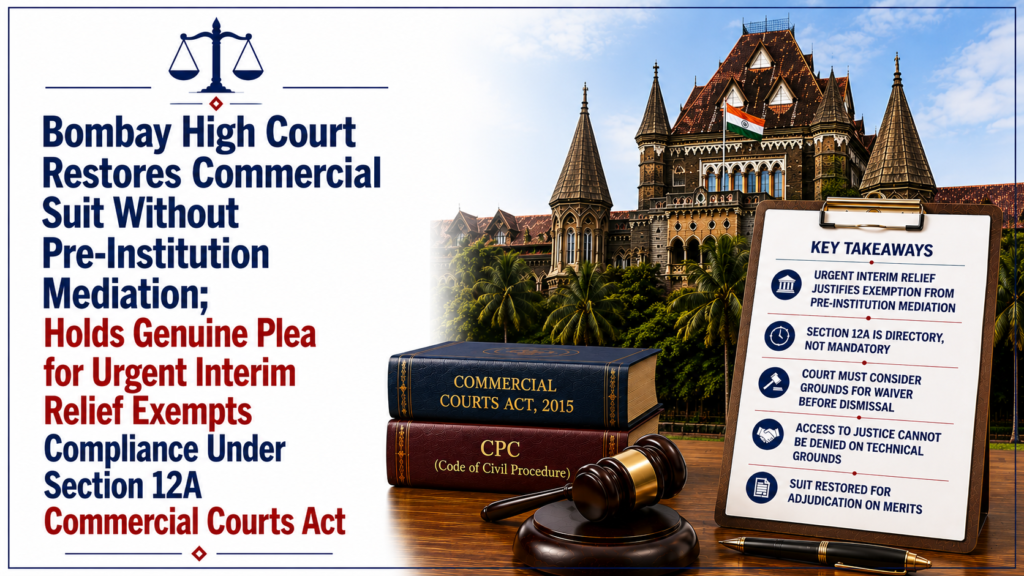
Bombay High Court Restores Commercial Suit Without Pre-Institution Mediation; Holds Genuine Plea for Urgent Interim Relief Exempts Compliance Under Section 12A Commercial Courts Act

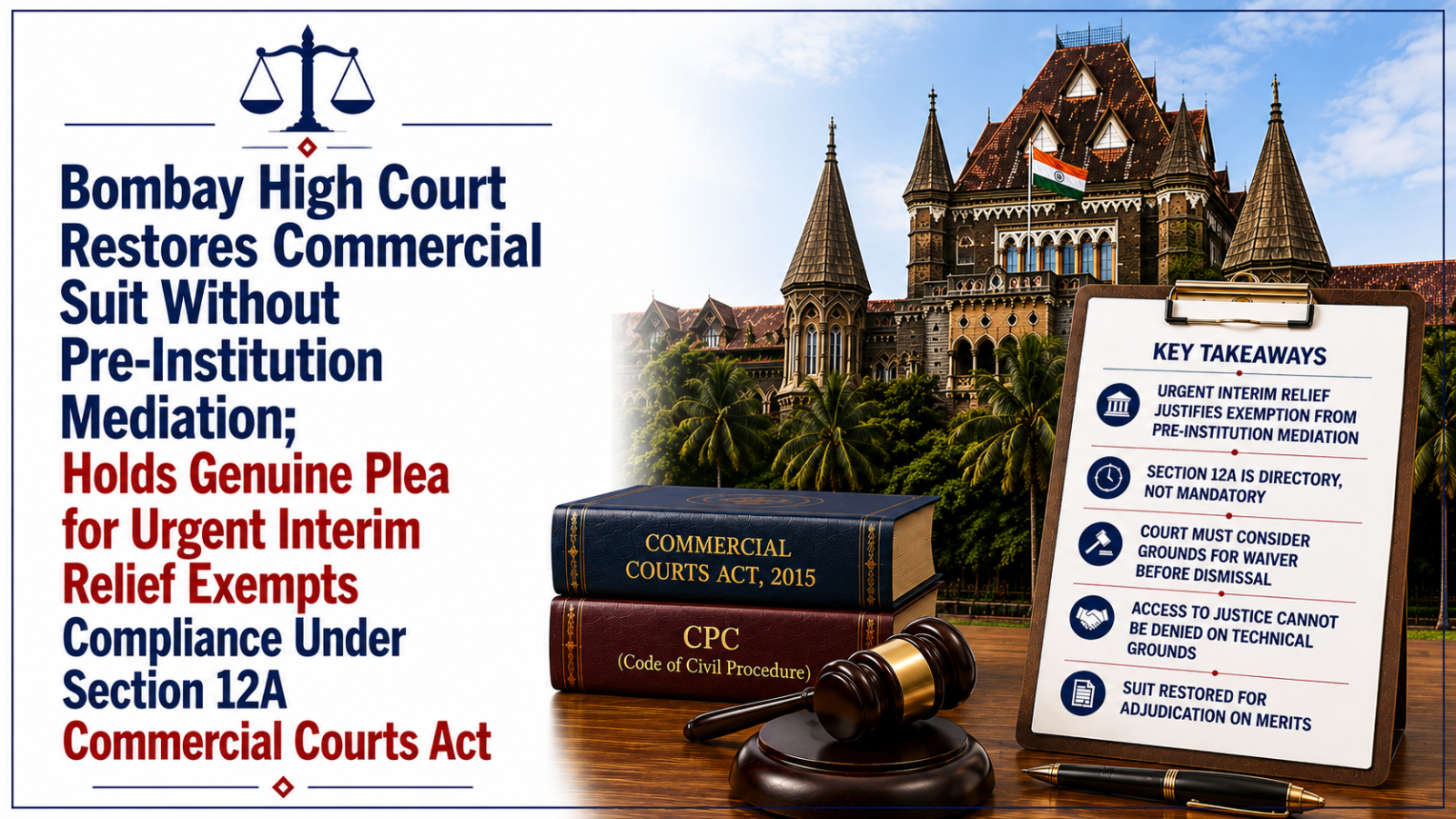
Bombay High Court Holds Commercial Suit Seeking Immediate Injunction Need Not Undergo Pre-Institution Mediation
Facts
The appellant, High Point Supply Company LLC, a US-based company, entered into an Exclusive Distribution Agreement (EDA) with the respondent, Agati Healthcare Pvt. Ltd., on 26 June 2023, appointing the appellant as the exclusive distributor of the respondent’s colostrum products in the North American market until June 2026. The agreement contained an exclusivity clause permitting direct sales only to an existing customer, PanTheryx, subject to specified conditions, including cessation of that exception upon a change of control.
The appellant alleged that after PanTheryx was acquired by Glanbia Nutritionals, the respondent continued supplying products directly to Glanbia in breach of the exclusivity covenant. The respondent thereafter terminated the agreement and attributed the breach to the appellant. The appellant instituted a commercial suit seeking specific performance of the EDA, declaration that the termination was illegal, permanent injunction restraining further breaches, disclosure of sales, damages, and urgent interim relief. The Trial Court rejected the plaint under Order VII Rule 11(d) CPC for failure to undertake pre-institution mediation under Section 12A of the Commercial Courts Act, 2015, holding that no genuine urgency existed. The appellant challenged that order before the Bombay High Court.
Issues
- Whether the suit genuinely contemplated urgent interim relief so as to fall within the exception under Section 12A(1) of the Commercial Courts Act, 2015.
- Whether the Trial Court correctly rejected the plaint under Order VII Rule 11(d) CPC for non-compliance with mandatory pre-institution mediation.
- Whether the Trial Court exceeded the permissible scope of enquiry by examining the merits of the interim relief instead of merely determining the existence of genuine urgency.
Appellant’s Arguments
The appellant contended that the Trial Court adopted an unduly technical and restrictive interpretation of Section 12A by treating pre-institution mediation as an absolute requirement despite the statutory exception for suits contemplating urgent interim relief.
It argued that the plaint disclosed continuing breaches of the exclusivity covenant, ongoing erosion of its exclusive distribution rights, loss of goodwill, customer relationships and market position, all of which required immediate judicial intervention. The appellant further submitted that the Trial Court improperly evaluated the merits of the injunction application instead of confining itself to the limited jurisdictional enquiry under Section 12A. Delay in filing the suit was explained by the need to obtain expert opinion on Colorado law, prepare pleadings in the United States, notarise documents and transmit them to India.
Respondent’s Arguments
The respondent submitted that Section 12A is mandatory and that the appellant had failed to establish any genuine urgency warranting exemption from pre-institution mediation.
It argued that the appellant remained inactive for several months after receipt of the termination notice, demonstrating absence of urgency. According to the respondent, the explanation regarding foreign legal advice and preparation of pleadings could not create urgency where none otherwise existed, and the prayers for interim relief were merely a device to circumvent the mandatory mediation requirement.
Analysis of the Law
The High Court analysed Section 12A of the Commercial Courts Act, 2015 in light of recent Supreme Court jurisprudence. It reiterated that while pre-institution mediation is mandatory, the legislature has consciously carved out an exception where the suit genuinely contemplates urgent interim relief.
The Court emphasised that the enquiry under Section 12A is jurisdictional, not adjudicatory. The Court is only required to determine whether, on a holistic reading of the plaint and accompanying documents, a bona fide factual foundation exists showing the necessity for urgent interim protection. It is impermissible at that stage to decide whether an injunction should ultimately be granted or whether damages would constitute an adequate remedy.
Precedent Analysis
The Court extensively relied upon:
- Patil Automation (P) Ltd. v. Rakheja Engineers (P) Ltd., holding Section 12A mandatory while recognising the statutory exception for urgent interim relief.
- Dhanbad Fuels (P) Ltd. v. Union of India, explaining that courts must examine the pleadings to determine whether genuine urgency exists.
- Novenco Building and Industry A/S v. Xero Energy Engineering Solutions Pvt. Ltd., holding that the court must assess immediacy of peril, likelihood of irreparable harm and whether delay would render the final relief ineffective.
- Buildcon Sethia Construction v. Dipti Co-operative Housing Society Ltd., holding that the plaint must be read holistically while determining whether urgent interim relief is genuinely contemplated.
Court’s Reasoning
The High Court held that the Trial Court adopted an impermissibly narrow approach by focusing only on isolated paragraphs of the plaint instead of reading the pleadings as a whole. The plaint clearly alleged continuing breaches of the exclusivity covenant, wrongful termination of the agreement and continuing erosion of contractual rights, thereby disclosing a bona fide factual foundation for urgent judicial intervention.
The Court further held that the Trial Court improperly conflated two distinct enquiries. Instead of limiting itself to deciding whether the suit genuinely contemplated urgent interim relief, it evaluated whether the appellant was actually entitled to an injunction and whether damages were an adequate remedy. Such questions arise only while deciding the interim application on merits and not while considering rejection of the plaint under Order VII Rule 11(d).
The High Court also rejected the Trial Court’s conclusion that the interim prayers were a mere camouflage to avoid mediation. It observed that the allegations of continuing breach and erosion of exclusivity rights could not be characterised as sham or colourable at the threshold. Although the delay in filing the suit was a relevant circumstance, it was not conclusive and did not by itself negate the plea of urgency.
Conclusion
The Bombay High Court allowed the appeal and set aside the Trial Court’s order rejecting the plaint. It held that the plaint disclosed a genuine factual foundation demonstrating that the suit contemplated urgent interim relief within the meaning of Section 12A(1) of the Commercial Courts Act, 2015. Consequently, the statutory exception to pre-institution mediation was attracted. The commercial suit was restored to the Trial Court, which was directed to decide the interim application independently on its own merits without being influenced by any observations contained in the impugned order or the High Court’s judgment.
Case Details
Case: High Point Supply Company LLC v. Agati Healthcare Pvt. Ltd.
Court: Bombay High Court
Case Number: Commercial First Appeal No. 15 of 2026
Judges: Hon’ble Mr. Justice R.I. Chagla and Hon’ble Mr. Justice Farhan P. Dubash
Date: 05 August 2026
Result: Appeal allowed; Trial Court’s order rejecting the plaint under Order VII Rule 11(d) CPC set aside; Commercial Suit No. 2 of 2025 restored; Trial Court directed to decide the interim application on merits.