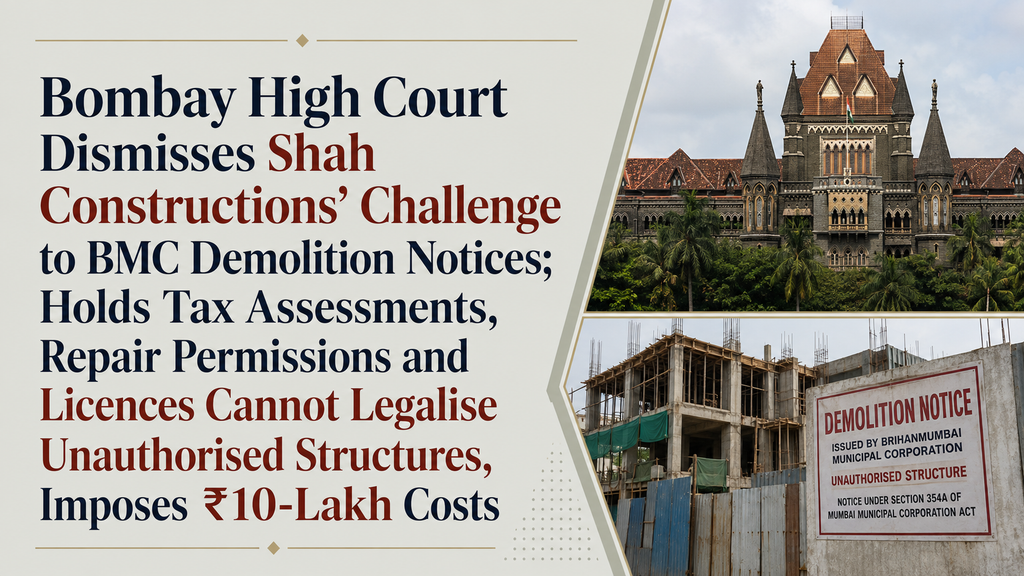
Bombay High Court Dismisses Shah Constructions’ Challenge to BMC Demolition Notices; Holds Tax Assessments, Repair Permissions and Licences Cannot Legalise Unauthorised Structures, Imposes ₹10-Lakh Costs

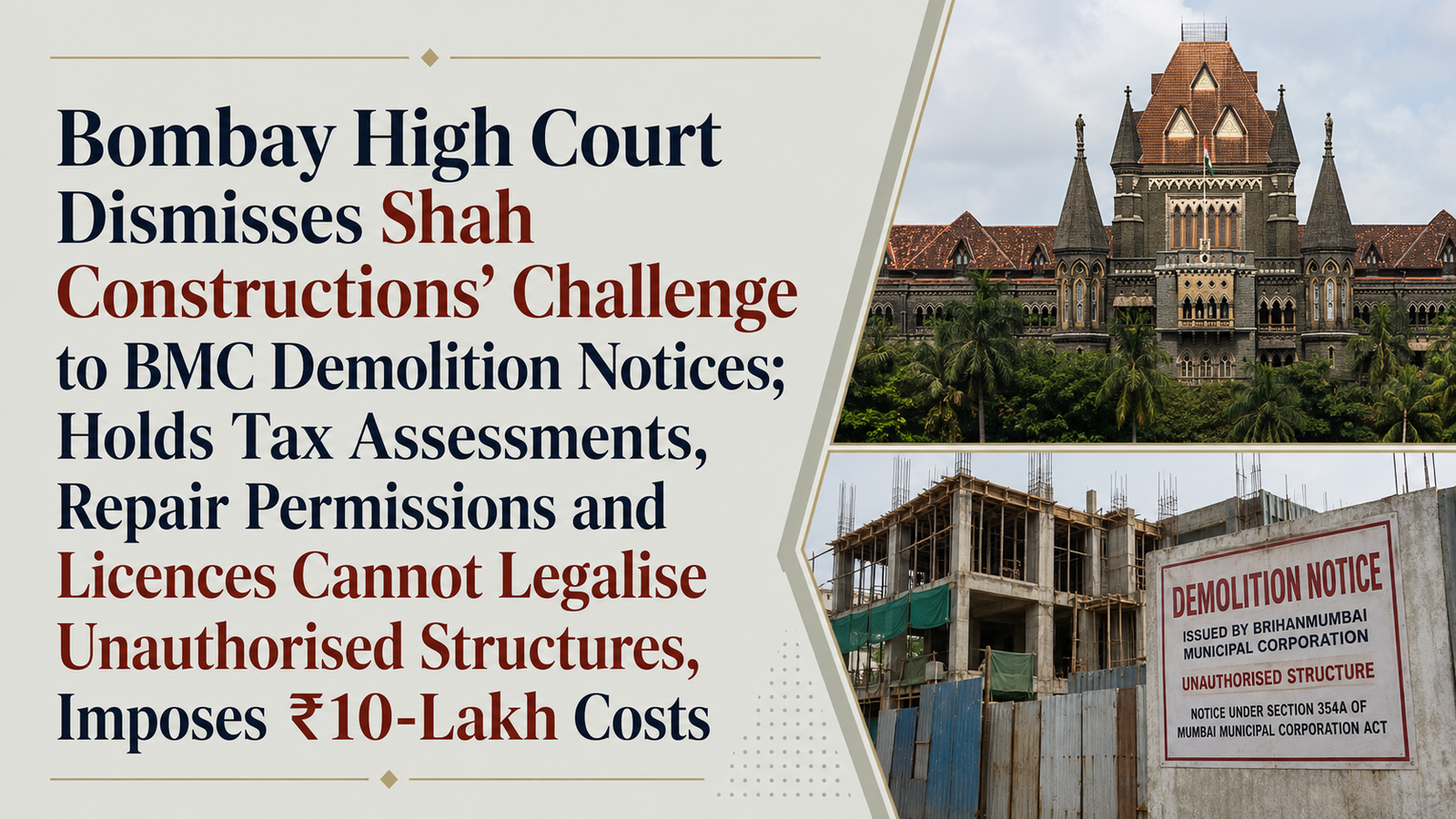
Bombay High Court Upholds BMC Demolition Notices for Andheri Structures; Finds No Sanctioned Plans or Proof Showing Construction Existed Before 1962 Datum Line
Facts
Shah Constructions Co. Ltd. challenged two notices dated 13 May 2026 and consequential orders dated 1 July 2026 passed by the Designated Officer, K/West Ward, BMC, concerning allegedly unauthorised construction on land bearing CTS No. 844/12, New Link Road, Industrial Area, Andheri West, Mumbai.
The structures comprised, among other things, five porta cabins, temporary sheds, a car workshop, three banquet halls, offices, storage sheds, a shop and a toilet.
The petitioner claimed these were tolerated commercial structures constructed before 1 April 1962, the datum line used by BMC for protection of old commercial structures.
In support, it relied upon a 1961 licence permitting stone-cutting activity, repair permissions issued in 1978 and 1982, withdrawal of an earlier Section 351 notice in 1983, municipal assessment records and various licences subsequently issued by BMC.
The Designated Officer rejected those documents as insufficient to establish that the impugned structures existed before the datum line and directed removal of the unauthorised construction within fifteen days.
Issues
The principal issues were whether the petitioner had established that the impugned structures existed before 1 April 1962 and were therefore protected or tolerated structures; whether municipal licences, assessment bills and repair permissions could prove that otherwise unauthorised structures were lawful; whether withdrawal of the earlier 1983 Section 351 notice prevented BMC from issuing fresh demolition notices on principles analogous to res judicata; and whether the High Court should interfere with BMC’s orders under Article 226.
The Court also considered whether the petitioner’s documentary presentation concerning earlier notices and repair permissions was reliable.
Petitioner’s Arguments
Shah Constructions argued that the structures were protected commercial premises existing prior to the datum line.
It relied heavily upon the 1961 licence for stone-cutting activity, contending that it demonstrated existence of the premises before April 1962. According to the petitioner, the licence followed an earlier 1959 grant from the Additional Collector.
It further relied upon repair permissions and the fact that a Section 351 notice issued on 26 July 1983 had subsequently been dropped by BMC on 18 November 1983, stating that the structures were protected under municipal policy. On that basis, the petitioner argued that fresh Section 351 proceedings were barred by res judicata.
The petitioner also pointed to property assessments, licences and payment of municipal dues, submitting that it had consistently been recognised by BMC and was a law-abiding landowner.
Finally, during hearing, it offered to voluntarily remove those portions which it accepted were unauthorised.
Respondent’s Arguments
BMC supported the notices and demolition orders.
It argued that the statutory procedure had been followed, the petitioner’s documents were examined, and none established that the nine structures presently existing on the site were lawfully constructed or existed before the datum line.
BMC therefore sought dismissal of the petitions and permission to proceed against the unauthorised construction.
Analysis of the Law
No Sanctioned Plan or Building Permission
The Court considered it decisive that the petitioner possessed no sanctioned plan or municipal authorisation for any of the structures.
When specifically questioned, senior counsel for the petitioner fairly admitted that no such sanctioned plans or authorisations existed.
The Court held that the 1961 licence merely permitted stone-cutting activity. It neither established that a structure existed nor described its dimensions or construction.
A licence permitting a business activity could not be converted into municipal approval for construction.
Repair Permission Does Not Establish Original Legality
The petitioner relied upon a 1978 repair permission.
The High Court held that permission to repair an existing structure does not establish that the original structure was lawfully constructed, nor does it establish its precise nature, dimensions or authorised area.
The Court further scrutinised the documents annexed to the two petitions and found that what was presented as separate material was, in fact, the same repair notice and the same earlier Section 351 notice.
It described this as an attempt to make the Court believe that separate notices existed for the structures involved in each petition.
Earlier 1983 Protection Letter Did Not Establish Pre-1962 Existence
The petitioner relied strongly upon BMC’s letter dated 18 November 1983 stating that the structures were protected.
The Court viewed that document with considerable suspicion, observing that it prima facie appeared to be a procured document.
More fundamentally, the Court held that the letter referred to repair permissions from 1978 and 1982 but did not identify any document establishing that the structures existed before 1 April 1962.
The 1982 letter itself referred to five porta cabins sought to be repaired, which could not establish existence of those structures before the datum line.
Thus, the earlier dropping of proceedings could not overcome the absence of foundational proof regarding the age, nature and size of the present structures.
Property Tax Does Not Legalise Illegal Construction
The Court rejected reliance upon assessment bills.
It held that even an entry stating that a structure predates 1 April 1962 cannot, by itself, prove the nature and size of the structure originally existing.
The assessment material related only to three units, whereas the present notices concerned nine structures.
The Court reiterated that property-tax assessment does not confer planning permission or regularise unauthorised construction.
Similarly, electricity bills, shop and establishment licences, municipal licences and other regulatory permissions cannot convert an unauthorised structure into a legally sanctioned one.
Precedent Analysis
Ashok Tukaram Ramugade v. MCGM, 2026 SCC OnLine Bom 5080
The Court relied upon this decision for the proposition that subsequent assessment of an unauthorised structure to property tax does not change its unauthorised character and does not amount to regularisation.
Sidharam M. Yanagandul v. State of Maharashtra, 2026 SCC OnLine Bom 971
This authority similarly held that assessment to property tax neither legalises nor regularises an unauthorised structure.
The Court noted that this principle had also been affirmed by a Division Bench in Laxmi Gopinath Shetye v. MHADA.
Rajendra Kumar Barjatya v. U.P. Avas Evam Vikas Parishad, 2024 SCC OnLine SC 3767
The Division Bench stated that it was bound by the Supreme Court’s directions in Rajendra Kumar Barjatya, reflecting the strict judicial approach towards unauthorised construction and enforcement of planning law.
Kaniz Ahmed v. Sabuddin, 2025 SCC OnLine SC 995
The Court also relied upon Kaniz Ahmed, which followed the Supreme Court’s approach towards illegal and unauthorised construction. These authorities supported dismissal of the petitions rather than judicial protection of structures lacking lawful sanction.
Court’s Reasoning
The Court initially observed that the petitioner’s case appeared convincing, but on closer scrutiny concluded that it was another case where construction had been undertaken without permission on the assumption that it could later be regularised.
The petitioner could not produce a sanctioned plan for any impugned structure.
The 1961 licence established only a stone-cutting business. Repair permissions could not establish lawful original construction. Assessment bills and licences did not prove authorisation. The 1983 correspondence failed to establish existence before the datum line.
Further, there was no reliable evidence establishing the original footprint or dimensions of any structure allegedly existing before April 1962. The Court noted that old structures could no longer be distinguished from new additions.
The Court was particularly critical of the broader phenomenon of persons constructing first and seeking regularisation later. It also criticised BMC’s historic failure to promptly control illegal construction and its practice of issuing repair permissions without verifying whether structures were originally lawful.
The Petitioner’s Offer to Demolish Part of the Construction
The petitioner offered to remove approximately 18,000 square feet out of around 34,000 square feet of constructed area.
The Court refused to accept this as a basis to protect the remainder.
There was “not even an iota of evidence” establishing the original area of any alleged pre-datum-line structure, and the Court found that the old and new portions could not presently be identified separately.
Allowing the remainder to survive would, according to the Court, send a message that illegalities could effectively be pardoned by financial capacity.
Conclusion
The Bombay High Court dismissed both writ petitions, thereby leaving the BMC’s Section 351 notices and demolition orders undisturbed.
The Court held that Shah Constructions had failed to prove either lawful authorisation or that the impugned structures existed in their present nature and dimensions before the 1 April 1962 datum line.
Neither property assessments, licences, repair permissions nor historic municipal correspondence could substitute for sanctioned plans or reliable evidence of lawful construction.
Taking a particularly serious view of the litigation, the Court imposed costs of ₹5 lakh in each writ petition — ₹10 lakh in total — payable within two weeks to the Bar Council of Maharashtra and Goa’s Advocate Academy and Research Center. The Court stated that the costs were intended to operate as a deterrent against illegal construction and similar litigation.
Case Details
Case: Shah Constructions Co. Ltd. v. Municipal Corporation of Greater Mumbai & Ors.
Court: High Court of Judicature at Bombay, Ordinary Original Civil Jurisdiction
Case Number: Writ Petition (L) No. 22853 of 2026 with Writ Petition (L) No. 22860 of 2026
Judges: Justice A.S. Gadkari and Justice Kamal Khata
Date: 25 August 2026
Result: Both writ petitions dismissed with costs of ₹5 lakh each, totalling ₹10 lakh.