

Court’s decision
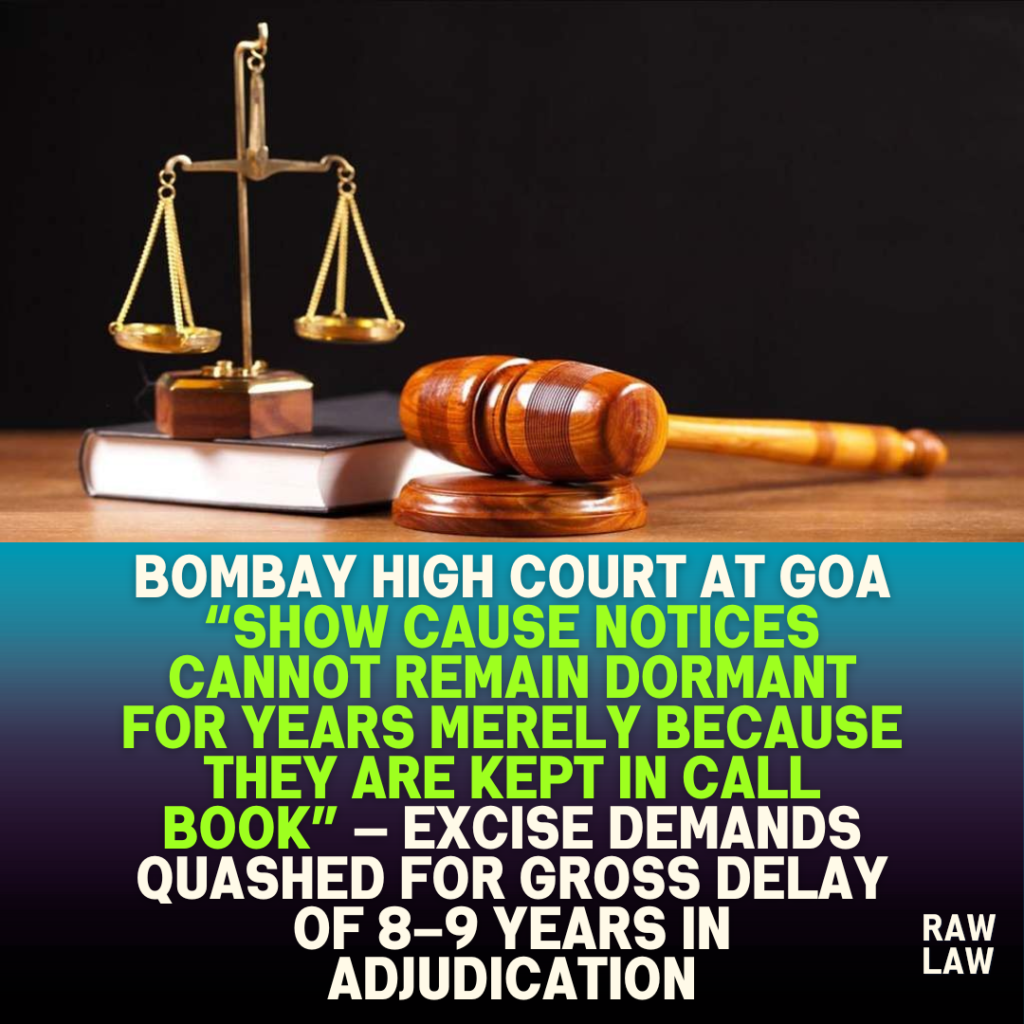
The Bombay High Court at Goa allowed both writ petitions and quashed the show cause cum demand notices issued in 2016 and 2017, holding that the Revenue could not be permitted to adjudicate stale notices after an inordinate and unexplained delay of nearly nine and eight years respectively. The Court held that merely transferring matters to the “Call Book” does not suspend the obligation of the Revenue to adjudicate proceedings within a reasonable time.
The Division Bench ruled that even in the absence of a statutory limitation period for adjudication, administrative authorities are bound by the doctrine of reasonable time. The continued dormancy of proceedings, particularly after the connected Supreme Court litigation had already concluded, was held to be fatal. The Court found that such delayed adjudication would defeat the very purpose of proceedings and cause irreparable prejudice to the assessee. Consequently, both show cause notices were quashed solely on the ground of gross delay.
Facts
The Petitioner is an assessee engaged in the manufacture of excisable goods such as photographic colour paper, graphic art films, and medical X-ray products, and was duly registered under the Central Excise regime. The Petitioner had availed CENVAT credit on inputs, capital goods, and services under the CENVAT Credit Rules, 2004.
Two show cause cum demand notices were issued to the Petitioner, one dated 16 March 2016 covering the period from April 2011 to June 2015, and another dated 4 January 2017 covering July 2010 to March 2011. Both notices alleged contravention of valuation provisions under the Central Excise Act, 1944, primarily on the ground that VAT/CST amounts collected but retained under a deferment scheme ought to have been included in the assessable value. Despite issuance, neither notice was adjudicated for several years.
Issues
The principal issue before the Court was whether show cause notices issued in 2016 and 2017 could validly be adjudicated in 2025, after a delay of nearly a decade, merely because they were transferred to the Call Book due to pendency of related litigation before the Supreme Court.
A connected issue was whether pendency of an appeal in a different case before the Supreme Court could justify indefinite postponement of adjudication, and whether such administrative delay violated principles of fairness, certainty, and natural justice applicable to fiscal proceedings.
Petitioner’s Arguments
The Petitioner argued that the extraordinary delay of 8–9 years in adjudicating the show cause notices rendered the proceedings legally unsustainable. It was contended that the Revenue cannot keep proceedings in limbo indefinitely on the pretext of Call Book transfers, especially when no statutory embargo existed on adjudication.
The Petitioner relied heavily on a consistent line of Bombay High Court judgments holding that show cause notices must be adjudicated within a reasonable time, even in the absence of a statutory limitation. It was further argued that prolonged dormancy severely prejudices the assessee, as records become unavailable, personnel change, and effective defence becomes impossible. The Petitioner contended that such stale proceedings deserved to be quashed outright.
Respondent’s Arguments
The Revenue defended the delay by submitting that both show cause notices were transferred to the Call Book in accordance with departmental circulars issued in 1995 and 2003. It was argued that the issues involved were directly linked to a pending civil appeal before the Supreme Court, and therefore adjudication was deferred to avoid conflicting outcomes.
The Revenue further submitted that Call Book cases are periodically reviewed and that the connected Supreme Court matter was disposed of only in September 2024. It was contended that steps were being contemplated to restore certain matters disposed of on monetary limit grounds, and therefore the adjudication could not be faulted merely on the ground of delay.
Analysis of the law
The Court examined the settled legal position that even where statutes do not prescribe a limitation period for adjudication, authorities must act within a reasonable time. The doctrine of reasonable time, the Court noted, flows from principles of fairness, certainty, and good administration.
The Court categorically held that departmental circulars permitting Call Book transfers do not override constitutional and judicial mandates requiring expeditious adjudication. Administrative convenience cannot defeat substantive rights. The purpose of adjudication is to recover public revenue through a fair process, and such purpose is frustrated when proceedings are kept dormant for years without justification.
Precedent Analysis
The Court relied extensively on earlier Division Bench judgments which have consistently quashed stale show cause notices. These decisions held that absence of a limitation period does not grant the Revenue an unfettered licence to adjudicate at any point in time.
The Court reaffirmed that pendency of appeals in other matters does not create a legal bar to adjudication unless specifically stayed by a competent court. The jurisprudence emphasises that Call Book transfers are purely administrative and cannot legitimise inordinate delay. The Court also relied on Supreme Court authority holding that statutory powers must be exercised within a reasonable period even when no limitation is prescribed.
Court’s Reasoning
Applying these principles, the Court found that the Revenue failed to provide any legally sustainable justification for the prolonged delay. The connected Supreme Court matter, which was cited as the reason for keeping the notices in the Call Book, had already been disposed of in September 2024. Yet, even after more than a year, no steps were taken to revive or adjudicate the notices.
The Court observed that allowing adjudication at such a belated stage would severely prejudice both sides, as it would be difficult to trace records, verify facts, and conduct a meaningful adjudication. The Court held that adjudication after such lapse of time would defeat the very object of issuing show cause notices and would amount to unfairness in fiscal administration.
Conclusion
The Bombay High Court at Goa held that the show cause notices issued in 2016 and 2017 could not be adjudicated after a delay of 8–9 years. The Court quashed and set aside both notices solely on the ground of gross and unexplained delay, without entering into the merits of the allegations. The writ petitions were accordingly allowed, and no order as to costs was passed.
Implications
This judgment is a strong reaffirmation of judicial intolerance towards prolonged fiscal uncertainty caused by dormant show cause notices. It reinforces that Call Book practices cannot be used as a shield for administrative inertia. The ruling provides significant relief to assessees facing decade-old tax demands and sends a clear message that revenue authorities must act with diligence, fairness, and expedition in adjudicatory proceedings.


