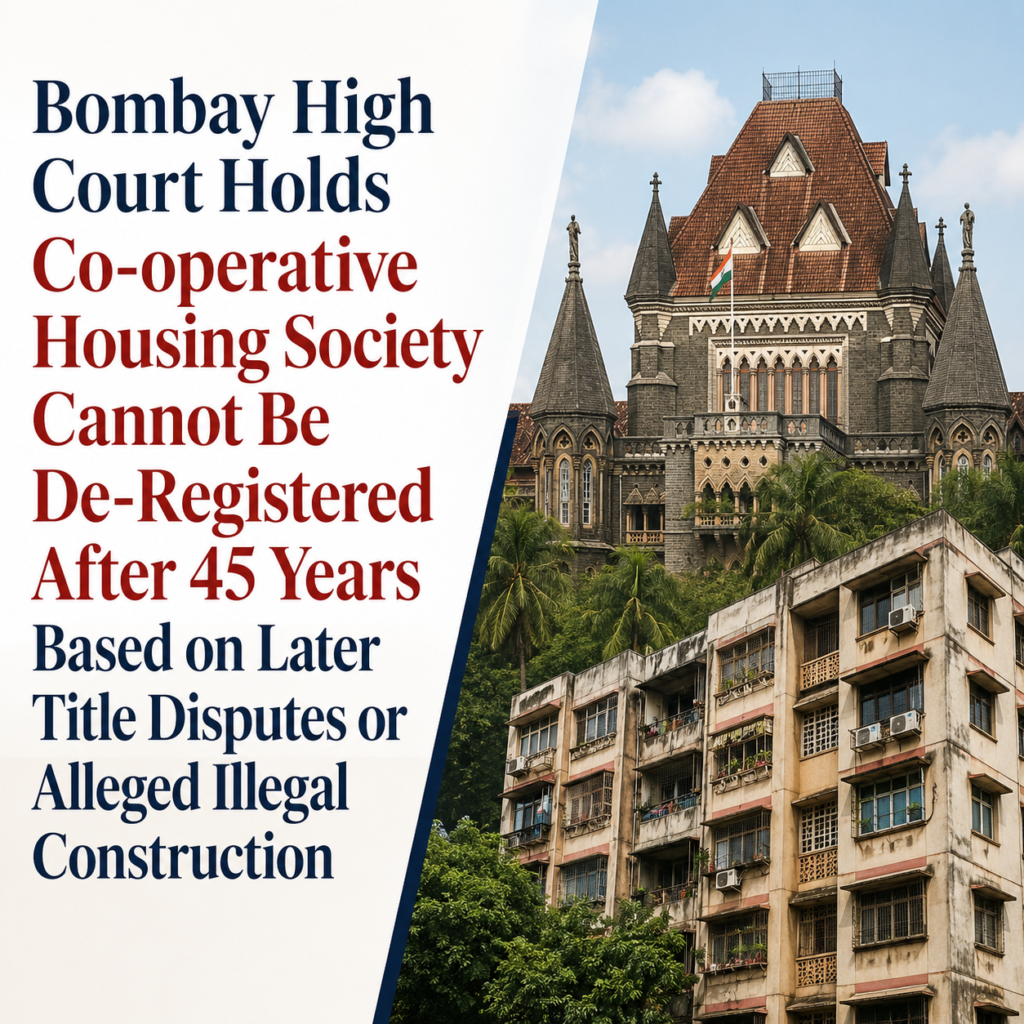
Bombay High Court Holds Co-operative Housing Society Cannot Be De-Registered After 45 Years Based on Later Title Disputes or Alleged Illegal Construction


Bombay High Court Holds Co-operative Society in alleged Illegal Construction or Deemed Conveyance Rejection Cannot Be De-registered After 45 Years Based on Later Title Disputes
Facts
Elite Diagnostic Center Pvt. Ltd. filed a writ petition challenging the order dated 6 May 2026 passed by the Minister for Co-operation, whereby the Minister allowed the appeal filed by Krishna Kunj Co-operative Housing Society Ltd. and set aside the Divisional Joint Registrar’s order dated 3 September 2024 de-registering the society. The society had been registered on 23 March 1981, and the petitioner had sought its de-registration in 2014 under Section 21A of the Maharashtra Co-operative Societies Act, 1960.
The case involved an unusual factual situation. The Director of the petitioner-company, Dr. Satish Sharma, was himself a member of the respondent society on the basis of ownership of a garage and had also functioned as an office bearer of the society. However, in his capacity as Director of the petitioner-company, he sought de-registration of the very same society, inter alia on the ground that garage occupiers could not be treated as members of a co-operative housing society. The Court noted that the Director had effectively sued himself, since he was arrayed as respondent no. 11 in the petition.
The petitioner claimed ownership over the land on which the society building stood and alleged that the society had been registered by misrepresentation, as only six flats existed and open spaces had allegedly been shown as garages to satisfy the statutory requirement of ten members. It was also alleged that the building was constructed without valid title, that probate proceedings connected with the alleged owner had failed, that the construction was unauthorised, and that the society’s application for deemed conveyance had been rejected.
Issues
The principal issue before the Bombay High Court was whether de-registration of a co-operative housing society under Section 21A of the MCS Act could be ordered by relying on events that occurred after the society’s registration.
The Court also considered whether disputes regarding title to land, alleged unauthorised construction, rejection of deemed conveyance, and eligibility of garage occupiers as members were relevant grounds for de-registration of a society registered 45 years earlier.
Another issue was whether de-registration proceedings could be used indirectly to safeguard or establish title over land.
Petitioner’s Arguments
The petitioner argued that the Minister had wrongly interfered with the Divisional Joint Registrar’s order de-registering the society. It was submitted that the society’s registration was obtained by gross misrepresentation, since the proposal showed ten members though only six flats were allegedly constructed.
The petitioner further contended that there were no constructed garages in the building and that open spaces had been wrongly shown as garages. It was argued that a garage could not be treated as a flat or unit for the purpose of admitting a person as a member of a co-operative housing society.
The petitioner also submitted that the construction itself was illegal because the building plans were sanctioned subject to procurement of probate, but the probate petition/suit was dismissed. It was argued that the flats were sold in violation of an interim order of the High Court, that no occupancy certificate existed for the building, and that fraud vitiates all acts.
Respondent’s Arguments
The society opposed the petition and argued that the application for de-registration was filed after an enormous delay. It was submitted that the society had been registered in 1981, whereas the de-registration proceedings were initiated only in 2014.
The society further contended that the Director of the petitioner-company had voluntarily become a member of the society, first as a flat owner and later as a garage owner, and had even acted as an office bearer. Therefore, the petitioner could not, after several decades, question the very registration of the society.
It was also argued that the scope of inquiry under Section 21A is narrow and that the Divisional Joint Registrar could not sit in appeal over the original registration order. The society submitted that there was no misrepresentation at the time of registration, as the documents disclosed the existence of six flats and four garages.
Analysis of the Law
The Court held that Section 21A of the MCS Act permits de-registration only in limited circumstances: where the society was registered on misrepresentation made by the applicants; where the work of the society is completed or exhausted; where the purposes for which the society was registered are not served; or where a primary agricultural co-operative credit society improperly uses the word “bank” or similar expressions.
In the present case, only the ground of “misrepresentation” was invoked. The Court held that the power of de-registration is not an appellate power over the original registration order. It can be exercised only in rare cases where registration was obtained through misrepresentation of such nature that, but for the misrepresentation, the society would not have been registered.
The Court clarified that mere inaccurate or incomplete information does not amount to misrepresentation under Section 21A. The misrepresentation must be deliberate, material and connected with the information supplied at the time of registration. Subsequent events cannot be used to infer misrepresentation at the time of registration.
Precedent Analysis
The Court relied on Rameshwar Co-operative Housing Society Ltd. v. Divisional Joint Registrar, where it was held that fraud and misrepresentation are serious allegations requiring strong proof. Procedural lapses or technical defects cannot be elevated to fraud unless there is deliberate deception, suppression of material facts, or presentation of forged or fabricated documents.
The Court also referred to Garment Craft v. Prakash Chand Goel, where the Supreme Court explained the limited nature of supervisory jurisdiction under Article 227 of the Constitution. The High Court observed that Article 227 is not meant to correct every error of fact or law, especially when the final outcome is justified.
Court’s Reasoning
The Court found that the Divisional Joint Registrar had ordered de-registration by relying on three broad factors: title disputes relating to the land, alleged unauthorised construction, and rejection of the society’s deemed conveyance application. However, most of these events occurred after the society was registered in 1981 and therefore could not constitute misrepresentation at the time of registration.
The Court held that the Assistant Registrar, while registering a society, is neither required nor empowered to adjudicate title disputes. Therefore, non-disclosure of title-related litigation or probate issues could not be treated as misrepresentation for the purpose of Section 21A.
On the argument regarding six flats and four garages, the Court found that the registration application itself disclosed that there were six flats and four garages. Therefore, there was no concealment. Even assuming that the Assistant Registrar committed an error in treating garage occupiers as eligible members, such an error could have been challenged by appeal under Section 152 of the MCS Act and could not be converted into a case of misrepresentation under Section 21A.
The Court also found the conduct of the petitioner’s Director significant. He had purchased a flat and garage in the society, obtained membership, acted as an office bearer, and continued to remain a member, yet his company sought de-registration of the society after decades. The Court held that the real purpose behind de-registration proceedings appeared to be protection of title over the land, which could not be achieved through Section 21A proceedings.
Conclusion
The Bombay High Court dismissed the writ petition and upheld the Minister’s order setting aside the de-registration of Krishna Kunj Co-operative Housing Society Ltd.
The Court held that de-registration under Section 21A cannot be ordered on the basis of post-registration events such as title disputes, alleged unauthorised construction, rejection of deemed conveyance, or subsequent municipal proceedings. Misrepresentation must relate to the registration process itself and must involve deliberate deception or suppression of material facts.
The Court further held that de-registration proceedings cannot be misused to indirectly establish or protect title over land. Since the society had existed for 45 years and had been managing the building, de-registering it at such a belated stage was unwarranted.
Case Details
Case: Elite Diagnostic Center Pvt. Ltd. v. Krishna Kunj Co-operative Housing Society Ltd. & Ors.
Court: Bombay High Court, Civil Appellate Jurisdiction
Case Number: Writ Petition No. 7855 of 2026
Judge: Justice Sandeep V. Marne
Date: 2 July 2026
Result: Writ petition dismissed; Minister’s order upheld; de-registration of society refused.