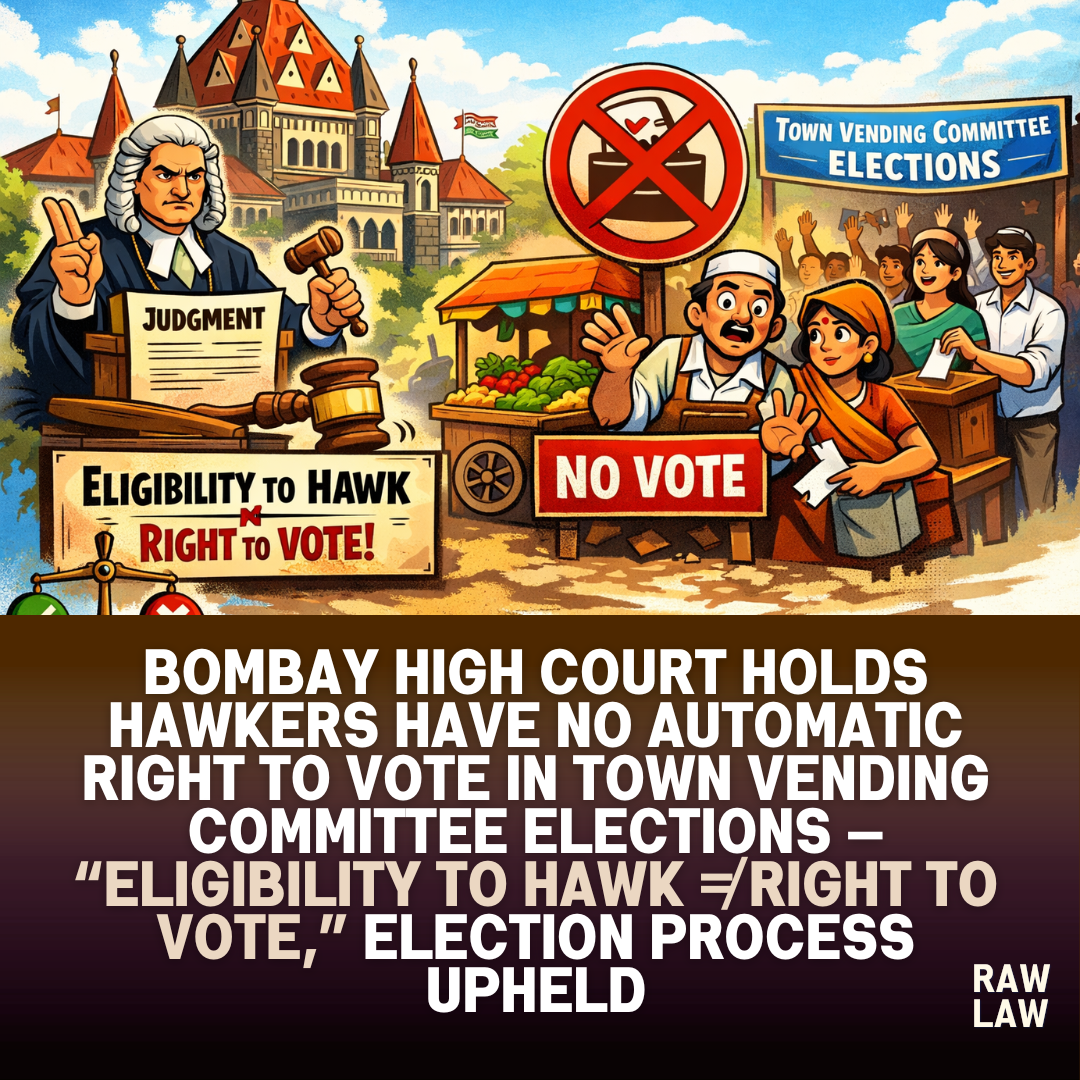
Bombay High Court holds hawkers have no automatic right to vote in Town Vending Committee elections — “Eligibility to hawk ≠ right to vote,” election process upheld

Court’s decision
The Bombay High Court refused to set aside the Town Vending Committee (TVC) elections held in Mumbai and upheld the voter list prepared by the Municipal Corporation of Greater Mumbai (MCGM). The Court held that merely being identified as a street vendor does not confer an automatic right to be included in the electoral roll. It ruled that scrutiny of eligibility is mandatory and that the election process complied substantially with statutory requirements.
Facts
The case involved multiple writ petitions filed by various street vendors’ unions challenging the TVC elections conducted on 29 August 2024 in Mumbai. The petitioners contended that the electoral roll used for elections included only about 32,000 vendors, whereas approximately 99,435 vendors had been identified in a 2014 survey.
The petitioners argued that this earlier list had judicial backing and should have formed the basis of the electoral roll. They also claimed that additional vendors who received Letters of Recommendation under the PM SVANidhi scheme should have been included.
The Municipal Corporation defended the process, stating that the final voter list was prepared after scrutiny, document verification, and compliance with statutory rules, reducing the list to eligible vendors.
Issues
The primary issue was whether all vendors identified in the 2014 survey were entitled to be included in the electoral roll for TVC elections.
A second issue was whether the Municipal Corporation complied with Rule 15 of the Street Vendors Rules, which requires publication of a preliminary voter list, invitation of objections, and finalization before elections.
The Court also examined whether eligibility to carry on vending automatically confers a right to vote in TVC elections.
Petitioner’s arguments
The petitioners argued that the electoral roll was unlawfully truncated from 99,435 to about 32,000 vendors. They contended that the earlier survey list had been accepted by the Court and thus formed the legitimate voter base. It was further argued that the Municipal Corporation failed to follow mandatory procedures under Rule 15, including publication of a preliminary list and invitation of objections. The petitioners emphasized that exclusion of thousands of vendors violated statutory rights and rendered the election process illegal. They also asserted that vendors identified under welfare schemes like PM SVANidhi must be included in the voter list.
Respondent’s arguments
The Municipal Corporation argued that the voter list was prepared through a lawful and detailed scrutiny process based on statutory guidelines and judicial directions. It contended that eligibility to vend does not automatically translate into a right to vote and that only verified and eligible vendors could form the electorate. The Corporation also submitted that objections were invited and considered, and the process complied with Rule 15. It further argued that inclusion of all 99,435 vendors without verification would defeat the purpose of regulated vending under the statutory framework.
Analysis of the law
The Court analyzed the Street Vendors (Protection of Livelihood and Regulation of Street Vending) Act, 2014, and the corresponding Rules, particularly Rule 15 governing preparation of voter lists.
It emphasized that the statutory scheme requires identification, verification, and registration of vendors before they can participate in governance structures like the TVC. The Court distinguished between the right to livelihood (protected under the Act) and participation in electoral processes, which requires additional compliance.
The Court also examined the 2009 National Policy on Urban Street Vendors and earlier judicial directions, noting that surveys are only the starting point and must be followed by scrutiny.
Precedent analysis
The Court relied on earlier judgments that recognized the rights of street vendors while balancing public interest and urban regulation. It noted that prior decisions did not grant unconditional rights to vendors without compliance with statutory procedures.
The Court clarified that earlier judicial recognition of survey lists was limited to protection from eviction and did not confer electoral rights.
It also reiterated principles that administrative processes, including voter list preparation, must involve verification and cannot rely solely on initial surveys.
Court’s reasoning
The Court held that the petitioners’ assumption that all 99,435 vendors had a right to vote was legally flawed. It clarified that the earlier recognition of these vendors only established their eligibility to carry on vending, not their right to be included in electoral rolls.
It further held that the Municipal Corporation was justified in scrutinizing applications and excluding those who failed to meet eligibility criteria or provide required documentation.
On the issue of procedural compliance, the Court found that sufficient opportunity was given to raise objections and that the process substantially complied with Rule 15. The delay in challenging the voter list also weighed against the petitioners.
The Court emphasized that allowing unverified inclusion would undermine the regulatory framework and lead to administrative chaos.
Conclusion
The Bombay High Court upheld the TVC election process and rejected the challenge to the voter list. It held that eligibility to vend does not automatically entitle a vendor to vote and that the Municipal Corporation acted within its authority in preparing a verified voter list.
The petitions were dismissed, allowing the process of constituting the Town Vending Committee to proceed.
Implications
This judgment clarifies the distinction between livelihood rights and participatory rights in statutory governance bodies. It reinforces that electoral participation requires compliance with eligibility verification processes.
The ruling strengthens municipal authority to regulate street vending while ensuring procedural fairness. It also discourages blanket claims based on earlier surveys without meeting statutory requirements.
For street vendors, the decision underscores the importance of documentation and compliance. For authorities, it affirms the legality of scrutiny-based voter list preparation.
Case law references
Olga Tellis v. Bombay Municipal Corporation
Recognized right to livelihood of pavement dwellers; used to contextualize vendor rights but not electoral rights.
Bombay Hawkers Union v. Bombay Municipal Corporation
Established need to balance vendor rights with public convenience.
Maharashtra Ekta Hawkers Union cases (2004, 2009, 2013)
Guided regulatory framework for hawking; emphasized structured implementation.
Azad Hawkers Union v. Union of India
Recognized 2014 survey but limited its effect to eligibility, not automatic electoral inclusion.
FAQs
1. Do all street vendors have the right to vote in Town Vending Committee elections?
No. The Court held that only verified and eligible vendors included in the final voter list can vote.
2. Does inclusion in a survey list guarantee electoral rights?
No. Survey inclusion only establishes eligibility to vend, not the right to vote.
3. Is verification mandatory before including vendors in voter lists?
Yes. Authorities must scrutinize applications and verify eligibility before finalizing electoral rolls.