Bombay High Court holds magistrate must show application of mind before issuing process — “Mechanical summoning is illegal,” criminal proceedings remanded

Court’s decision
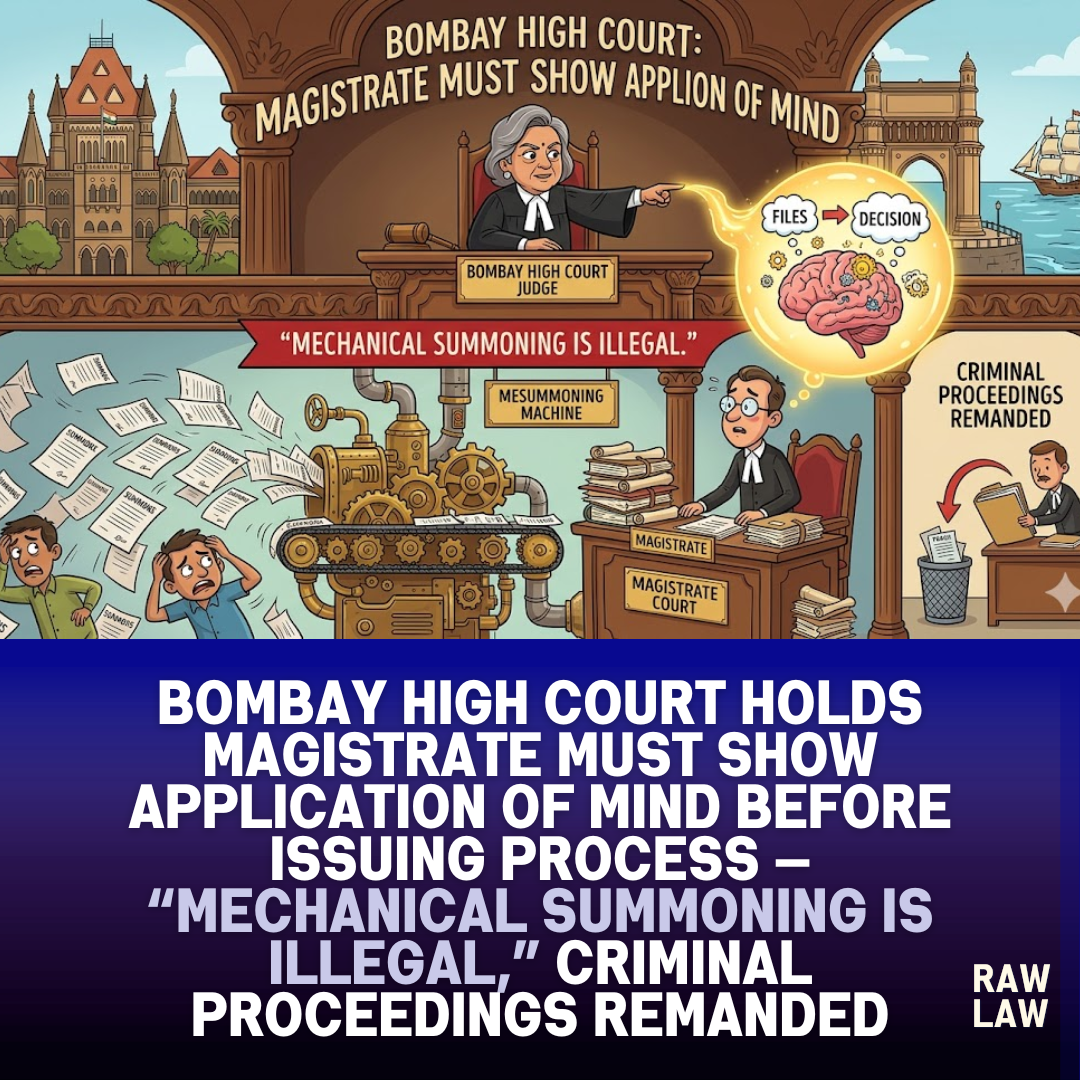
The Bombay High Court allowed the writ petition and quashed the Magistrate’s order issuing process against the accused in a matrimonial dispute. The Court held that the issuance of process was mechanical and did not reflect judicial application of mind, rendering it legally unsustainable. The matter was remanded to the Magistrate for fresh consideration in accordance with law.
Facts
The case arose from matrimonial disputes following a marriage solemnized in 2016. Due to marital discord, divorce proceedings were initiated by the husband. Subsequently, the wife filed a complaint alleging cruelty and misappropriation of property.
Based on this complaint, criminal proceedings were initiated under Sections 498A and 406 read with Section 34 of the Indian Penal Code. The Magistrate issued process against the accused by order dated 19 April 2024.
The accused challenged this order before the High Court, contending that the Magistrate had issued process without proper application of mind and without evaluating the allegations or supporting material.
Issues
The primary issue was whether the Magistrate’s order issuing process satisfied the legal requirement of application of mind.
A related issue was whether a mechanical order issuing summons could be sustained in law.
The Court also examined whether the High Court, in writ jurisdiction, could itself assess the merits of the complaint or whether the matter should be remanded.
Petitioner’s arguments
The petitioners argued that the Magistrate issued process in a routine and mechanical manner without examining the complaint, evidence, or legal provisions. It was contended that the order lacked any indication of judicial satisfaction regarding the existence of a prima facie case.
The petitioners further submitted that such non-application of mind vitiates the entire criminal proceeding. They urged the Court to quash not only the order but also the entire criminal case, or alternatively to examine the merits of the allegations.
Respondent’s arguments
The State supported the Magistrate’s order and argued that no interference was warranted at the stage of issuance of process.
The complainant contended that the Magistrate had indeed applied his mind, as evident from the fact that process was issued only for certain offences and not all those alleged. It was further argued that even if the order was defective, the proper course would be remand rather than quashing the entire proceedings.
The respondents also opposed the High Court undertaking a merits-based evaluation at this preliminary stage.
Analysis of the law
The Court analyzed settled principles governing issuance of process under criminal law. It emphasized that summoning an accused is a serious matter and cannot be done mechanically.
The Court referred extensively to Supreme Court jurisprudence clarifying that while detailed reasoning is not required, there must be clear indication that the Magistrate has applied his mind to the allegations and supporting material.
It reiterated that at this stage, the Magistrate must only determine whether a prima facie case exists, not whether conviction is likely.
Precedent analysis
The Court relied on Mahmood Ul Rehman v. Khazir Mohammad Tunda, which held that issuance of process must reflect application of mind.
It also relied on Pepsi Foods Ltd. v. Judicial Magistrate, emphasizing that criminal law cannot be set into motion as a matter of course.
Further reliance was placed on Bhushan Kumar v. State (NCT of Delhi), which clarified that reasons need not be detailed but satisfaction must exist.
The Court distinguished cases where minimal reasoning was acceptable, noting that absence of any indication of application of mind renders the order invalid.
Court’s reasoning
The Court found that the impugned order merely recorded that the Magistrate had perused the police report and statements, without indicating any analysis of the allegations or evidence.
It held that such a bare recital does not satisfy the requirement of judicial application of mind.
The Court rejected the argument that partial issuance of process implied application of mind, observing that there must be explicit indication of consideration of material.
It concluded that the Magistrate failed to exercise judicial discretion and acted mechanically, which vitiates the order.
However, the Court declined to examine the merits of the complaint, holding that such evaluation falls within the Magistrate’s domain at the initial stage.
Conclusion
The Bombay High Court quashed the Magistrate’s order issuing process and remanded the matter for fresh consideration. It clarified that the Magistrate must reassess the complaint and evidence and pass a reasoned order in accordance with law.
Implications
This judgment reinforces procedural safeguards in criminal law by emphasizing the necessity of judicial application of mind at the stage of issuing process.
It protects individuals from arbitrary or mechanical criminal prosecution while preserving the complainant’s right to pursue legitimate claims.
The ruling also clarifies the limited role of High Courts in writ jurisdiction, emphasizing that they should not substitute the Magistrate’s function at the initial stage.
For Magistrates, the judgment underscores the importance of demonstrating prima facie satisfaction before summoning accused persons.
Case law references
Mahmood Ul Rehman v. Khazir Mohammad Tunda
Held that issuance of process must reflect application of mind and cannot be mechanical.
Pepsi Foods Ltd. v. Judicial Magistrate
Held that summoning an accused is a serious matter requiring judicial scrutiny.
Bhushan Kumar v. State (NCT of Delhi)
Clarified that detailed reasoning is not required, but satisfaction must exist.
Nagawwa v. Veeranna Shivalingappa Konjalgi
Held that Magistrate must form a prima facie opinion before issuing process.
FAQs
1. Can a Magistrate issue summons without detailed reasoning?
Yes, detailed reasoning is not required, but the order must reflect application of mind and satisfaction of a prima facie case.
2. What happens if a Magistrate issues process mechanically?
Such an order can be quashed by a higher court for non-application of mind.
3. Can High Courts decide the merits at the stage of issuing process?
No. High Courts generally remand the matter to the Magistrate instead of evaluating merits at the initial stage.