Bombay High Court – “Infrastructure developer eligible for tax deduction under income tax law; contractor argument rejected”, revenue appeals dismissed

1. Court’s decision
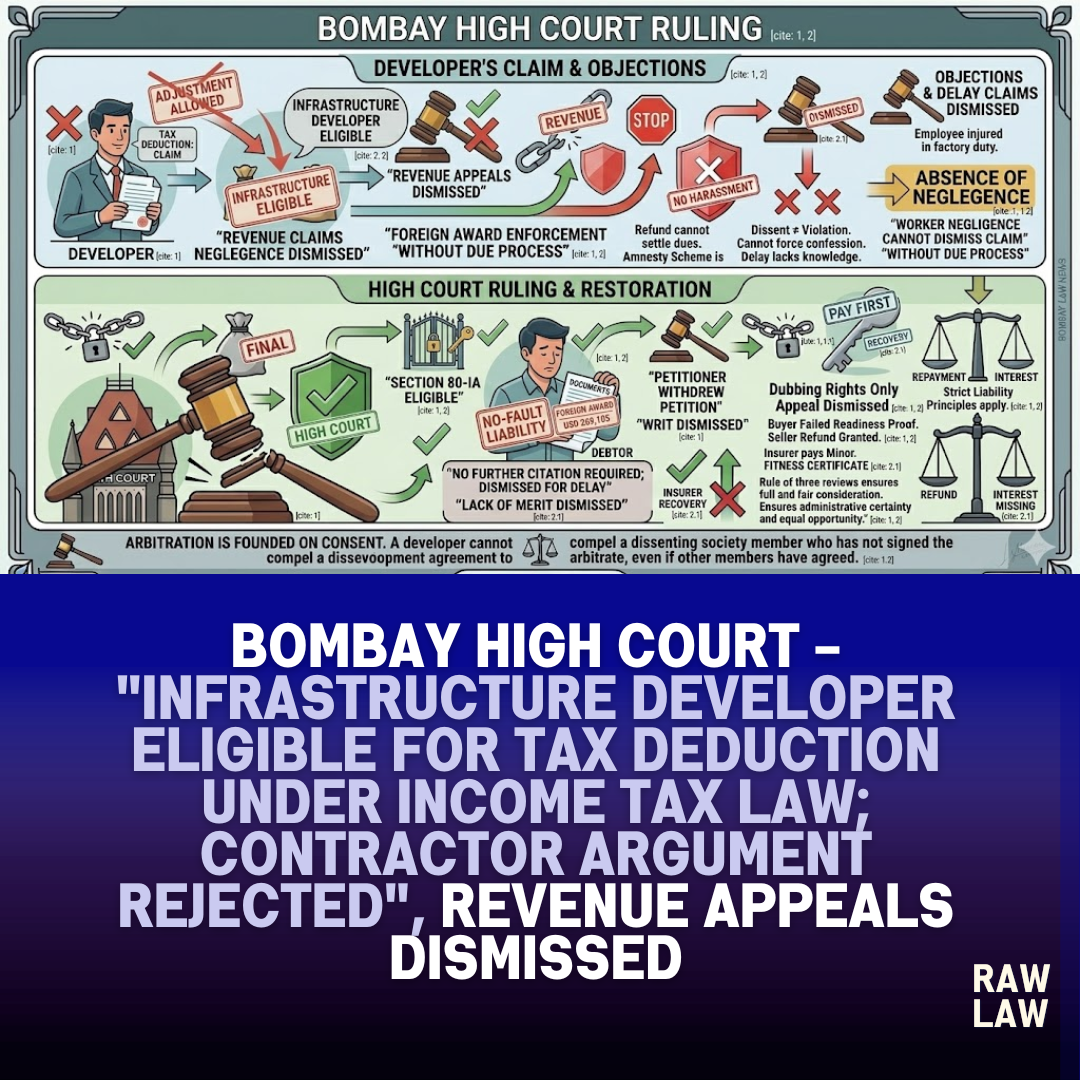
The Bombay High Court dismissed the revenue’s appeals and upheld the Income Tax Appellate Tribunal’s ruling granting tax deductions to a company executing large infrastructure projects under Section 80-IA(4) of the Income Tax Act, 1961. The Court held that the enterprise qualified as a developer of infrastructure facilities rather than merely a works contractor.
The Court ruled that deduction under Section 80-IA cannot be denied simply because the infrastructure facility belongs to the government or because payments were made periodically during project execution. The Court concluded that the developer had undertaken financial, technical, and operational risks in executing the projects and therefore satisfied the statutory requirements for claiming tax benefits.
Accordingly, the substantial question of law was answered against the revenue and in favour of the assessee, resulting in dismissal of both income tax appeals.
2. Facts
The dispute concerned eligibility for tax deduction under Section 80-IA(4) for profits derived from infrastructure projects executed by a civil engineering company. The matter related to assessment years 2000-2001 and 2001-2002.
During the relevant period, the company was engaged in executing two major infrastructure projects: a hydroelectric-related development project in Maharashtra and another multi-purpose irrigation and power project in Andhra Pradesh. The company claimed that it had developed infrastructure facilities and therefore qualified for deduction of approximately ₹80.47 crore under Section 80-IA(4).
The assessing officer rejected the claim, holding that the enterprise was merely a contractor executing government work. According to the revenue authorities, the infrastructure facilities belonged to government bodies and were financed by the state governments or international funding agencies.
The appellate authority affirmed the assessing officer’s decision. However, the Income Tax Appellate Tribunal reversed the decision and allowed the deduction, prompting the revenue to file appeals before the High Court.
3. Issues
The principal legal issue before the High Court concerned the interpretation of Section 80-IA(4) of the Income Tax Act.
The Court had to determine whether the company executing infrastructure projects awarded by state governments could be considered a “developer of infrastructure facilities” eligible for deduction, or whether it should be treated merely as a works contractor executing civil construction work.
The Court also examined related questions regarding ownership of infrastructure assets, financial risk undertaken by the enterprise, and whether partial development of infrastructure facilities would still qualify for deduction.
4. Petitioner’s arguments
The revenue argued that the enterprise was only a contractor performing civil construction activities under contracts awarded by government authorities. It contended that the infrastructure projects belonged to the respective state governments and were financed by government funds or international loans.
According to the revenue, Section 80-IA intended to grant deductions only to enterprises that independently develop infrastructure by mobilizing their own resources and assuming financial risk. Since the company was paid periodically for work completed, the revenue asserted that it bore no financial risk and therefore could not qualify as a developer.
The revenue further argued that the enterprise had only executed a portion of the infrastructure projects rather than developing the entire infrastructure facility. It also contended that there was no transfer of infrastructure by the company to the government, since ownership of land and facilities remained with government authorities throughout.
5. Respondent’s arguments
The enterprise argued that it had undertaken complex engineering work involving design, planning, execution, and substantial investment in specialized machinery and manpower. It emphasized that infrastructure development involves scientific planning, technical expertise, and assumption of execution risks.
The company contended that it had deployed large teams of engineers, contractors, and labourers, along with heavy machinery specifically acquired for the projects. It maintained that it had borne significant financial and operational risks during the execution of the projects.
The enterprise also argued that legislative amendments to Section 80-IA expanded the scope of deduction to enterprises engaged solely in development of infrastructure facilities. Therefore, it was not necessary for the developer to operate or maintain the facility after construction.
6. Analysis of the law
The Court examined the legislative evolution of Section 80-IA. The provision was introduced to encourage private sector participation in infrastructure development, particularly in sectors such as roads, ports, bridges, airports, and water projects.
Initially, the deduction applied only to enterprises that developed, operated, and maintained infrastructure facilities. However, amendments introduced through subsequent Finance Acts broadened the scope to include enterprises engaged solely in development, operation and maintenance, or a combination of these activities.
The Court noted that later amendments also clarified that the deduction was intended to benefit enterprises that invest and undertake infrastructure development risks, while excluding mere works contractors executing contracts for another entity.
Thus, determining whether an enterprise qualifies as a developer depends on the nature of responsibilities, risks undertaken, and contractual obligations.
7. Precedent analysis
The Court relied on earlier judicial precedents interpreting Section 80-IA and related provisions.
In a prior Bombay High Court decision concerning port infrastructure equipment, the Court held that an enterprise engaged in development of infrastructure facilities could claim deduction even if it did not operate or maintain the facility after development.
The Court also considered rulings of the Gujarat High Court where companies executing infrastructure projects were held to be developers rather than contractors when they assumed financial, technical, and entrepreneurial risks.
These precedents emphasized that the distinction between developer and contractor must be determined from the terms of the agreement, investment involved, and risks undertaken.
8. Court’s reasoning
The High Court concluded that the enterprise in the present case had undertaken significant financial and operational responsibilities in executing the projects. Evidence showed that the company deployed large teams of engineers and workers and invested heavily in specialized machinery to complete technically complex infrastructure components.
The Court held that the enterprise exercised discretion in planning and executing the projects, including decisions regarding resources, equipment deployment, and construction methodologies. These factors demonstrated that the enterprise was involved in genuine development activities rather than merely executing predetermined tasks.
The Court also rejected the revenue’s argument that periodic payments convert a development contract into a works contract. It held that payment schedules are merely contractual mechanisms and do not determine the legal character of the enterprise’s role.
Further, the Court observed that ownership of the infrastructure facility remaining with the government does not negate the developer’s eligibility for deduction. Public infrastructure projects inherently belong to government authorities.
Finally, the Court held that transferring the completed facility to the government after development satisfied the statutory requirement of “transfer” under Section 80-IA.
9. Conclusion
The High Court concluded that the enterprise fulfilled the statutory conditions for claiming deduction under Section 80-IA(4). It held that the enterprise was a developer of infrastructure facilities and not merely a works contractor.
The Court affirmed the findings of the Income Tax Appellate Tribunal and dismissed the revenue’s appeals.
The substantial question of law was answered in favour of the enterprise and against the revenue authorities.
10. Implications
The judgment reinforces the principle that infrastructure developers executing government contracts can still qualify for tax incentives under Section 80-IA if they assume financial, technical, and operational risks.
The ruling clarifies that government ownership of infrastructure facilities does not disqualify developers from claiming tax benefits. It also establishes that periodic payments during project execution do not automatically convert development contracts into works contracts.
The decision provides significant clarity for infrastructure companies involved in public projects such as dams, tunnels, power facilities, and irrigation systems. By reaffirming the legislative intent of promoting private participation in infrastructure development, the ruling strengthens the legal framework supporting tax incentives for infrastructure investment.
Case Law References
1. CIT v. ABG Heavy Industries Ltd.
The Bombay High Court held that an enterprise developing infrastructure facilities can claim deduction under Section 80-IA even if it does not operate or maintain the facility. The present Court relied on this precedent to affirm that development alone is sufficient.
2. PCIT v. Montecarlo Construction Ltd.
The Gujarat High Court held that infrastructure contractors assuming financial and entrepreneurial risks qualify as developers under Section 80-IA. The Bombay High Court considered the factual similarity with the present case.
3. CIT v. J. H. Gotla
The Supreme Court emphasized that statutory provisions should be interpreted rationally to avoid absurd results. The Court relied on this principle to reject the revenue’s narrow interpretation.
4. Government of Kerala v. Mother Superior Adoration Convent
The Supreme Court held that beneficial tax provisions must be interpreted in a manner that furthers their objective. This principle supported a liberal interpretation of Section 80-IA.
FAQs
1. What is Section 80-IA deduction under the Income Tax Act?
Section 80-IA provides tax deductions for enterprises engaged in developing, operating, or maintaining infrastructure facilities such as roads, bridges, dams, ports, and irrigation systems.
2. Can a contractor claim deduction under Section 80-IA?
A mere works contractor cannot claim deduction. However, if the enterprise undertakes financial risk, planning, and development responsibilities, it may be treated as an infrastructure developer eligible for deduction.
3. Does government ownership of infrastructure prevent tax deduction?
No. Courts have clarified that infrastructure projects often belong to government authorities. Developers executing such projects may still qualify for deduction if they satisfy statutory conditions.