

Court’s Decision
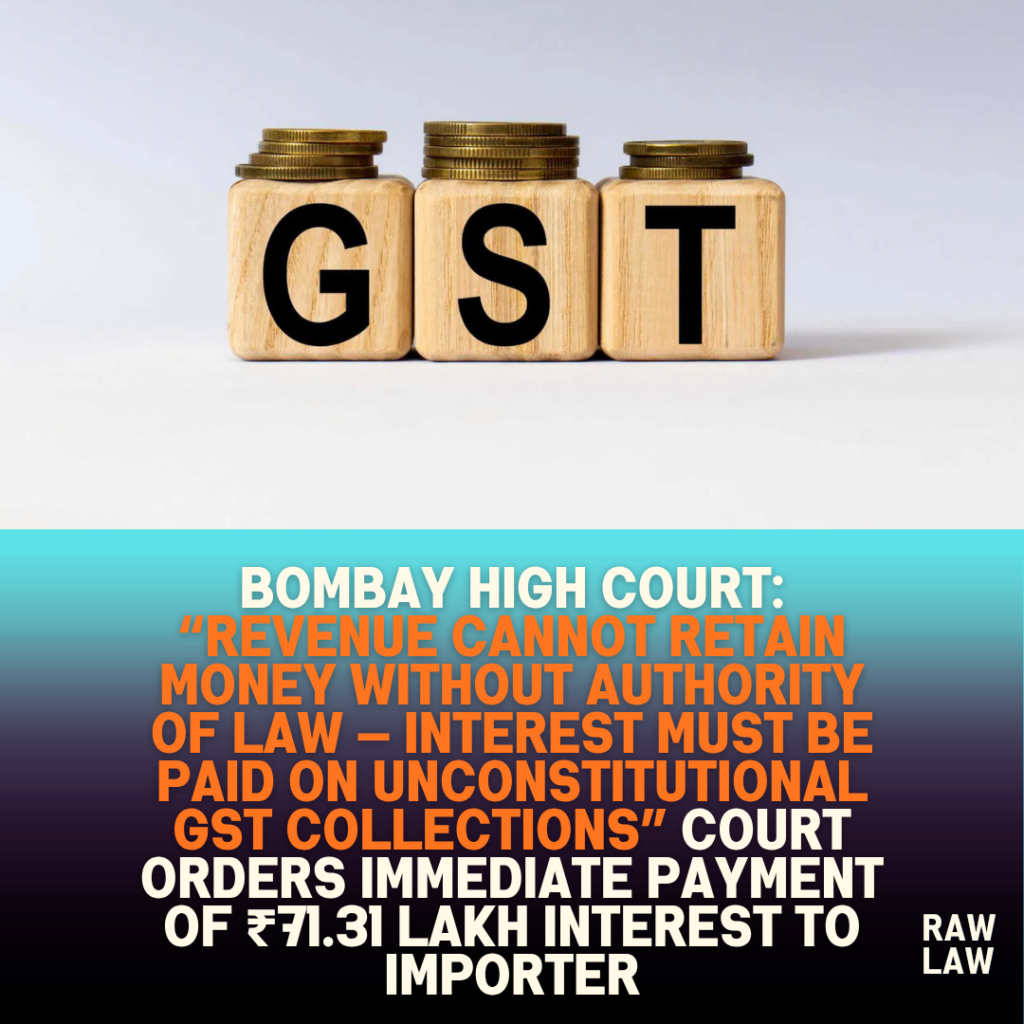
The Bombay High Court (Justices M.S. Sonak and Advait M. Sethna) in a landmark ruling held that when a tax is collected without authority of law, the government cannot unjustly retain such money and must refund it with interest.
The Court directed the Union of India and CGST authorities to pay ₹71,31,225 as interest to the petitioner company, whose Integrated GST (IGST) on ocean freight had been earlier declared unconstitutional. The Bench observed that “to deprive the taxpayer of interest would be to confer a premium on unjust enrichment”, reaffirming that the constitutional mandate under Article 265 forbids retention of taxes not authorized by law.
“The IGST collected on ocean freight was unconstitutional. The Revenue, having utilized such amounts till refund, cannot deny interest to the petitioner. To do so would violate the doctrine of restitution.”
Facts
The petitioner, an importer of crude and refined palm oil, was compelled to pay IGST under reverse charge on ocean freight pursuant to Notifications No. 8/2017 and 10/2017 issued under the IGST Act. Between July 2017 and April 2019, the company paid a total of ₹2,62,37,558 in IGST.
Challenging the levy, the petitioner filed Writ Petition No. 8318 of 2019, where the Bombay High Court, following the Supreme Court’s ruling in Union of India v. Mohit Minerals Pvt. Ltd., declared the levy of IGST on ocean freight unconstitutional and directed refund of the amount along with applicable interest.
Pursuant to this, the petitioner applied for a refund of IGST along with interest amounting to ₹71,31,225. The refund of the principal amount was granted, but the claim for interest was rejected on the ground that the refund was processed within 60 days as stipulated under Sections 54 and 56 of the CGST Act.
Aggrieved, the petitioner approached the High Court again under Article 226, seeking quashing of the order denying interest.
Issues
- Whether the petitioner was entitled to interest on refund of IGST collected under unconstitutional notifications.
- Whether the time limitation under Sections 54 and 56 of the CGST Act applied to refunds of tax collected without authority of law.
- Whether the retention of IGST without payment of interest violated Article 265 and the doctrine of restitution.
Petitioner’s Arguments
The petitioner argued that once the notifications imposing IGST on ocean freight were struck down as unconstitutional by both the Supreme Court and the Bombay High Court, the Revenue had no authority to retain the amount collected.
It was contended that the Revenue’s refusal to pay interest contravened not only Article 265 of the Constitution, which mandates that no tax shall be collected except by authority of law, but also the doctrine of restitution, which obligates repayment with interest of any illegally retained sum.
Counsel relied on precedents including Ranbaxy Laboratories Ltd. v. Union of India (2011) and Union of India v. Hamdard (Waqf) Laboratories (2016), where the Supreme Court held that interest must be paid from the date the refund becomes due. The petitioner further cited Cosmol Energy Pvt. Ltd. v. State of Gujarat (2021), where the Gujarat High Court ruled that amounts collected under unconstitutional IGST notifications must be refunded with interest.
It was emphasized that the respondents’ reliance on Section 54 of the CGST Act was misplaced, as the provision governs refunds of tax validly collected, whereas in this case, the levy itself was declared void ab initio.
Respondent’s Arguments
The Union of India, represented by the Assistant Commissioner of CGST, argued that the refund was processed within 60 days of the petitioner’s online application (filed on 6 January 2023), as per Section 54 read with Section 56 of the CGST Act. Hence, there was no delay warranting payment of interest.
It was further contended that the petitioner failed to apply for the refund within eight weeks as directed in the earlier High Court judgment (dated 10 August 2022). The department maintained that the claim of interest was inapplicable and that the case of Mohit Minerals Pvt. Ltd. was distinguishable on facts.
Analysis of the Law
The Bench observed that the IGST was levied and collected under Notifications No. 8/2017 and 10/2017, which had already been declared unconstitutional in Mohit Minerals Pvt. Ltd. (2022). Consequently, the Revenue had no authority to collect or retain such tax.
Referring to the coordinate bench decision in Sanathan Textile Pvt. Ltd. v. Union of India (2024), the Court reaffirmed that IGST on ocean freight was an impermissible double taxation, since importers already pay IGST on the composite CIF value under Section 8 of the CGST Act.
Thus, the refund granted to the petitioner was merely the return of unlawfully retained money, and the denial of interest amounted to an unconstitutional enrichment of the exchequer.
The Court rejected the Revenue’s reliance on Section 54, clarifying that the section applies only to tax validly collected under the CGST Act. Since the IGST on ocean freight was collected without authority of law, the provisions governing statutory refunds were inapplicable.
“Section 54 can operate only for tax collected in accordance with the Act. It has no application where the levy itself has been declared unconstitutional.”
Precedent Analysis
- Union of India v. Mohit Minerals Pvt. Ltd. (2022) 61 G.S.T.L. 257 (SC) — The Supreme Court held that levy of IGST on ocean freight was unconstitutional as it violated the concept of composite supply and imposed a double levy on importers.
- Ranbaxy Laboratories Ltd. v. Union of India (2011) 273 E.L.T. 3 (SC) — The Court held that interest on refunds becomes payable from the date of the refund application, not from the order of sanction.
- Union of India v. Hamdard (Waqf) Laboratories (2016) 333 E.L.T. 193 (SC) — Reaffirmed that interest on delayed refunds is a statutory right.
- Cosmol Energy Pvt. Ltd. v. State of Gujarat (2021) 55 G.S.T.L. 390 (Guj.) — Held that IGST on ocean freight was collected without authority of law, and the taxpayer was entitled to interest on refund.
- Mafatlal Industries Ltd. v. Union of India (1997) 5 SCC 536 — The Supreme Court laid down the doctrine of unjust enrichment, holding that money illegally collected must be returned with appropriate compensation.
- Altisource Business Solutions India Pvt. Ltd. v. Union of India (2025) — The Bombay High Court reiterated that Sections 54 and 56 cannot shield revenue from paying interest when the levy itself is illegal.
Court’s Reasoning
The Court emphasized that revenue authorities cannot benefit from unconstitutional collections, and their obligation to refund extends to payment of interest as part of restitution.
The judges held that Article 265 of the Constitution forms the bedrock of fiscal legality, and any collection not backed by law must be returned with interest to neutralize unjust gain.
“Having utilized the taxpayer’s money for years, the Revenue cannot plead technicalities to avoid its statutory and constitutional duty. Interest is a necessary corollary of refund.”
Rejecting the argument that the refund was processed within 60 days, the Bench noted that Sections 54 and 56 did not apply to taxes collected without jurisdiction, and the petitioner’s right to interest arose from the date of deposit, not from the date of refund application.
The Court further held that the doctrine of restitution under Section 144 of the CPC requires full restoration of benefits wrongfully taken, including the time value of money.
Conclusion
The Bombay High Court allowed the writ petition, quashing the rejection order and directing the respondents to pay ₹71,31,225 as interest to the petitioner within four weeks.
The Court held that the IGST collected under unconstitutional notifications constituted a clear violation of Article 265, and denying interest would amount to sanctioning unjust enrichment.
“The Government cannot retain money without authority of law. Interest is not charity — it is compensation for use of another’s money.”
Implications
This judgment strengthens the taxpayer’s right to interest on refunds arising from unconstitutional levies, reinforcing the constitutional principle of restitution.
It draws a clear distinction between statutory refunds and refunds of unlawful tax collections, clarifying that Sections 54 and 56 of the CGST Act cannot limit interest entitlement in cases where the levy itself is void.
The decision sets a vital precedent for businesses seeking restitution following the Mohit Minerals ruling, emphasizing that the State must not profit from unlawful taxation.


